Most of the dust that sets off your allergies is too small to see. Plenty of it settles onto your bedding before it ever reaches your filter, which is why a fresh filter alone won’t always stop the morning sneezing.
So which 20x25x2 air filter should you buy? For most homes with dust allergies, I’d pick a MERV 11 pleated filter. It traps pollen, pet dander, and mite debris and still lets your system breathe. Step up to MERV 13 when your system can take the extra resistance, especially if someone in the house also has asthma.
TL;DR Quick Answers
20x25x2 air filter
A 20x25x2 air filter is a two-inch pleated HVAC filter with an actual cut near 19½" × 24 1⁄2" × 1 3⁄4". The extra depth fits more pleated media than a one-inch filter, so it holds more dust before airflow suffers. For most homes with dust allergies, MERV 11 is the sweet spot.
Fit: Order by the nominal size, 20x25x2. It won’t swap with a 20x25x1 or 20x25x4, because your filter slot sets the depth.
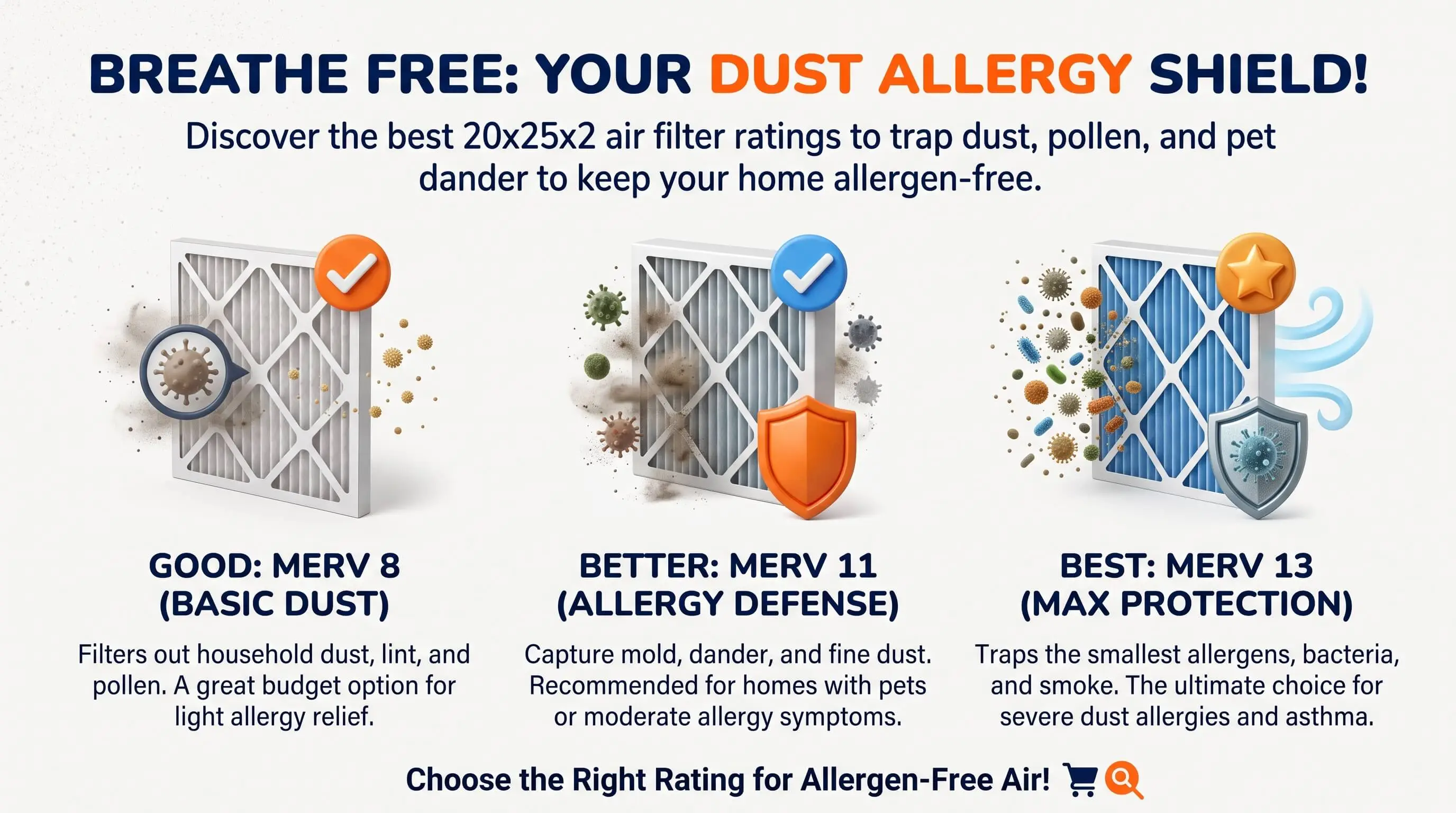
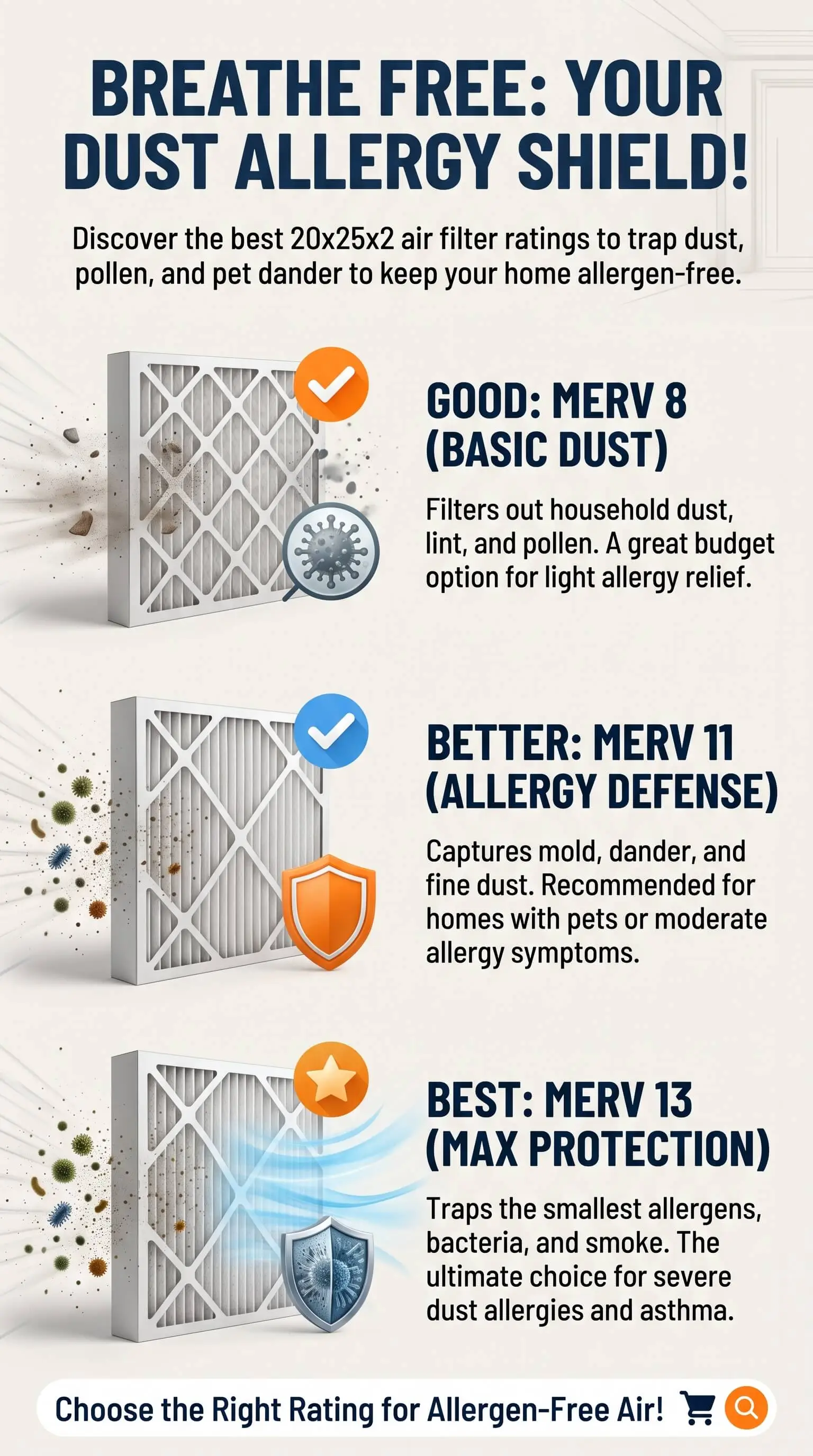
Best MERV: MERV 8 handles basic dust, MERV 11 suits allergies, and MERV 13 fits asthma or smoke when your system allows it.
Change interval: Swap it every 60 to 90 days, or about every six weeks in peak allergy season.
Hidden catch: It only filters air while your system runs. Run the fan after you vacuum or change the bedding, while allergens are still airborne.
Never wash it: Rinsing or vacuuming a pleated filter strips its electrostatic charge.
Top Takeaways
Rating: MERV 11 fits most dust allergy homes. Go with MERV 13 for asthma or smoke when your system allows.
Fit: Order 20x25x2, expect an actual cut near 19½" × 24½" × 1¾", and make sure it seats snugly.
Timing: Swap it every 60 to 90 days, or about every six weeks in peak allergy season.
Fan: Run the fan after cleaning so you catch allergens while they’re still airborne.
Routines: Humidity control, mite-proof covers, and hot-water washing pick up where the filter leaves off.
What Is Actually in the Dust That Sets Off Your Allergies?
Allergists at the American College of Allergy, Asthma & Immunology name five main triggers hiding in house dust: dust mites, cockroach particles, mold spores, pollen, and pet dander. Dust mites cause the most trouble. You react less to the mites themselves than to their body fragments and waste.
Those particles move in a pattern worth knowing. Vacuuming, walking across carpet, or shaking out a sheet kicks them into the air. Once the activity stops, they drift back down, and after a thorough cleaning that can take more than two hours.
That timing shapes your filter choice. Your filter can only clean the air that reaches the return vent, so its real job is catching allergens while they’re still floating. Shedding pets add more to manage, so this air filter strategy for homes with shedding dogs is worth a read.
How Does a 20x25x2 Air Filter Trap Household Dust?
You order by the nominal size, 20x25x2, but the actual cut runs closer to 19½" × 24 1⁄2" × 1 3⁄4". That small clearance lets the filter slide in and seat snugly, which matters because air slipping around the frame skips the media completely.
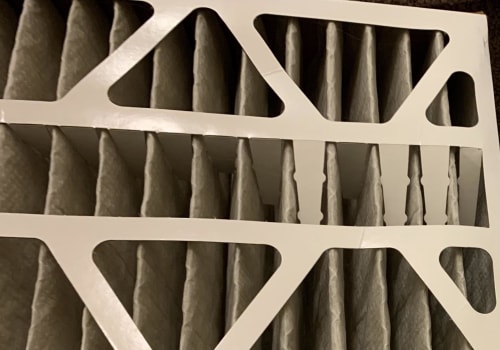
Inside, a pleated air filter uses folded synthetic media to trap particles as air passes through. Many filters also carry an electrostatic charge that pulls in the smaller ones. Depth is where a two-inch filter quietly earns its keep. It packs more pleated surface into the same opening than a one-inch filter, so a higher rating loads up more slowly and keeps air moving.
Can’t find yours? This guide to finding the air filter in your house covers the usual spots. Two-inch filters usually sit in a cabinet at the air handler.
Which MERV Rating Works Best for Dust Allergies?
Two trusted sources land in slightly different places. The American College of Allergy, Asthma & Immunology recommends MERV 11 or 12 for dust allergies, while the EPA suggests MERV 13 or the highest rating your system fan and filter slot can handle. Your system and your symptoms decide which one fits. Here’s a quick guide to MERV ratings.
MERV 8: Fine for Dust, Light on Allergens
MERV 8 catches lint, larger dust, and some pollen. I’d call it a baseline for homes where nobody’s sneezing.
MERV 11: The Practical Pick for Most Allergy Households
MERV 11 lands right in the range allergists recommend. It traps pollen, pet dander, and dust mite debris, and in a two-inch frame you’ll barely notice an airflow trade-off. When you’re choosing the right 20x25x2 air filter for a home with dust allergies, start here.
MERV 13: When Allergies Overlap With Smoke or Asthma
The EPA points homeowners toward MERV 13 because filters at this level must remove at least 50% of the smallest particles tested. Reach for it if your household deals with asthma, wildfire smoke, or rough pollen seasons. Check your HVAC manual or ask a technician first.
Will a Higher MERV Filter Strain Your HVAC System?
Denser media pushes back on airflow a little, and technicians call that pressure drop. According to the EPA, most furnaces and central systems run a MERV 13 just fine as long as you change the filter on time. Trouble starts when a high-MERV filter clogs. Watch for these signs:
Weak airflow at the supply vents
Heating or cooling cycles that run noticeably longer
A whistling sound around the filter door
Ice on the indoor coil during cooling season
Spot any of them and drop back one MERV level, or have a technician check the blower.
How Often Should You Change a 20x25x2 Air Filter With Allergies?
Most manufacturers say every 60 to 90 days. With allergies in the house, I’d change it about every six weeks during peak season, and sooner if you have pets.
Pro Tip: Hold your old filter up to a light. If light barely makes it through the pleats, the filter’s done. Never wash or vacuum a pleated filter, since that strips its electrostatic charge. This walkthrough on changing your furnace filter makes the swap quick.
Should You Run the HVAC Fan to Catch More Allergens?
A central filter only works while your system runs, and the EPA notes that home systems often run less than 25% of the time during heating and cooling seasons. Allergists suggest leaving the fan on so the whole house gets filtered. That uses more electricity, though, and it weakens humidity control in summer. I’d split the difference. For improving energy efficiency without sacrificing air filtration, run the fan for an hour or two after you vacuum, change the bedding, or dust.
What Can’t a 20x25x2 Air Filter Fix on Its Own?
Dust mites burrow into mattresses, pillows, and upholstery, where no filter can reach them. Back your filter up with these habits:
Keep indoor humidity under 50% with a dehumidifier or your air conditioner.
Zip mattresses and pillows into mite-proof covers.
Wash sheets and blankets in hot water every week.
Use a HEPA vacuum, and wear an N95 mask while you clean.
Run a HEPA air cleaner in the allergy sufferer’s bedroom.
Fix the moisture problem feeding any mold, since no filter can stop mold growth.
“When I visit allergy homes after a filter upgrade, the complaint I hear most is dust still landing on the nightstand. That’s mite debris settling before it ever reaches the return, which is why the fan schedule and the bedroom routine matter as much as the MERV number.”
Essential Resources
20x25x2 Air Filters: Size details, the actual cut, and MERV 8, 11, and 13 options for this filter size.
EPA: Guide to Air Cleaners in the Home: Federal advice on choosing HVAC filters, MERV 13, and replacement timing.
ACAAI: Dust Allergies: What allergists recommend for dust triggers, MERV 11 or 12 filters, and humidity.
AAFA: Dust Mite Allergy: Symptoms, diagnosis, and practical ways to cut dust mite exposure at home.
National Center for Healthy Housing: Dust Mites: Where dust mites live in a home and how to cut their numbers.
ASHRAE: Filtration and Disinfection FAQ: MERV ratings and filter fit, from the group that writes the standard.
U.S. Department of Energy: Maintaining Your Air Conditioner: Why a clean filter protects efficiency, and how often to check yours.
Supporting Statistics
1. Allergens turn up in nearly every home. Researchers tested almost 7,000 U.S. homes and found more than 90% had three or more detectable allergens, and 73% had at least one at high levels. Insight: a spotless house can still hold allergens. Source: National Institute of Environmental Health Sciences
2. Outdoor particles keep finding their way in. The 2026 State of the Air report found that 152.3 million Americans, 44% of the population, live where ozone or particle pollution earns a failing grade. Insight: every open door lets fine particles in for your filter to catch. Source: American Lung Association
3. Asthma touches a lot of households. National survey data from 2025 shows about 8.5% of adults and 6.3% of children currently have asthma. Insight: dust mites are a leading trigger of allergic asthma, so MERV 13 deserves a look in these homes. Source: Centers for Disease Control and Prevention
Final Thoughts and Opinion
I think the MERV number gets too much of the credit and too much of the blame. A MERV 11 in a two-inch frame, changed on time, will serve most allergy households better than a MERV 13 left in for six months. Your filter is a shield, and it can only catch what travels to it.
The bigger difference comes from pairing the right filter with a few small habits. Run the fan after you clean, keep humidity down, and protect the bedroom. Little effort, big impact. That’s how you make the invisible visible and take back control of the air your family breathes. For the efficiency side of this size, see the 20x25x2 filter that surprises homeowners.
Frequently Asked Questions
Is MERV 11 or MERV 13 better for dust allergies?
Start with MERV 11. It sits in the range allergists recommend and keeps airflow strong. MERV 13 catches more fine particles and makes sense when someone has asthma or smoke is a concern, as long as your system can handle it and you change it on schedule. While the Clean Air Act focuses on outdoor air pollution, using the right filter helps manage airborne particles inside your home.
Can a 20x25x2 air filter get rid of dust mites?
No. Dust mites live in bedding, carpets, and furniture, so no filter can pull them out. A filter can trap the mite debris that floats up when you clean or make the bed. Add mite-proof covers, hot-water washing, and humidity under 50% for real relief.
Is 20x25x2 the same as 25x20x2?
Yes. Manufacturers list length and width in either order, so both labels describe the same filter. The two-inch depth is what makes the seal.
Can I use a 20x25x1 air filter in a 20x25x2 slot?
Not reliably. A one-inch filter shifts around in a two-inch track and lets air slip past the frame unfiltered, which defeats the purpose for allergy control. Order the depth your cabinet was built for.
Do allergy filters make the furnace work harder?
A little. Denser media adds some airflow resistance, but most systems handle MERV 11 or 13 well with on-time changes. A two-inch filter’s larger pleated surface also keeps resistance lower than a one-inch filter at the same rating.
Why does my house still feel dusty after a new filter?
A lot of household dust settles before it reaches the return vent, and your central system only runs part of the day. Run the fan after cleaning, keep humidity down, and use a HEPA vacuum to catch more of what the filter misses.
Choose Your 20x25x2 Air Filter With Allergies in Mind
Matching the right 20x25x2 air filter to your system and changing it on time is one of the easiest ways to protect your family from the dust you can’t see. Choose your MERV rating, invest in high quality filters, set a reminder for the next swap, and breathe easier at home.