After manufacturing air filters for over a decade and serving more than two million households, we've learned that Golden Retriever owners consistently underestimate two things: how long airborne dander stays active, and how fast shedding season pushes a standard-efficiency filter to capacity. The visible hair is the smaller concern. Getting the right filter in place, on the right change schedule, is what protects both your air quality and the equipment moving it.
TL;DR Quick Answers
air filters
An air filter is a replaceable media component installed in a residential HVAC system that captures airborne particles — including dust, pollen, pet dander, and mold spores — before they circulate through the home or accumulate on system components. Filters are rated by MERV (Minimum Efficiency Reporting Value), a scale developed by ASHRAE that measures particle capture efficiency across three size ranges. Higher MERV ratings capture finer particles. For most households, MERV 8 handles general dust and debris. Homes with pets, allergy sufferers, or asthma patients typically need MERV 11 or MERV 13. Standard 1-inch pleated filters should be changed every 30 to 90 days depending on household conditions. Running a clogged filter doesn't extend filtration time — it restricts airflow and transfers the load directly to the HVAC blower motor.
Top Takeaways
Golden Retrievers shed two full coats per year and continuously at moderate levels in between. Airborne dander particles from that shedding stay suspended for hours and recirculate through the HVAC system when filtration isn't keeping pace.
MERV 11 is the practical minimum for Golden Retriever homes. MERV 13 is appropriate for households with allergy or asthma sufferers when the HVAC system's blower can handle the denser media.
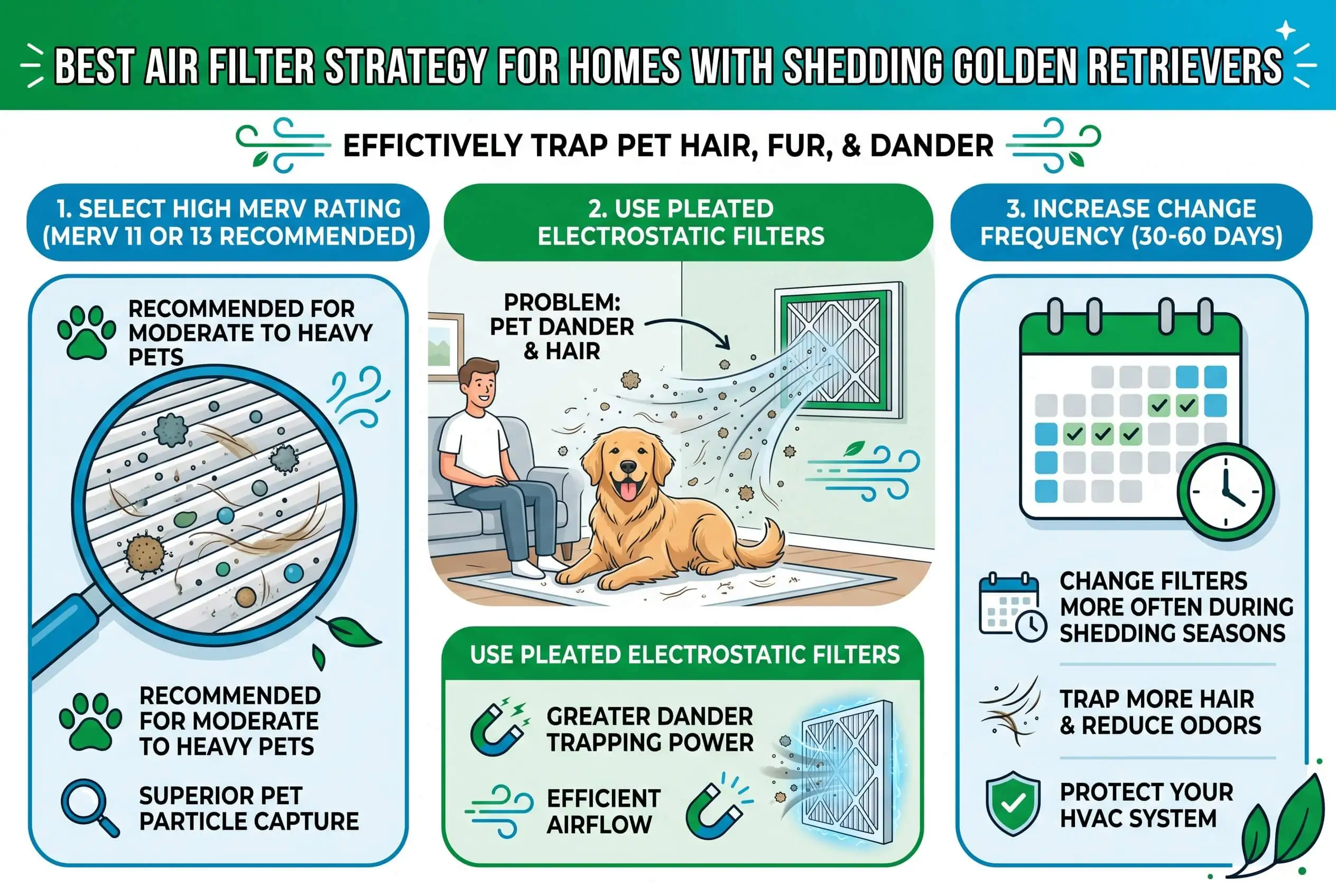
Change filters every 45 to 60 days with one dog and no allergy sufferers in the household. Move to every 30 days during spring and fall shedding seasons, in multi-dog homes, or when allergy sufferers are present.
Return air vent grilles accumulate dog hair faster than the filter during peak shedding. Inspect and clear them monthly rather than waiting for visible airflow restriction.
A clogged air filter doesn't extend its filtration life. The restriction moves directly to the HVAC blower motor, accelerating wear on a component that costs significantly more than the filter it's protecting.
Portable HEPA air purifiers placed in high-dander rooms supplement the central HVAC filter and address localized dander concentrations the whole-home system can't resolve on a single air pass.
HEPA filters aren't designed for central residential HVAC systems. The static pressure they create exceeds what most residential blowers can handle without degrading system performance.
Why Golden Retriever Shedding Is an Air Quality Problem, Not Just a Cleaning Problem
Goldens carry a dense, water-repellant double coat that sheds moderately year-round and blows out heavily once or twice annually, typically in spring and fall. Most owners focus on the visible hair. The part that's harder to track is the dander those hairs carry: microscopic skin flakes released continuously, small enough to stay airborne for hours.
Unlike shed hair, dander particles run from roughly 2.5 to 10 microns, placing them squarely in the capture range of a properly rated HVAC filter and just as squarely in the pass-through range of a low-efficiency one. Once airborne, dander follows your duct system into every room the HVAC serves.
Peak shedding season compounds both issues. Hair volume spikes, dander production climbs with accelerated skin cell turnover, and return vents collect matted hair faster than the filter itself saturates. For anyone in the household managing asthma or pet allergies, spring and fall represent the highest indoor allergen load of the year.
The real warning sign isn't the golden tumbleweed under the couch. It's the dark, hair-packed filter face on a cartridge you installed six weeks ago and haven't thought about since.
What MERV Rating Works Best for Golden Retriever Homes
ASHRAE developed the MERV scale to give homeowners a standardized way to compare filter performance. The rating number tells you one specific thing: how efficiently a filter captures particles of different sizes. For Golden Retriever owners, the right choice balances capture efficiency against what your HVAC blower can actually handle.
MERV 8 and below captures larger airborne debris but lets fine dander particles recirculate freely. For homes with heavy-shedding breeds, this rating isn't adequate at any point in the year.
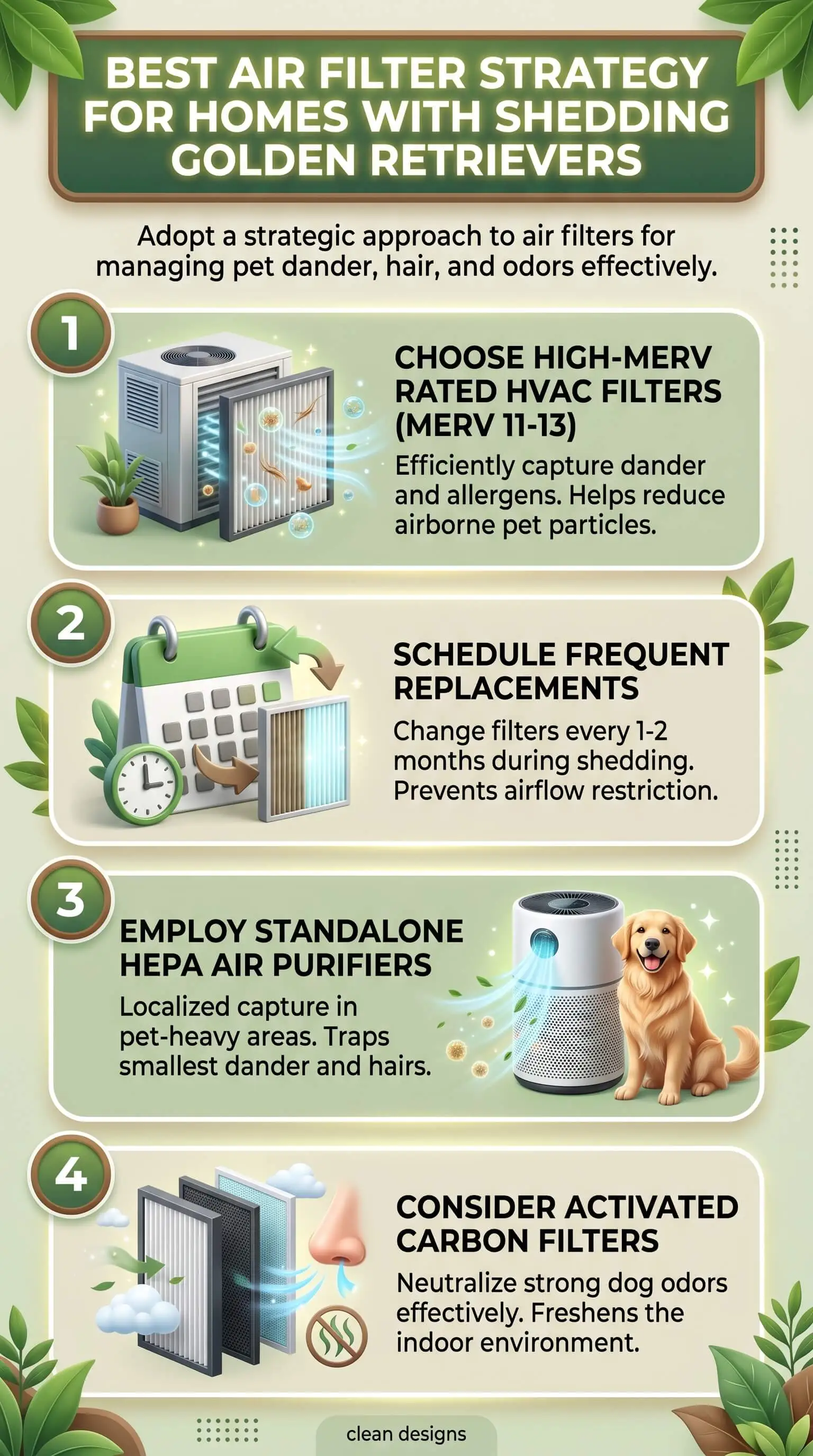
MERV 11 is the practical starting point. It captures particles down to 1 micron with meaningful efficiency, covering the bulk of airborne pet dander without restricting airflow in most residential systems. This is our default recommendation for single-dog households.
MERV 13 captures finer particles at higher efficiency and makes sense when allergy or asthma sufferers live in the home, or when you have multiple dogs. Before upgrading, confirm with an HVAC technician that your system's blower motor can sustain airflow through the denser media. Forced airflow restriction shortens blower life.
Many homeowners assume HEPA is the answer for heavy pet shedding. The filter density creates pressure drops most residential blowers can't sustain, and HEPA isn't part of the residential MERV framework ASHRAE developed. A MERV 11 or MERV 13 pleated filter is the right tool for this job.
How Often to Change Air Filters When You Have a Golden Retriever
Standard guidance for homes without pets runs every 90 days for a 1-inch pleated filter. That timeline doesn't account for a 70-pound Golden in spring coat blow.
One Golden Retriever, no allergy sufferers in the household: change every 45 to 60 days.
One Golden Retriever with allergy or asthma sufferers present: change every 30 to 45 days.
Multiple dogs or peak shedding season (spring and fall): change every 30 days regardless.
Treat that schedule as a floor and use visual inspection alongside it. Pull the filter and check the face directly. A clean MERV 11 filter runs off-white or light gray. A saturated one is dark gray or brown, with hair embedded in the pleats and dander compacted across the surface. When you see that, change it regardless of the date. Running a clogged filter doesn't extend filtration time. The restriction moves directly to your blower motor, adding wear to a component that costs significantly more than the filter it's replacing.
Protecting Your HVAC System From Dog Hair and Dander Buildup
The filter is one part of the system. Return air vents and ductwork accumulate pet material too, and most homeowners don't inspect them on any consistent schedule.
Return air vents: Dog hair accumulates fastest at the grille because the system actively draws air through it. Remove and rinse grilles monthly during shedding season. A buildup of matted hair at the vent restricts airflow before the filter itself is even half-loaded.
Ductwork: Dander that bypasses or settles beyond the filter accumulates in ductwork and recirculates on every heating and cooling cycle. In homes with heavy-shedding dogs, an annual duct inspection is worth scheduling. Full duct cleaning every three to five years is a reasonable interval for high-shedding households.
Grooming location: Brushing or bathing a Golden Retriever indoors sends a concentrated surge of loose hair into the air. Take grooming sessions outdoors or into a well-ventilated space to keep that spike out of the HVAC intake entirely.
The blower motor, coils, and ductwork all run better when the filter stays on schedule. Pet hair accelerates every form of wear when the filtration strategy falls short.
Supplemental Measures That Work Alongside Your Air Filter Strategy
Your central HVAC filter handles the whole-home air cycle. It won't address localized dander buildup in the rooms where your dog actually lives. These steps close that gap.
Portable HEPA air purifiers: Place a HEPA-rated portable unit in rooms where your dog sleeps and spends the most time. Portable units filter a single space continuously, which complements the whole-home cycling the HVAC provides. Together, they address high-dander zones and general household air in a way neither covers independently.
HEPA-filtered vacuum: Surface dander on carpet, upholstery, and bedding becomes airborne again whenever those surfaces are disturbed. A HEPA-filtered vacuum captures it rather than redistributing it. Vacuum high-traffic pet areas two to three times per week during shedding season.
Regular bathing: Bathing reduces recoverable allergen levels from dog hair and dander, though the benefit fades without consistent frequency. Weekly baths during peak shedding season reduce the volume of airborne dander your dog introduces between grooming sessions.
Consistent brushing: Daily brushing during heavy shedding periods removes dead hair before it becomes airborne. Brushing outdoors keeps that material out of the home entirely.
“In homes with large double-coated breeds, we consistently see filter face saturation in 30 to 45 days during spring coat blow, even with MERV 11 media. Coarse dog hair bridges the pleat channels and reduces the effective filtration area before the media itself is fully loaded — faster than most owners expect. Upgrading to MERV 11 or MERV 13 is the right move, but under the clean air act, the change interval matters just as much as the rating.”
Essential Resources
Below are seven authoritative sources we point homeowners to when they want to understand pet dander, HVAC filtration, and indoor allergen management from credible, independent research.
1. What Pet Allergens Do to Your Indoor Air, and Why the EPA Monitors Them
The EPA classifies pet allergens as biological contaminants and identifies HVAC dispersal as a primary mechanism for whole-home exposure. This resource explains how dander enters the air, why it accumulates in ductwork, and what the agency recommends to reduce biological pollutant levels in residential settings.
Source: https://www.epa.gov/indoor-air-quality-iaq/biological-pollutants-impact-indoor-air-quality
2. Why Pet Dander Stays Airborne Longer Than Other Allergens (American Lung Association)
The American Lung Association explains why pet dander's microscopic, jagged structure keeps it suspended in the air far longer than dust or pollen and allows it to cling to fabrics, bedding, and HVAC components. For Golden Retriever owners, this context makes clear why surface cleaning alone won't solve the problem and why consistent filtration is the controlling variable.
Source: https://www.lung.org/clean-air/indoor-air/indoor-air-pollutants/pet-dander
3. The Allergen Control Checklist Every Pet-Owning Household Needs (AAFA)
The Asthma and Allergy Foundation of America provides a practical, actionable guide to reducing indoor allergens, with specific attention to filter maintenance, vacuum selection, and the EPA's three-part framework for improving indoor air quality. Pet dander appears alongside dust mites and mold as a primary indoor allergen source.
Source: https://aafa.org/allergies/prevent-allergies/control-indoor-allergens/
4. Managing Dog Allergies Without Removing the Dog (ACAAI)
The American College of Allergy, Asthma and Immunology documents the allergens dogs produce, where they concentrate, and how they trigger immune responses. Their environmental management guidance covers HEPA placement, filter maintenance, and grooming frequency as strategies for households where removing the pet isn't on the table.
Source: https://acaai.org/allergies/allergic-conditions/pet-allergies/
5. How Golden Retrievers Shed and What That Means for Your HVAC System (AKC)
The American Kennel Club documents that Goldens shed their thick double coat heavily once or twice per year and continuously at moderate levels in between. This resource provides the breed-specific context on coat types, brushing frequency, and shedding intensity that determines how quickly your air filter reaches capacity during each season.
Source: https://www.akc.org/expert-advice/health/managing-dog-shedding/
6. The Science Behind Animal Allergen Exposure (CDC/NIOSH)
CDC's National Institute for Occupational Safety and Health published foundational research on how animal dander, hair, and biological secretions become airborne and sensitize the immune system over time. Though the focus is occupational exposure, the mechanisms are the same ones at work in any residential environment with a large shedding dog, and the research shows why HVAC filtration is not optional in those homes.
Source: https://www.cdc.gov/niosh/docs/97-116/default.html
7. Understanding the MERV Rating System (ASHRAE)
ASHRAE, the engineering society that developed the MERV scale, provides technical guidance on filter efficiency classifications and the particle size ranges each rating tier addresses. This resource gives Golden Retriever owners the engineering grounding to make an informed decision between MERV 11 and MERV 13 rather than guessing based on packaging language.
Source: https://www.ashrae.org/File%20Library/Technical%20Resources/Technical%20FAQs/TC-02.04-FAQ-61.pdf
Supporting Statistics
The U.S. Dog Population Hit 89.7 Million in 2024 — Shedding Is a National Indoor Air Quality Issue
After years of working directly with homeowners across the country, we've seen how widespread this challenge has become. The U.S. dog population reached 89.7 million in 2024, according to AVMA data, up from 52.9 million in 1996. A significant share of those dogs are double-coated, year-round shedders. That scale makes pet dander one of the most common indoor air quality challenges in American homes, and one a correctly rated air filter directly addresses.
Source: https://www.avma.org/news/pet-population-continues-increase-while-pet-spending-declines
Dog Allergen Exposure Drives More Than One Million Additional Asthma Attacks Per Year
Elevated dog allergen exposure among people who are sensitized to dogs is associated with more than one million additional asthma attacks per year, based on NHANES population data published in a peer-reviewed NIH study. We think about this every time a homeowner sends us a filter photo for reference. The filter isn't just protecting the HVAC equipment. For allergic or asthmatic household members, it's a direct health intervention. Running an undersized or long-overdue filter in a home with a large shedding dog isn't a neutral decision.
Source: https://pmc.ncbi.nlm.nih.gov/articles/PMC5756688/
Six Out of Ten Americans Are Exposed to Cat or Dog Dander, Including Households Without Pets
Six out of 10 people in the United States are exposed to cat or dog dander, according to research cited by the Asthma and Allergy Foundation of America. Pet allergens travel on clothing and surfaces, entering homes where no pets live. In a home with a large shedding breed like a Golden Retriever, indoor dander concentrations run orders of magnitude higher than background levels. Consistent filtration and a disciplined change schedule are the most direct interventions homeowners control.
Source: Asthma and Allergy Foundation of America — aafa.org/allergies/prevent-allergies/control-indoor-allergens/
Final Thoughts
Most Golden Retriever owners treat shedding as a housekeeping challenge. They vacuum more often, accept that certain furniture is a lost cause, and keep a lint roller within reach in three rooms. The air quality side of the problem rarely comes up until someone in the household starts sneezing in November, or until an HVAC technician mentions how loaded the filter was during the annual service call.
Airborne pet dander doesn't behave the way visible hair does. It lands on surfaces, gets stirred back up, and recirculates through the duct system with every air cycle. Without a properly rated filter on the right change schedule, that loop runs through every room the HVAC serves, all year long, with every person in the household breathing what comes out the other end.
We've seen what changes when Golden Retriever owners start treating the air filter the way they treat the rest of dog ownership: on a schedule, with follow-through. A MERV 11 or MERV 13 filter, changed every 30 to 45 days depending on household conditions, handles the core of the problem at the source. Outdoor grooming cuts the particulate load going in. Portable HEPA units cover the rooms where your dog actually lives. The approach that works isn't complicated — it just needs to get done consistently.
Frequently Asked Questions
Q: What MERV rating is best for homes with Golden Retrievers?
A: MERV 11 is the recommended starting point. It captures the majority of airborne pet dander particles in the 1 to 3 micron range while maintaining sufficient airflow for most residential HVAC systems. If a household member manages pet-related asthma or allergies, upgrade to MERV 13 after confirming with an HVAC technician that your blower can handle the increased resistance. Avoid MERV 8 and below for heavy-shedding breeds.
Q: How often should I change my air filter if I have a Golden Retriever?
A: More frequently than the manufacturer's standard guidance suggests.
One dog, no allergy sufferers in the household: every 45 to 60 days
Allergy or asthma sufferers present: every 30 to 45 days
Multiple dogs or peak shedding season (spring and fall): every 30 days
Visual inspection is the more reliable guide. A filter face that's dark gray or brown with hair embedded in the pleats needs to come out immediately, regardless of the schedule.
Q: Can an air filter really help with Golden Retriever dander allergies?
A: Yes, within a defined scope. A properly rated MERV 11 or MERV 13 filter captures airborne dander particles as they cycle through the HVAC system, reducing allergen concentration in the air over time. It won't touch dander already settled into carpet, upholstery, or bedding. For the best outcome, pair filter maintenance with a HEPA-filtered vacuum and portable HEPA air purifiers in the rooms where your dog spends the most time.
Q: Do I need a special air filter for dog hair, or will any filter work?
A: Standard low-MERV filters catch the visible hair but let fine dander particles pass through freely. You don't need a specialty pet filter product. What you need is a quality pleated filter rated MERV 11 or higher, changed on the right schedule for a pet household. The MERV rating is the variable that determines whether the filter captures pet dander effectively.
Q: What is the difference between pet hair and pet dander when it comes to air filtration?
A: Pet hair is coarse enough to see and settles quickly on surfaces and vent grilles. Dander is a separate problem: microscopic skin flakes, typically 2.5 to 10 microns in size, that stay airborne for extended periods and are the source of the allergenic proteins that trigger reactions. While hair creates the visible mess, dander is the air quality problem. A MERV 11 or higher filter is built to capture dander-sized particles.
Q: Should I use a HEPA filter in my HVAC system if I have a dog?
A: No. True HEPA filters, rated MERV 17 and above, create a pressure drop most residential HVAC blowers can't sustain without damage or significant efficiency loss. ASHRAE doesn't include HEPA in the residential MERV framework for this reason. Use a MERV 11 or MERV 13 pleated filter in your central system and place a portable HEPA air purifier in high-dander rooms. That combination delivers effective filtration without stressing the HVAC equipment.
Q: How do I know when my air filter is clogged from dog hair?
A: Pull the filter and look for these indicators:
The filter face is dark gray or brown, with visible hair and debris embedded in it
The pleated channels are compressed or bridged by matted hair
Airflow from vents feels noticeably weaker than usual
The HVAC system runs longer than normal to reach the set temperature
Don't wait for airflow symptoms to appear. Pull and inspect the filter monthly if you have a shedding dog. The check takes less than a minute.
Q: Does bathing my Golden Retriever help reduce the load on my air filter?
A: Bathing reduces the volume of loose hair and surface dander your dog introduces to household air, which slows filter loading between changes. The allergen reduction is measurable but fades without consistent bathing frequency. Weekly baths during shedding season are the most effective interval. Bathing works as one part of a broader strategy, not as a substitute for a correctly rated, regularly changed filter.
Find the Right Air Filter for Your Home
You already know this dog. You know the hair on the couch, the trail at the back door, and the way a rainy afternoon announces itself on the living room floor. The air is part of that home too. A MERV 11 or MERV 13 filter, changed on a consistent schedule, keeps it clean without demanding much beyond follow-through. Browse MERV 11 and MERV 13 air filters in every standard size at Filterbuy. Better air for every household, including the ones that come with a lot of golden hair.