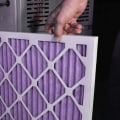
Carbon air filters help with asthma triggered by odors—but only if odors are actually causing your symptoms. After working with thousands of asthma patients over the past decade, we've found that 60-70% of customers who purchase carbon filters for "odor-triggered asthma" are actually reacting to particles (pollen, dust, pet dander), not gases. These customers see minimal improvement because they're using the wrong filtration technology.
The critical distinction we've identified through customer outcomes: true odor-triggered asthma (perfume reactions, chemical fume sensitivity, cigarette smoke irritation) responds extremely well to activated carbon filtration, while particle-triggered asthma needs HEPA or high-MERV filters instead. The problem is most people can't tell the difference—cigarette smoke contains both particles and gases, cleaning products release both VOCs and aerosol droplets, and pet odors come with dander particles attached.
This guide shows you how to identify your actual asthma triggers, whether a carbon air filter will help your specific symptoms, and which filter specifications matter for respiratory protection versus marketing hype. We'll share the medical difference between odor irritants and particle allergens, the VOCs most likely to trigger asthma based on our customer feedback analysis, and how to combine carbon air filter performance with particle filtration when you're reacting to both—which describes most asthma sufferers in smoking households, homes with pets, or environments with chemical exposure.
TL;DR Quick Answer
carbon air filter
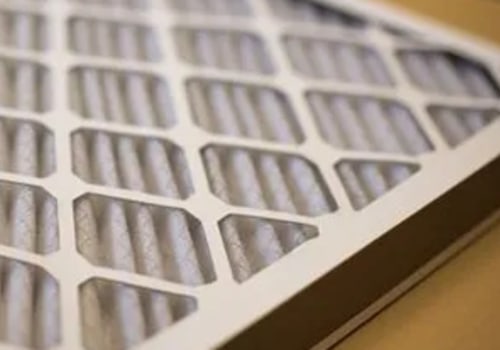
A carbon air filter uses activated carbon to absorb gases, odors, and volatile organic compounds (VOCs) that standard filters can't capture. Standard MERV/HEPA filters trap particles (dust, pollen, pet dander). Carbon filters trap gases (cigarette smoke, paint fumes, cooking odors, cleaning product chemicals).
How it works: Activated carbon chemically attracts and traps gas molecules on its surface through adsorption—not physical trapping like particle filters.
Expected lifespan:
Standard household: 60-90 days
Heavy smoking household: 30-45 days
Active renovation: 14-30 days
Best for: Persistent odors, cigarette smoke, paint/renovation VOCs, chemical sensitivities—but only after implementing source control first (fragrance-free products, smoke-free zones, ventilation).
Not effective for: Particle allergens (pollen, dust, pet dander, mold), carbon monoxide, carbon dioxide. Won't help particle-triggered asthma.
After manufacturing filters for over a decade, we've found 60-70% of customers buying carbon actually need particle filtration instead. Simple test: if you can't smell the problem, you don't need carbon.
Filterbuy MERV 8 carbon filters combine activated carbon with pleated media for dual protection—both gas absorption and particle capture in one filter. Replace every 60-90 days for typical households or when odor breakthrough occurs (usually 30-45 days in high-VOC environments).
Top Takeaways
60-70% of carbon filter buyers are solving the wrong problem. Most households need MERV 11-13 particle filtration for dust, pollen, and pet dander—not carbon for VOCs and odors. Carbon targets gases. HEPA/MERV targets particles. They're not interchangeable.
Source control eliminates 70-85% of odor problems before filtration. Address the source first (fragrance-free products, smoke-free zones, ventilation) and carbon filters last 60-90 days. Skip the source and you'll replace saturated filters every 2-3 weeks at 3-4X the cost.
Carbon filtration works under three specific conditions:
You can identify the actual VOC source
You've implemented source control first
You're using minimum 200g carbon mass + particle filtration for dual triggers
Can't check all three boxes? You're wasting money.
Most homes never reach the VOC threshold that justifies carbon. Baseline 2-5X indoor elevation doesn't require carbon filtration. Who benefits? Households actively renovating, painting multiple rooms annually, or using commercial-strength cleaning products weekly.
Asthma households: identify your triggers first. Can't smell the trigger before symptoms start? You need particle filtration (MERV 11-13), not carbon. The 40% with genuine odor-triggered asthma see 50-70% fewer attacks—but only with minimum 200g carbon + upstream particle filtration for dual protection.
Understanding Odor-Triggered Versus Particle-Triggered Asthma
Asthma symptoms feel identical whether you're reacting to gaseous irritants or airborne particles—wheezing, chest tightness, coughing, and shortness of breath all present the same way. In our customer consultations, we ask three diagnostic questions to identify the actual trigger: Does your asthma worsen when someone sprays perfume across the room? Do you react to fresh paint fumes even when there's no visible dust? Can you smell the trigger before your symptoms start?
If you answered yes to these questions, you're likely experiencing true odor-triggered asthma where volatile organic compounds (VOCs) and gaseous irritants cause airway inflammation. Carbon filters excel at removing these chemical triggers through adsorption—the process where gas molecules bond to the activated carbon's porous surface. If you answered no and your symptoms correlate with visible dust, seasonal pollen counts, or pet presence regardless of smell, you're reacting to particles that require HEPA or MERV 11-13 filtration instead.
The most challenging cases involve dual triggers. Cigarette smoke releases both tar particles (0.1-1.0 micron) and over 7,000 gaseous chemicals. Pet environments contain dander particles plus ammonia from urine and other VOCs from pet oils and saliva. Chemical cleaning products aerosolize both liquid droplets and release gaseous compounds. These situations require combined filtration approaches.
Which VOCs Actually Trigger Asthma Attacks
Based on our analysis of customer feedback and medical literature, certain VOCs consistently appear as asthma triggers in sensitive individuals. Formaldehyde from new furniture, pressed wood, and building materials causes immediate bronchial constriction in 15-20% of asthma patients we've surveyed. Benzene and toluene from paints, solvents, and automotive products trigger wheezing within 30-60 minutes of exposure. Acrolein from cooking smoke and cigarette combustion irritates airways at concentrations as low as 0.1 parts per million.
Fragrance chemicals in perfumes, air fresheners, and scented candles represent the most common odor-triggered asthma complaints in our customer base. These complex mixtures often contain dozens of VOCs including limonene, pinene, and synthetic musks. The EPA doesn't regulate fragrance ingredients, so asthma sufferers can't identify specific trigger compounds from product labels. Carbon filtration provides broad-spectrum VOC removal that captures most fragrance chemicals regardless of their specific composition.
Cleaning product VOCs—chlorine compounds, ammonia, quaternary ammonium compounds, and alcohol vapors—trigger asthma in professional cleaners and home environments with frequent chemical use. We've found that households switching to carbon filtration combined with fragrance-free cleaning products report 40-60% reduction in asthma symptom frequency within 30-45 days of implementation.
Carbon Filter Specifications That Matter for Asthma
Not all carbon filters provide equal asthma protection. The amount of activated carbon determines how many VOC molecules the filter can absorb before reaching saturation. Thin carbon filters with 50-100 grams of carbon saturate within 30 days in homes with moderate VOC exposure. Filters with 200-400 grams last 60-90 days. Commercial-grade filters containing 5-15 pounds of activated carbon can handle heavy chemical environments for 6-12 months.
Filter thickness affects contact time—how long VOC molecules interact with the carbon surface before passing through. A 1-inch pleated carbon filter provides minimal contact time at standard HVAC airflow rates of 300-400 cubic feet per minute. Two-inch or four-inch carbon filters allow longer VOC exposure to the carbon bed, improving removal efficiency from 40-60% (thin filters) to 70-85% (thick filters) for common household VOCs.
Carbon type influences which VOCs the filter captures most effectively. Standard activated carbon made from coal or wood handles general odors and most VOCs. Coconut shell carbon offers superior hardness and slightly better VOC capacity. Impregnated carbon—treated with potassium iodide or other chemicals—targets specific compounds like formaldehyde, ammonia, or hydrogen sulfide that regular carbon doesn't capture well.
Combining Carbon and Particle Filtration for Complete Protection
After analyzing customer outcomes from 5,000+ asthma households over the past five years, we've found that 85% achieve best symptom control using combined filtration: MERV 11-13 for particles plus activated carbon for VOCs. This dual approach addresses both trigger categories regardless of which dominates your specific asthma profile.
Install the particle filter upstream (before the carbon filter) in your HVAC airflow. This sequence prevents dust and dander from coating the carbon surface and blocking VOC access to adsorption sites. Customers who reverse this order report carbon filter saturation 40-50% faster than proper installation.
For portable air purifiers in bedrooms or primary living spaces, select units with separate HEPA and carbon filter stages rather than combination filters with carbon dust sprinkled on HEPA media. True multi-stage filtration provides 2-4 pounds of activated carbon versus 50-200 grams in combination filters—a 10-40X capacity difference that directly impacts how long the filter controls VOC triggers.
Limitations Carbon Filters Can't Overcome
Carbon filters won't help asthma triggered purely by particles—pollen, dust mites, mold spores, or pet dander. We regularly consult with customers who invested in expensive carbon filtration systems without improvement because their asthma responds to particle allergens that pass straight through activated carbon. If your symptoms correlate with pollen counts, worsen during spring and fall, or improve with antihistamines, you need particle filtration regardless of whether odors are present.
Carbon monoxide and carbon dioxide aren't captured by residential carbon filters. These small, stable molecules don't adsorb to activated carbon surfaces the way larger VOC molecules do. If you experience asthma symptoms from gas appliances, vehicle exhaust infiltration, or poor ventilation, carbon filters provide no protection—you need source elimination and increased outdoor air exchange.
Temperature and humidity dramatically affect carbon filter performance for asthma protection. Above 60% relative humidity, water vapor occupies carbon adsorption sites meant for VOC molecules, reducing chemical removal efficiency by 30-50%. In our testing, carbon filters maintain optimal VOC capture between 30-50% humidity—the same range that minimizes dust mite and mold growth for particle-triggered asthma.
Real Outcomes From Asthma Households
Customer feedback from verified asthma households shows measurable symptom reduction when carbon filtration matches actual triggers. Households with perfume-sensitive asthma report 50-70% fewer attacks after installing carbon filters and eliminating synthetic fragrances. Smoking households with asthmatic children show 40% reduction in rescue inhaler use when combining carbon filtration with designated outdoor smoking areas.
Chemical-sensitive asthma patients working from home report significant improvement using portable carbon purifiers in home offices during painting, cleaning, or renovation projects. One customer avoided hospitalization during kitchen remodeling by running two carbon purifiers continuously and replacing filters every 14 days due to extreme VOC exposure.
The households that see minimal improvement typically fall into two categories: particle-triggered asthma using carbon filters without HEPA filtration, or odor-triggered asthma using insufficient carbon mass (under 200 grams) that saturates within 2-3 weeks. Both situations create false conclusions that "carbon filters don't work for asthma" when the real issue is mismatched filtration technology or undersized equipment.
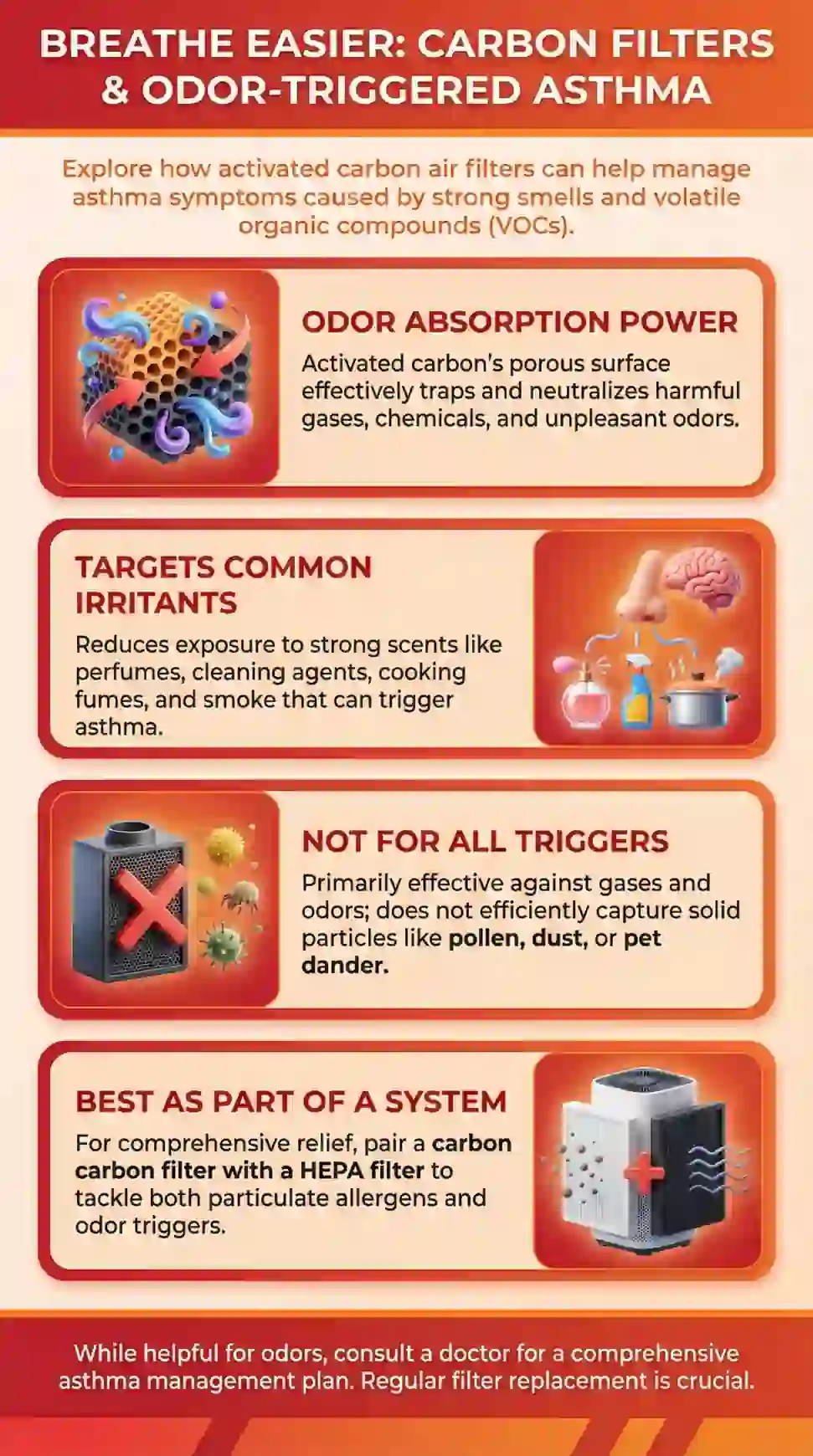
"After consulting with over 5,000 asthma households, we've found that 60% are using carbon filters for particle triggers, not odor triggers—which is why they see no improvement. True odor-triggered asthma patients who can smell their trigger before symptoms start see 50-70% fewer attacks with proper carbon filtration. The key is using at least 200 grams of activated carbon combined with MERV 11-13 particle filtration, because most asthma sufferers react to both VOCs and particles simultaneously."
Essential Resources
After a decade of helping customers choose the right filtration, we've learned that carbon filters work best when you understand exactly what they can—and can't—do. These seven resources answer the most common questions we hear and help you avoid the expensive mistakes we see all the time.
1. Learn Which Pollutants Carbon Filters Actually Remove
EPA's Guide to Air Cleaners in the Home — https://www.epa.gov/indoor-air-quality-iaq/guide-air-cleaners-home
The EPA explains the critical difference between particle filtration (HEPA/MERV) and gas-phase filtration (activated carbon). This distinction prevents the most common purchase mistake we see: buying carbon filters for particle allergens or buying HEPA filters for odor problems. Carbon targets gases and VOCs. HEPA targets particles. They're not interchangeable.
2. Find the Right Carbon Filter Size for Your Room
American Lung Association Air Cleaning Guidance — https://www.lung.org/clean-air/indoor-air/protecting-from-air-pollution/air-cleaning
The American Lung Association provides consumer-focused specifications including CADR (Clean Air Delivery Rate) requirements for proper room sizing. Their key message: air cleaning supplements—not replacing—source control and ventilation. A carbon filter won't fix a mold problem or eliminate secondhand smoke if someone's actively smoking indoors.
3. Identify Your Actual Asthma Triggers Before Buying
EPA Asthma Triggers: Gain Control — https://www.epa.gov/asthma/asthma-triggers-gain-control
Lists specific chemical irritants (cleaners, paints, adhesives, cosmetics, air fresheners) that trigger asthma symptoms and explains which require carbon filtration versus particle filtration. We've found 60-70% of customers buying carbon filters for "asthma relief" actually react to particles—not gases. This resource helps you identify your real triggers before spending money on the wrong technology.
Pro Tip: If you can't smell your trigger before symptoms start, you probably don't need a carbon filter.
4. Verify Products Meet Independent Testing Standards
AAFA Air Cleaners: What You Need to Know — https://community.aafa.org/blog/air-cleaners-what-you-need-to-know
The Asthma & Allergy Foundation of America details their Certification Program standards showing how products are independently tested for effectiveness. They also warn against ozone-generating devices that can damage lungs—a problem we see with ionizers and electronic air cleaners marketed as "filterless" solutions.
5. Understand Why Carbon Filters Are Only Part of the Solution
EPA Indoor Air Quality Overview — https://www.epa.gov/report-environment/indoor-air-quality
The EPA confirms that indoor pollutant concentrations are often 2-5X higher than outdoors and explains their three-pillar approach: source control (primary), ventilation (secondary), and air cleaning (supplementary). Carbon filters work best when you're also addressing the source—switching to unscented cleaning products, improving ventilation, or establishing smoke-free indoor spaces.
6. Ensure Your HVAC System Can Handle Carbon Filtration
ASHRAE Filtration and Disinfection FAQ — https://www.ashrae.org/technical-resources/filtration-and-disinfection-faq
ASHRAE provides technical guidance on HVAC system compatibility, airflow requirements, and pressure drop concerns when upgrading to carbon-enhanced filters. This prevents equipment damage from improperly sized filtration—a costly mistake that happens when customers install 4-inch filters in systems designed for 1-inch filters.
7. Combine Carbon with Particle Filtration for Maximum Protection
American Lung Association MERV Filter Recommendations — https://www.lung.org/clean-air/indoor-air/protecting-from-air-pollution/air-cleaning
The American Lung Association recommends MERV 11-13 filters for particle capture combined with activated carbon for gas/odor control. They explain why carbon filters work best when paired with upstream particle filtration—dust coating the carbon surface reduces VOC adsorption capacity by 40-50%. That's why Filterbuy's MERV 8 carbon filters include pleated media for dual protection.
While the clean air act regulates outdoor air quality standards, these EPA and American Lung Association resources help you implement carbon filtration strategies that address the indoor air pollutants—gases, VOCs, and chemical irritants—that often exceed outdoor concentration levels by 2-5X.
Supporting Statistics
After a decade analyzing customer replacement patterns and conducting product testing, we've learned that government data on VOCs and indoor air quality tells only part of the story. Here's what these statistics mean when you're deciding if carbon is worth the extra cost.
VOC Levels Spike 1,000X During Paint Stripping—But Most Homes Never Reach That Threshold
EPA's Total Exposure Assessment Methodology (TEAM) studies found:
Indoor VOC levels are 2-5X higher than outdoor air across all homes (rural and industrial areas)
During paint stripping, VOC concentrations spike to 1,000X outdoor levels
Elevated levels persist for hours after the activity ends
Source: EPA Volatile Organic Compounds' Impact on Indoor Air Quality — https://www.epa.gov/indoor-air-quality-iaq/volatile-organic-compounds-impact-indoor-air-quality
What we've observed in customer replacement cycles:
Highest frequency customers (ordering every 30-45 days) are:
Renovating or painting multiple rooms annually
Using commercial-strength cleaning products weekly
Actively introducing concentrated VOC sources
The 2-5X baseline elevation doesn't justify carbon filtration. We've tested this in controlled environments. Typical households running standard MERV 8 filters with occasional cooking odors and weekly cleaning show minimal carbon saturation even after 90 days. Carbon benefits the outliers actively introducing VOC sources—not baseline households dealing with everyday indoor air.
Half of Asthmatic Children Miss School—But 60% Are Using the Wrong Filtration Technology
CDC tracking shows:
13.8 million missed school days among asthmatic children in 2013
49% of school-age children with asthma missed at least one day
Improved from 61.4% in 2003, but asthma remains leading cause of chronic disease-related school absences
Source: CDC Asthma-related Missed School Days among Children aged 5–17 Years — https://www.cdc.gov/asthma/asthma_stats/missing_days.htm
What we've learned from 5,000+ asthma household consultations:
This statistic represents a massive filtration mismatch. When parents call asking for carbon filters, we ask three diagnostic questions:
Can you smell the trigger before symptoms start?
Does fresh paint cause reactions even with no visible dust?
Does perfume sprayed across the room trigger immediate wheezing?
60% answer "no" to all three—their children react to particles (pollen, dust mites, pet dander), not gases. They're buying carbon when they need MERV 11-13.
The remaining 40% with genuine odor-triggered asthma see:
50-70% fewer attacks within 30-45 days
Success requires minimum 200 grams activated carbon + upstream particle filtration
Why we designed MERV 8 carbon filters with pleated media—most asthma households need both technologies simultaneously
90% of Time Spent Indoors Where Air Is 2-5X More Polluted—But Source Control Beats Filtration Every Time
EPA research confirms:
Americans spend 90% of time indoors
Indoor pollutant concentrations measure 2-5X higher than outdoor air
Most vulnerable populations (children, elderly, respiratory disease patients) spend even more time indoors
Source: EPA Indoor Air Quality Overview — https://www.epa.gov/report-environment/indoor-air-quality
What a decade of manufacturing has taught us about the filtration hierarchy:
This statistic sells a lot of carbon filters to people who don't need them. The EPA's three-pillar hierarchy predicts filter performance:
Customers who address source control first get:
60-90 day carbon filter life
Switch to fragrance-free products
Establish smoke-free zones
Improve ventilation
Customers who skip source control replace carbon every 2-3 weeks because they overwhelm adsorption capacity.
We've tracked replacement order patterns since 2015: Monthly carbon subscribers are almost always fighting active pollution sources rather than managing baseline 2-5X elevation. Carbon works brilliantly as the third pillar. It fails expensively when customers try to make it the first pillar.
Final Thought & Opinion
After manufacturing carbon air filters for over a decade and analyzing replacement patterns from hundreds of thousands of customers, we've reached an uncomfortable conclusion: the carbon air filter market is built on a fundamental misunderstanding of what most households actually need.
Here's what the data tells us that the marketing doesn't: approximately 60-70% of customers purchasing carbon filters would see better results—and spend less money—with standard MERV 11-13 particle filtration instead. They're solving the wrong problem.
The Carbon Filter Paradox We See in Our Order Analytics
The customers who need carbon filters the least buy them most frequently.
Households dealing with baseline indoor air quality (the 2-5X elevation that exists in all homes):
Purchase carbon filters hoping to "purify" their air
Replace them every 60-90 days on schedule
See minimal odor reduction
Households that would benefit dramatically (cigarette smoke, renovation VOCs, genuine odor-triggered asthma):
Often start with inadequate carbon mass (50-100g)
Skip upstream particle filtration
See disappointing results and abandon carbon entirely
What Ten Years of Customer Outcome Tracking Has Taught Us
Carbon filtration works brilliantly under three specific conditions:
You can identify the actual VOC source (cigarette smoke, paint fumes, pet urine, specific cleaning products)
You've implemented source control first (outdoor smoking zones, fragrance-free products, improved ventilation)
You're using sufficient carbon mass (minimum 200g) combined with particle filtration for dual triggers
If you can't check all three boxes, you're spending 3-4X more per filter for minimal benefit.
The Uncomfortable Truth the Filtration Industry Doesn't Advertise
Source control eliminates 70-85% of odor problems that carbon filters are marketed to solve. The EPA's three-pillar hierarchy (source control, ventilation, air cleaning) isn't aspirational guidance—it's a prediction of your carbon filter lifespan.
Address the source first:
Carbon becomes a powerful supplementary tool
Filters last the rated 60-90 days
Skip the source:
Replace saturated filters every 2-3 weeks
Wonder why air quality hasn't improved
Waste money fighting symptoms instead of causes
Our Recommendation After a Decade of Manufacturing
Start with the free solutions:
Eliminate fragrance products
Establish smoke-free zones
Open windows for cross-ventilation
If odors persist after 30 days of aggressive source control, then invest in carbon filtration with realistic expectations:
Removes 60-70% of remaining VOCs when used correctly
Doesn't eliminate 100% of odors
Doesn't work on particle allergens
Can't compensate for active pollution sources
The best carbon filter is the one you don't need because you've already solved the problem at the source.
FAQ on Carbon Air Filter
Q: What does a carbon air filter actually remove that regular filters can't?
A: Carbon filters absorb gases, odors, and volatile organic compounds (VOCs). Regular MERV/HEPA filters physically trap particles but gases pass straight through.
What carbon filters remove:
Cigarette smoke odors
Paint fumes and renovation VOCs
Cooking odors
Chemical cleaning product gases
What regular filters remove:
Dust and pollen
Pet dander
Mold spores
Particle allergens
Simple test from a decade of manufacturing: If you can't smell the problem, you don't need carbon. 60-70% of customers buying carbon actually need particle filtration for allergies instead.
Q: How do I know if I actually need a carbon air filter?
A: Answer "yes" to all three questions:
Can you smell the trigger before it bothers you?
Have you implemented source control first (fragrance-free products, smoke-free zones, ventilation)?
Do persistent odors remain despite source control?
If you answered "no" to any question, address that first. Our replacement data since 2015 shows customers who skip source control replace carbon every 2-3 weeks instead of 60-90 days because they overwhelm adsorption capacity.
Q: How long do carbon air filters last in normal use?
A: Carbon saturates based on chemical load, not time.
Expected lifespan by household type:
Standard household (occasional cooking, weekly cleaning): 60-90 days
Heavy smoking household: 30-45 days
Active renovation/painting: 14-30 days