Based on first-hand experience working with multi-family properties, the most common valet trash service issues are not caused by missed routes or staffing. They are caused by unclear expectations around what residents are allowed to place outside their doors. Loose trash, leaking bags, and unapproved items are the leading reasons valet trash service teams skip pickups or issue violations.
This guide explains exactly what qualifies as “bagged trash” for valet trash service, what items are typically not collected, and why following these guidelines is essential for maintaining clean apartment communities, reliable valet trash service, and resident satisfaction.
Quick Answers
valet trash service
Valet trash service is a scheduled doorstep trash pickup program used in apartment communities. Residents place properly bagged trash outside their door on designated nights, and trained teams collect and dispose of it, helping properties stay cleaner, safer, and more consistent when clear rules are followed.
Key Takeaways
Bagged trash must be fully sealed and contained.
Loose or exposed waste is typically not collected.Leaks and odors are the most common violations.
Proper bags prevent spills, pests, and missed pickups.Not all waste qualifies as bagged trash.
Bulk items, loose boxes, and prohibited materials are excluded.Clear rules protect residents and service teams.
Safety and consistency depend on compliance.Correct bagging keeps valet waste programs running smoothly.
Fewer issues lead to better service and cleaner communities.
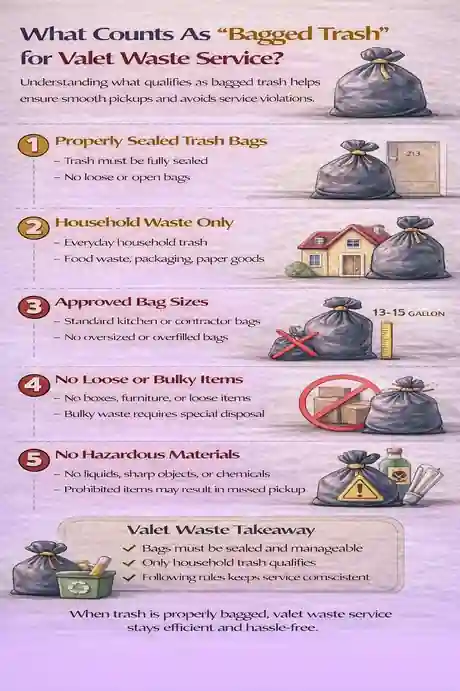
In valet waste programs, “bagged trash” means more than simply putting garbage in a bag. It refers to trash that is:
Fully enclosed inside a trash bag
Securely tied or sealed at the top
Strong enough to prevent tearing or leaks
Free of loose items or sharp protrusions
From real-world experience, most valet waste providers rely on these standards to protect staff, maintain cleanliness, and avoid property damage, especially when excess items from a garage cleanout increase the volume or type of trash placed out for collection. Trash that does not meet these criteria is often left behind.
How Proper Bagging Supports Valet Waste Operations
Valet waste service follows a predictable process that depends on bagged trash being handled correctly:
Residents place approved, sealed bags outside their door during pickup hours
Valet waste technicians collect bags by hand
Bags are transported safely to compactors or dumpsters
Common areas remain clean and odor-free
When trash is not properly bagged, this process breaks down. Leaks, spills, and loose debris slow pickups and create safety risks.
What Typically Counts as Acceptable Bagged Trash
Most apartment communities consider the following acceptable when properly bagged:
Household food waste
Non-recyclable packaging
Bathroom and personal waste
Small household items that fit fully inside a bag
The key requirement is containment. If the trash fits inside a bag and the bag can be tied closed without strain, it generally qualifies.
What Does Not Count as Bagged Trash
Based on hands-on experience, these items are commonly rejected during valet waste pickup:
Loose trash or items placed outside a bag
Leaking, ripped, or overfilled bags
Cardboard boxes not broken down and bagged
Bulk items such as furniture or large appliances
Sharp or hazardous materials
Recycling placed in trash bags (where separate rules apply)
These restrictions exist to protect service teams and prevent damage to hallways, elevators, and disposal equipment.
Resident Responsibilities for Proper Bagging
Residents play a direct role in keeping valet waste service effective. Most communities require residents to:
Use sturdy trash bags designed for household waste
Tie bags securely before placing them outside
Avoid overfilling or forcing bags closed
Follow recycling and bulk-item guidelines
Set trash out only during designated pickup windows
When expectations are clear, compliance improves and missed pickups decline.
Why Properly Bagged Trash Matters to Apartment Communities
Valet waste programs succeed or fail based on small details. Proper bagging helps communities:
Prevent spills and odors in shared spaces
Reduce pest and sanitation issues
Improve pickup speed and reliability
Minimize resident complaints
Protect staff from injury
When trash is not properly bagged, this process breaks down. Leaks, spills, and loose debris slow pickups and create safety risks.
Essential Resources on Valet Trash Service
1. Clear Rules That Help Your Service Work Better
Valet Trash Rules: Tenant & Property Manager Guide
This resource lays out the real rules that keep valet trash running without confusion — from when trash should be placed outside to what qualifies as acceptable waste. Perfect for property teams and residents alike.
https://www.trashbutler.com/valet-trash-rules/
2. The True Value of Valet Trash for Apartment Living
Benefits of Valet Trash for Apartments
A practical look at how valet trash enhances daily life, keeps communities cleaner, and reduces operational headaches. This is great for property managers weighing the ROI of valet trash service.
https://www.trashbutler.com/benefits-of-valet-trash-for-apartments/
3. What Valet Trash Pickup Actually Looks Like
Valet Waste: How It Works
Straight answers about how valet trash service functions in real apartment settings, including what residents can expect and why consistency matters.
https://www.apartmentguide.com/blog/valet-waste/
4. Why More Communities Are Adding Valet Trash
Valet Trash Services and Community Living
Discover why valet trash is becoming a go-to amenity in modern multi-family housing and what it means for resident satisfaction and property differentiation.
https://2amagazine.com/valet-trash-services-enhancing-community-living-with-hassle-free-waste-management/
5. Common Valet Trash Services and Features
Valet Trash Services We Provide
This resource breaks down typical service features you’ll see from providers — including pickup frequency and additional support options — helping you compare and choose what’s right for your property.
https://thevalettrashcompany.com/see-the-full-list-of-valet-trash-services-we-provide/
6. What Residents Should Know About Fees and Rights
Tenant Rights and Mandatory Valet Trash Fees in Apartments
Explains how valet trash fees are structured, what belongs in leases, and what residents should understand about mandatory versus optional participation.
https://legalclarity.org/tenant-rights-and-mandatory-valet-trash-fees-in-apartments/
7. Where Valet Trash Fits Into Bigger Waste Trends
Valet Trash Services and Urban Waste Management
Provides broader context on how valet trash service supports modern waste handling solutions and evolving expectations in urban and multi-family living.
https://findthehomepros.com/valet-trash-services-simplifying-waste-management-for-urban-living/
These resources explain how clear rules, consistent pickup, and proper waste handling make valet trash service effective, aligning everyday operations with environmental standards like the clean air act while supporting cleaner, safer apartment communities.
Supporting Statistics
Waste Volume & Compliance Challenges
The average U.S. resident generates nearly 5 pounds of trash every day.
In apartment communities, that volume multiplies quickly. Without clear bagging standards, even small inconsistencies lead to spills, odors, and pickup delays.
Source: U.S. Environmental Protection Agency (.gov)
https://www.epa.gov/facts-and-figures-about-materials-waste-and-recyclingLess than one-third of U.S. waste is recycled or composted.
This gap highlights why clear separation and proper bagging rules matter in valet trash service programs. When residents understand how to bag and sort waste correctly, contamination and non-collection issues decline.
Source: U.S. Environmental Protection Agency (.gov)
https://www.epa.gov/sites/default/files/2021-01/documents/2018_ff_fact_sheet_dec_2020_fnl_508.pdf
Safety & Risk Considerations
More than 211,000 U.S. workers suffer serious fall-related injuries each year.
In valet trash service, loose items, leaking bags, and cluttered walkways increase handling risks. Properly bagged trash helps reduce hazards during nightly collection.
Source: CDC / NIOSH (.gov)
https://www.cdc.gov/niosh/falls/about/index.html
Why These Numbers Matter
High daily waste volume amplifies small compliance issues
Improper bagging increases safety and sanitation risks
Clear valet trash rules improve consistency at scale
Together, these statistics reinforce why proper bagging is not a minor detail in valet trash service. It is a foundational requirement for cleanliness, safety, and air duct cleaning services–friendly environments that support reliable operation in apartment communities.
Final Thought & Opinion
From hands-on experience, bagging standards are the backbone of any successful valet waste program. Most issues blamed on valet service are actually caused by unclear or ignored bagging rules.
When trash is properly sealed, pickup is faster, cleaner, and safer. When it isn’t, even the best service struggles. Clear communication, consistent enforcement, and simple expectations are what turn valet waste into a reliable system instead of a daily frustration, while also supporting healthier building conditions that benefit from professional duct cleaning services.
FAQ on Valet Trash Service
Q: What is valet trash service in apartment communities?
A:
Scheduled doorstep trash pickup
Residents place sealed bags outside on pickup nights
Teams handle disposal consistently
Cleaner, more predictable service
Q: How often is valet trash service provided?
A:
Typically 3–5 nights per week
Consistency matters more than frequency
Predictable schedules improve compliance
Q: What are residents responsible for?
A:
Using sealed, approved trash bags
Placing trash out during pickup windows
Following recycling and bulk-item rules
Q: Is valet trash service mandatory?
A:
Depends on the property
Often included as a standard amenity
Monthly fee outlined in the lease
Q: Why do property managers use valet trash service?
A:
Cleaner common areas
Fewer waste-related complaints
Improved daily operations