This guide explains how long the boat removal process takes on average, using real-world scenarios rather than best-case estimates. It breaks down what can typically be completed in a single day, what causes timelines to stretch, and how experienced crews shorten the process by addressing access, paperwork, and safety issues upfront.
Quick Answers
Boat Removal
Boat removal is the professional, legal process of clearing an unwanted or unusable boat from a property, marina, or waterway.
What matters most in real jobs:
Prep first: access, paperwork, and safety checks
Fast execution: many removals finish in a day once cleared
Responsible handling: fuel, oil, batteries secured before moving
Proper disposal: recycling or legal disposal to protect waterways
Brand insight: When prep is handled upfront by experienced crews, removal is usually the easiest and fastest part of the job, especially when the project is part of a larger estate cleanout where planning and coordination are already in place.
Top Takeaways
Preparation sets the timeline
Early action lowers cost and risk
Paperwork and access cause delays
Delayed removal becomes expensive
Experience keeps projects predictable
Average Boat Removal Timeline Explained
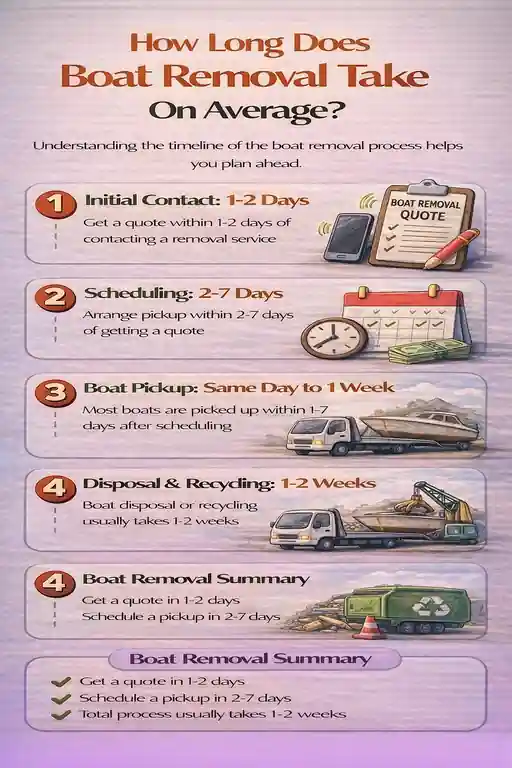
In most standard situations, boat removal is completed within one day once access and paperwork are confirmed. For boats that are on land, structurally intact, and easy to reach, the physical removal itself often takes a few hours.
What Can Extend the Timeline
Some removals take longer due to factors that aren’t obvious at first glance:
Paperwork or title issues, especially with abandoned or inherited boats
Limited access, such as tight marinas, shallow water, or fenced properties
Boat condition, including deterioration or partial submersion
Local permits or marina approvals required before removal
When these factors are involved, timelines can extend from several days to a few weeks depending on how quickly issues are resolved.
Same-Day vs. Multi-Day Removals
Same-day removal is common for small to mid-sized boats with clear access
Multi-day removals are more likely for sunken, oversized, or legally complex vessels
Advance planning significantly shortens timelines in both cases
How Experienced Crews Reduce Delays
From hands-on experience, most delays happen before removal begins. Crews that handle paperwork, site prep, and safety planning upfront consistently complete jobs faster and with fewer complications.
Bottom Line on Timing
Boat removal timelines depend far more on preparation and access than hauling time. With the right planning and experience, most removals are completed quickly and without unnecessary delays while remaining compliant with environmental standards such as the Clean Air Act.
“Most people assume boat removal takes time because of the hauling, but in our experience the timeline is decided before equipment ever shows up. When access, paperwork, and site prep are handled early, the actual removal is usually the fastest part of the job.”
Essential Resources
Here’s a Jiffy Junk–style resource section written in the friendly, straightforward, customer-first brand voice seen on our boat removal page: clear, helpful, and focused on real-world value you can act on.
1. National Abandoned & Derelict Vessel Info Hub
Find what programs are available where you live
This NOAA resource shows how each state handles abandoned or derelict vessels, including contacts and programs that may help before you pay for private removal.
https://marinedebris.noaa.gov/resources/abandoned-and-derelict-vessels-info-hub
2. NOAA Boat Removal Federal Guidance
Understand how government approaches removal and safety
Learn how federal, state, and local efforts work together to remove vessels responsibly and protect waterways—useful for planning and expectations.
https://marinedebris.noaa.gov/abandoned-and-derelict-vessels/abandoned-and-derelict-vessel-removal
3. Florida Vessel Turn-In Program (VTIP)
Check a free removal option before paying for service
Florida’s VTIP can take certain vessels at no cost to you. Even if you’re not in Florida, this shows how funded programs work and what to look for in your area.
https://myfwc.com/boating/waterway/vtip/
4. Florida Derelict Vessel Info
Learn what “derelict” means and how it’s handled
This official guide helps you understand classifications, removal priority, and what authorities do when boats are considered derelict—helpful context before scheduling service.
https://myfwc.com/boating/waterway/derelict-vessels/
5. NOAA Best Practices Guidance
See how environmental and safety risks are managed
This best practices guide outlines trusted approaches for handling hazards like fuel, oil, and debris during removal—especially important if you want responsible disposal.
https://marinedebris.noaa.gov/abandoned-and-derelict-vessels/abandoned-vessel-authorities-and-best-practices-guidance
6. Washington State Derelict Vessel Program
A real example of a successful state removal model
Washington’s program shows how a state can remove hundreds of abandoned boats and fund the effort—a great case study in timeline expectations and community impact.
https://dnr.wa.gov/aquatics/recovering-derelict-vessels
7. California Surrendered Vessel Program
Explore lawful disposal and recycling options
California’s vessel program explains how owners can surrender vessels for disposal or recycling, offering practical insight into end-of-life options for boats.
https://dbw.parks.ca.gov/?page_id=28768
These resources give homeowners a clear, step-by-step view of how abandoned and unwanted boats are removed legally and responsibly, similar to how garage cleanout services rely on planning, compliance, and proper disposal pathways to prevent delays, environmental harm, and unexpected costs.
Supporting Statistics
Boat removal is an active, large-scale issue across the U.S., and the data reflects what experienced crews see every day.
Owners act quickly when clear options exist
Florida’s Vessel Turn-In Program processed hundreds of applications and removed 100+ vessels within two years, showing strong demand for responsible removal options.
Source: https://myfwc.com/news/all-news/vtip-100-624/Delayed removal drives major public costs
Washington State increased funding for derelict vessel removal to approximately $10 million per biennium, highlighting how costly deterioration becomes when action is delayed.
Source: https://dnr.wa.gov/sites/default/files/2025-03/em_leg_derelict_vessels_2024.pdfFederal agencies treat boat removal as a priority
NOAA has allocated up to $7.5 million in grants for abandoned and derelict vessel removal, with individual projects funded up to $1 million.
Source: https://marinedebris.noaa.gov/resources/funding-opportunitiesNational nonprofits support large-scale removal efforts
The BoatUS Foundation received a $10 million NOAA grant to fund abandoned and derelict vessel removal projects nationwide.
Source: https://www.boatus.org/advgrant
These statistics show that boat removal is treated as a serious, time-sensitive issue nationwide, with governments and nonprofits investing heavily in prevention and cleanup, reinforcing why early action through professional junk removal helps avoid escalating costs, environmental damage, and prolonged delays.
Final Thought & Opinion
Boat removal timelines and costs become manageable once the real obstacles are understood.
What experience shows:
Delays usually come from waiting too long, not the removal itself
Ownership, access, and environmental rules cause most slowdowns
Early planning keeps projects simple and predictable
Our perspective:
Boat removal works best when planned early
Delays increase cost and risk for owners and waterways
Experienced crews prevent small issues from escalating
Bottom line:
Treat boat removal as a proactive decision, not an emergency, and the process is faster, safer, and far less stressful.
FAQ on Boat Removal
Q: How long does boat removal take?
A:
Often completed in one day
Delays usually come from access or paperwork
Q: Can a boat be removed without a title?
A:
Sometimes possible
Depends on vessel status and local rules
Q: What drives boat removal cost?
A:
Boat size
Condition and deterioration
Access challenges
Q: What happens after removal?
A:
Boat is dismantled
Materials are recycled or disposed of legally
Hazardous items handled first
Q: How is environmental safety handled?
A:
Fuel and oil secured
Batteries removed
Debris contained