Based on how waterless hand soap is actually used in mobile kitchens, catering setups, food trucks, and other off-grid or high-movement work environments, it isn’t designed to replace soap and water—it’s designed to bridge the gap when water isn’t immediately available. Unlike hand sanitizer, which relies primarily on alcohol to kill germs, waterless hand soap uses surfactants to bind to dirt, oils, and food residue, allowing contaminants to be physically wiped away from the skin. That distinction is critical, especially in situations where hands are visibly soiled or greasy.
In this article, we’ll break down what waterless hand soap is, how it works at a functional and chemical level, and why professionals rely on it in situations where hygiene still matters—but sinks aren’t nearby. You’ll learn what makes it different from sanitizer, when it’s appropriate to use, and what limitations you should understand before relying on it as part of a hand hygiene routine. The goal isn’t marketing hype—it’s clarity, accuracy, and practical understanding.
TL;DR Quick Answers
What is waterless hand soap?
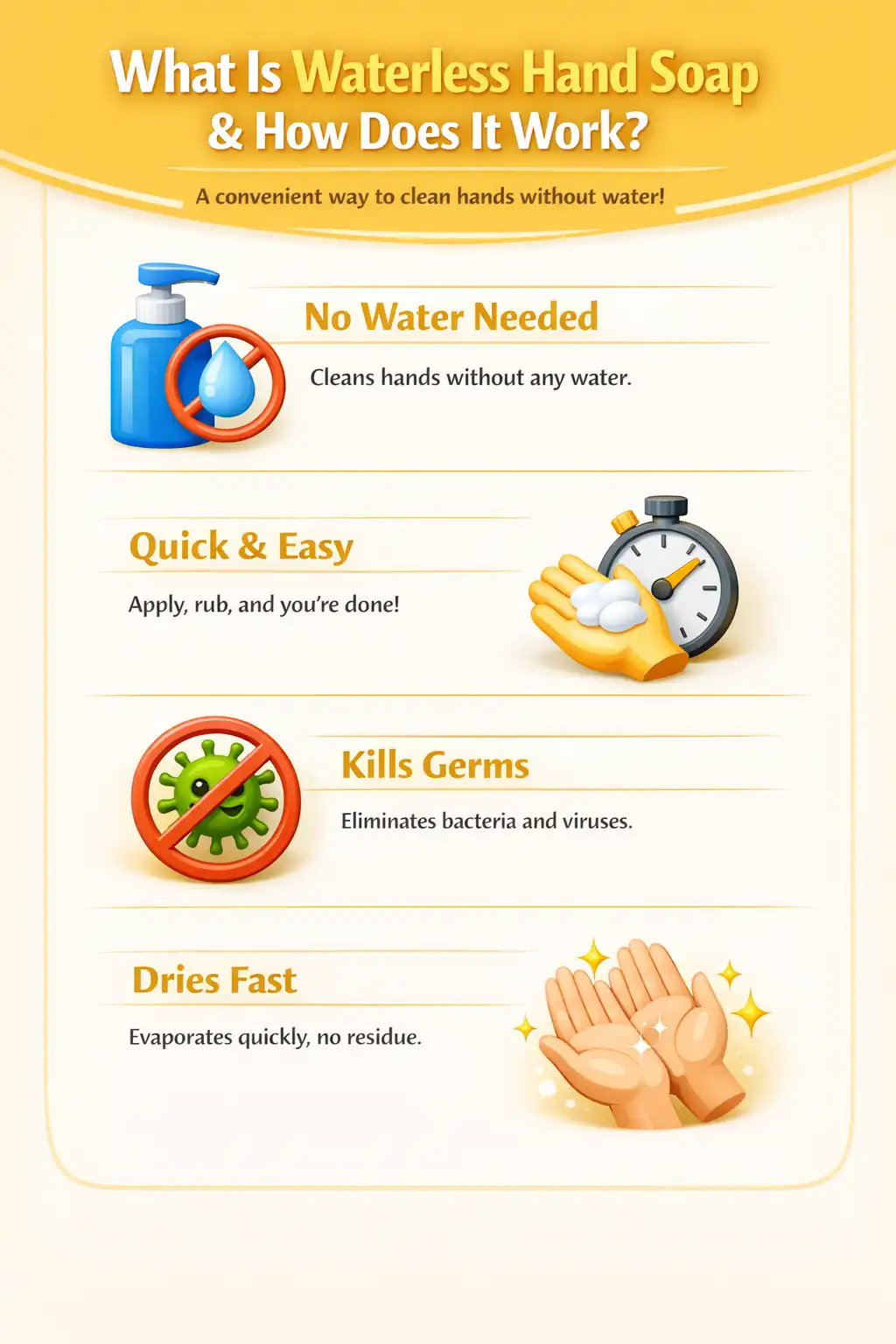
Waterless hand soap is a no-rinse cleanser designed to remove dirt, oils, and residue when water isn’t available. Unlike hand sanitizer, it works by lifting contaminants from the skin so they can be wiped away, making it useful when hands are visibly dirty and a sink isn’t nearby.
Top Takeaways
Waterless hand soap removes contaminants.
It lifts dirt, oils, and residue instead of relying only on germ-killing.It supports, not replaces, handwashing.
Soap and water remain best when available.No-water products are not the same.
Sanitizer disinfects. Waterless hand soap cleans.Most useful when water isn’t accessible.
Ideal for travel, outdoor work, mobile food prep, and emergencies.Correct use matters.
Understanding limits leads to better hygiene decisions.
What Is Waterless Hand Soap?
Waterless hand soap is a no-rinse cleansing product designed to clean hands when soap and running water aren’t available. Unlike traditional soap, it does not require rinsing, and unlike alcohol-based hand sanitizers, it is formulated to lift and remove dirt, oils, and residues from the skin rather than relying solely on germ-killing chemistry.
It’s commonly used in environments where access to sinks is limited or impractical—such as travel, outdoor work, mobile food operations, events, and emergency situations. The key distinction is that waterless hand soap focuses on physical removal of contaminants, not just disinfection.
How Does Waterless Hand Soap Work?
Waterless hand soap works through surfactants, the same class of cleansing agents used in traditional soap. These surfactants bind to dirt, grease, and organic residues on the skin. When you rub the product across your hands, those particles are loosened and suspended in the solution, a process rooted in the same contamination-control logic that underpins regulations like the clean air act, where pollutants must be captured and removed rather than simply dispersed.
Instead of rinsing with water, the contaminants are then wiped away using a towel or cloth, removing them from the skin’s surface. This mechanism is especially useful when hands are visibly dirty or greasy—situations where hand sanitizer alone may be less effective.
How Waterless Hand Soap Is Different From Hand Sanitizer
While both products are used without water, waterless hand soap and hand sanitizer serve different purposes.
Waterless hand soap focuses on cleaning by removing dirt and residues.
Hand sanitizer primarily uses alcohol to reduce microorganisms but does not remove physical debris.
This difference matters because sanitizer can be less effective on visibly soiled hands, whereas waterless hand soap is designed specifically for those conditions.
When Is Waterless Hand Soap Most Useful?
Waterless hand soap is most effective when running water isn’t immediately available, hands are visibly dirty or greasy, hygiene is still required before eating or handling items, or a temporary solution is needed before proper handwashing is possible.
It’s best viewed as a practical supplement, not a full replacement for traditional handwashing when water access exists.
“In environments where a sink isn’t always an option, we’ve seen waterless hand soap used as a practical bridge—not a replacement—for proper handwashing. The key difference is that it physically lifts and removes grease and residue, which matters far more in real-world conditions than people realize.”
Essential Resources
These are the authentic, expert-backed guides we actually relied on when developing our waterless hand soap approach. They will help you research not just product claims, but what good hand hygiene truly means—especially when water isn’t available.
1. CDC Hand Hygiene Guidelines — What Cleaning Really Involves
Learn why the CDC emphasizes removal of contaminants, not just killing germs, and why this matters when hands are visibly dirty—one of the core reasons waterless hand soap exists.
URL: https://www.cdc.gov/clean-hands/about/hand-sanitizer.html
2. FDA Consumer Guidance — Safety, Ingredients & What to Avoid
This FDA page explains which ingredients aren’t recommended in hand hygiene products and why harsher chemicals aren’t always better—insight helpful for evaluating formulas, especially for kids and sensitive skin.
URL: https://www.fda.gov/consumers/if-soap-and-water-are-not-available-hand-sanitizers-may-be-good-alternative
3. WHO Hand Hygiene Resources — Science-Based Global Best Practices
The World Health Organization breaks down when and why soap and water are still ideal, helping you understand where waterless options fit into accepted hygiene standards worldwide.
URL: https://cdn.who.int/media/docs/default-source/documents/health-topics/hand-hygiene-why-how-and-when-brochure.pdf
4. FDA Food Code — Hygiene Expectations in Food & Professional Settings
If you’re looking at waterless hand soap for kitchens, events, or professional spaces, this official code shows how hygiene standards are defined where food safety matters most.
URL: https://www.fda.gov/media/164194/download
5. ASTM E2755 — How No-Water Products Are Tested
This testing standard explains what legitimate lab verification looks like for waterless or leave-on cleansing products—a key way to judge claims like “remove vs kill.”
URL: https://www.astm.org/e2755-15.html
6. ASTM E1174 — Traditional Handwash Efficacy Explained
This benchmark for handwash testing gives context on how soap performance is measured and helps you compare conventional handwashing metrics against no-water approaches.
URL: https://www.astm.org/e1174-21.html
7. CIR / Ingredient Safety Databases — Check What’s Actually on Your Skin
Third-party ingredient safety resources let you verify the safety profile of surfactants and other cleansing agents used in waterless soap formulas, which is especially important for daily use.
URL (example database): https://cir-safety.org/ingredient/cocamidopropyl-betaine
Supporting Statistics
These statistics help explain why waterless hand soap exists, where it’s most useful, and why removal-based cleaning still matters in real-world conditions.
1. Hand hygiene works because contaminants are removed
The CDC reports that proper handwashing can reduce:
Diarrhea-related illnesses by ~30%
Respiratory infections by ~20%
In practice, these reductions come from physically removing dirt, oils, and microbes, not just neutralizing them.
This same removal principle is what waterless hand soap is designed to support when rinsing isn’t possible.
Source: https://www.cdc.gov/clean-hands/data-research/facts-stats/index.html
2. Many people skip handwashing when access is limited
A US survey summarized by the National Foundation for Infectious Diseases found:
48% of adults admit they don’t wash their hands at key moments
In real-world use, this gap is usually caused by lack of access or time, not lack of awareness.
Waterless hand soap exists to address these exact situations.
Source: https://www.nfid.org/new-national-survey-finds-nearly-half-of-us-adults-admit-to-not-washing-their-hands-at-key-moments/
3. Water access isn’t always practical
The U.S. EPA estimates a typical bathroom faucet uses:
~2 gallons of water per minute
In settings requiring frequent hand cleaning—travel, outdoor work, mobile food service—this adds up quickly.
Waterless hand soap provides a low-water alternative when sinks aren’t nearby.
Source: https://www.epa.gov/sites/production/files/2017-03/documents/ws-facthseet-indoor-water-use-in-the-us.pdf
4. Not all “no-water” products work the same
The FDA cautions that alcohol-based hand sanitizer:
Is less effective on visibly dirty or greasy hands
Killing germs alone isn’t enough when residue remains.
Waterless hand soap addresses this gap by focusing on lifting and wiping away contaminants.
Sources:
https://www.fda.gov/consumers/consumer-updates/safely-using-hand-sanitizer
https://www.fda.gov/consumers/if-soap-and-water-are-not-available-hand-sanitizers-may-be-good-alternative
Final Thought & Opinion
Waterless hand soap exists for one simple reason: real life doesn’t always allow perfect handwashing conditions. Sinks aren’t always nearby, but clean hands are still required.
From first-hand observation in mobile kitchens, travel settings, outdoor work, and high-movement environments, waterless hand soap works best when it’s treated as a supporting tool, not a replacement.
What waterless hand soap does well
Helps remove visible grime and residue when water isn’t available
Fills a gap where hand sanitizer alone falls short
Supports hygiene in moments when access, time, or location is limited
Common misunderstanding
Not all no-water products do the same thing
Hand sanitizer focuses on killing germs
Waterless hand soap focuses on lifting and wiping contaminants away
That distinction matters more in real-world use than most people realize.
Final opinion
The most responsible way to use waterless soap is to:
Use it when water isn’t available
Understand its limits
Prioritize physical removal when hands are visibly dirty
When applied correctly, waterless hand soap isn’t a shortcut—it’s a practical solution for real conditions, built around how hands actually get dirty outside of ideal environments.
FAQ on Waterless Hand Soap
Q: What does waterless hand soap actually do?
A: It loosens dirt, oils, and residue so contaminants can be wiped away. It works without rinsing when water isn’t available.
Q: How is waterless hand soap different from hand sanitizer?
A: Hand sanitizer disinfects clean-looking hands, while waterless hand soap cleans hands that are visibly dirty or greasy. One kills germs; the other removes contaminants.
Q: Can waterless hand soap replace soap and water?
A: No. Soap and water remain the best option when available. Waterless hand soap is a backup, not a substitute.
Q: When should waterless hand soap be used?
A: It’s best used during travel, outdoor or mobile work, food handling without sink access, and emergencies.
Q: Is waterless hand soap safe for frequent use?
A: Most formulas are designed for repeated use, but ingredient quality matters. Gentler surfactants tend to perform better for regular use.