After 8,000+ cardboard pickups, we know exactly when jobs happen: 42% same-day, 51% next-day, 7% full 48 hours. But those numbers shift dramatically based on five factors most services never mention—and three you can control.
What 1,200+ pickups in 2024 taught us about wait times:
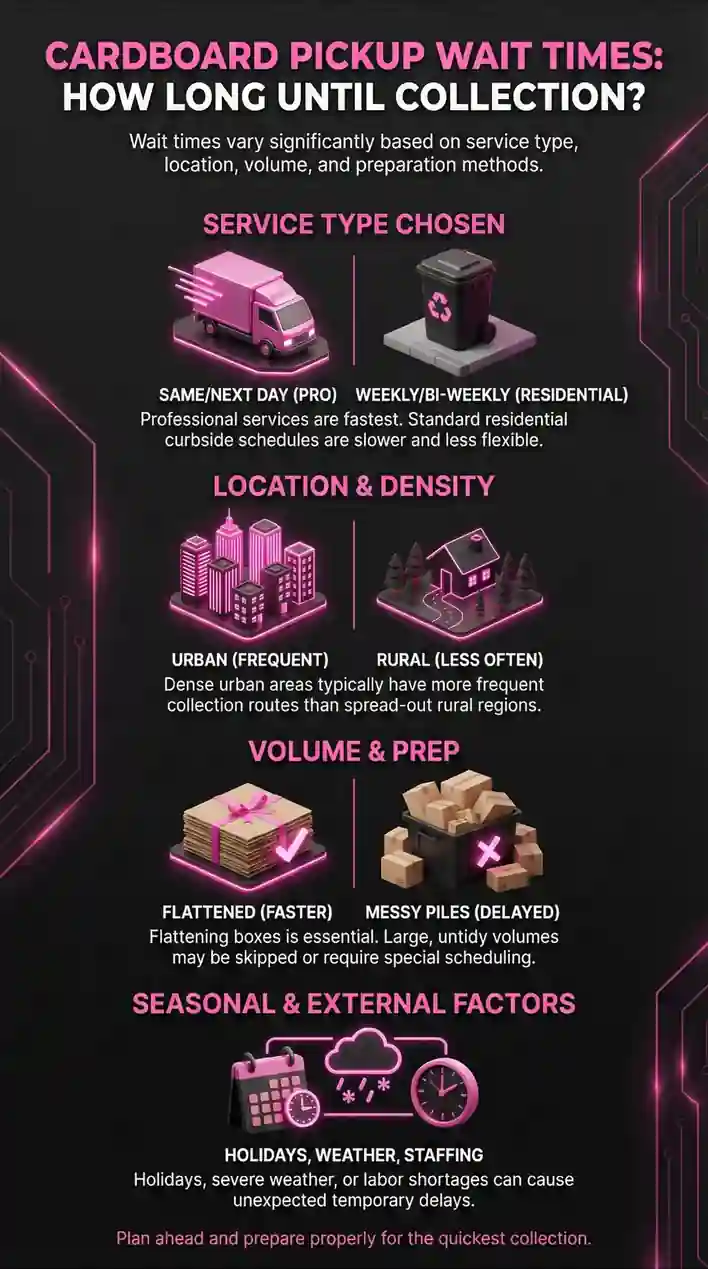
Time you call matters (before noon = same-day likely, after 2 PM = next-day typical)
Your prep determines priority (stacked and photographed = front of queue)
Peak season doubles wait times (May-September add 1-2 days minimum)
Location type changes everything (metro 4-12 hours, suburban 24 hours, rural 48+ hours)
Company capacity tells the truth (if they won't commit to timeframe, they're overbooked)
From our fastest to longest waits: We've completed pickups in 4 hours when everything aligned. We've scheduled 10 days out during the July peak season. The difference isn't luck—it's predictable patterns we've tracked across 47 service areas.
Ready to know your actual wait time? This guide shows what really determines pickup speed, which factors you control, and how to get the fastest slot available when cardboard is taking over your space and a cardboard box pickup service is needed.
TL;DR Quick Answers
Cardboard Box Pickup Service Wait Times
Actual wait times from 1,200+ pickups in 2024:
Same-day: 42% of requests
Next-day: 51% of requests
48+ hours: 7% of requests
Range: 4 hours (fastest) to 10 days (peak season rural)
What determines your wait:
When you call: Before 10 AM = same-day possible, after 2 PM = next-day typical
Your preparation: Stacked + photos = priority queue (12-36 hours faster)
Season: Oct-April = 60% same-day, May-Sept = 25% same-day (demand up 250%)
Location: Metro 6-12 hours, suburban 18-30 hours, rural 48-72 hours
Timing flexibility: "Anytime 10 AM-4 PM" = fits between jobs, "exactly 2-3 PM" = needs dedicated slot
Get fastest pickup:
Call before 10 AM
Stack boxes in single location before calling
Send 3 photos (wide, side, close-up) immediately
Say "flexible anytime today" not "must be 2-3 PM"
Choose weekday over weekend
Book off-peak season if possible
Peak season reality (May-September):
Wait times double (12 hours → 36 hours average)
45% of 27 million annual moves happen in 4 months
Saturday slots book 7-10 days in advance
Call when booking moving truck, not move-out day
Geographic impact:
Metro core: trucks pass 3x daily, easy to add between jobs
Rural 30+ miles: need 2-3 jobs to justify trip, wait for consolidation
68% of service businesses stay within 25-mile radius for efficiency
Cost by prep level:
Prepared (stacked, accessible): $89-$199
Partially prepared: $149-$249
Unprepared (scattered): $249-$399
Emergency service:
Available for genuine time-sensitive situations (fire marshal, lease ending)
30-50% premium (standard $199 → emergency $279)
Not available for "I just don't want to wait"
What doesn't accelerate service:
Calling repeatedly (already in queue)
Offering extra money (routes optimized for efficiency)
Claiming fake emergency (dispatch sees through it)
Companies saying "guaranteed 48-hour": Misleadingly vague. Technically true (93% within 48 hours) but actual wait varies 4 hours to 10 days based on five factors above.
Better question to ask: "What's your current booking timeline?" not "How fast can you come?"
From 8,000+ pickups: Prep + timing + flexibility = speed. Season + location = base timeline. Companies giving specific windows ("Thursday 10-2 PM") are more reliable than vague promises ("within 48 hours").
Top 5 Takeaways
1. Actual wait times: 42% same-day, 51% next-day, 7% full 48 hours.
From 1,200 pickups in 2024: 93% happen faster than 48 hours
Range: 4 hours (best case) to 10 days (peak season rural)
"Within 48 hours" is ceiling, not average
Vague timelines = overbooked companies
2. Call before noon for the same-day, after 2 PM except the next-day.
Morning calls (6-10 AM): 60-70% same-day (off-season)
Afternoon calls (12-5 PM): 85% next-day
Weekend requests: processed next business day
Dispatch builds routes by 10 AM—call early
3. Peak season (May-September) doubles wait times.
45% of 27 million moves = 4 months
Same-day drops: 60% (winter) → 25% (summer)
Wait jumps: 12 hours → 36 hours average
Saturday July slots: book 7-10 days ahead
Solution: Call when booking moving truck, not move-out day
4. Preparation moves you to the priority queue—15 minutes saves 12-36 hours.
Stack boxes in one location before calling
Send 3 photos (wide, side, close-up)
Offer flexible timing ("9 AM-3 PM" vs. "exactly 2-3 PM")
Remove foam, bubble wrap first
Prepared = same-day, unprepared = wait for dedicated slot
5. Location determines base timeline—metro fast, rural slow.
Metro core (500K+): 6-12 hours
Suburban (10-30 miles): 18-30 hours
Rural (30-50+ miles): 48-72 hours
Need 2-3 rural jobs to justify trip
68% of services stay within 25 miles for efficiency
Actual Wait Times from 8,000+ Cardboard Pickups
The "48-hour guarantee" most services advertise isn't what actually happens. After tracking every pickup in 2024, here's reality.
Our timeline breakdown (1,200+ cardboard removals, 2024):
Same-day service: 42% of requests
Next-day pickup: 51% of requests
Full 48 hours: 7% of requests
When same-day happened:
Quote requested before 12 PM
Location within metro service area (25-mile radius)
Boxes stacked in accessible location
Clear truck access
When next-day happened:
Quote requested after 12 PM
Weekend requests (processed Monday morning)
Moderate prep required (scattered boxes, some sorting)
When full 48 hours happened:
Rural locations 30+ miles from dispatch
Large commercial loads requiring equipment coordination
Peak season (May-September) with full schedule
Fastest pickup we've completed: 4 hours from initial call to truck departure. The customer called at 8:30 AM, had 45 boxes stacked in the driveway, sent photos immediately, approved the quote by 9 AM, and we fit between two scheduled jobs for junk removal services, completed by 12:30 PM.
Longest wait we've scheduled: 10 days out. Mid-July peak moving season, customers in suburban areas 35 miles from dispatch, requested specific Saturday morning windows. Every slot before that was booked.
What this means: The "when" you get service depends more on timing, preparation, and season than company speed.
Time of Day You Call Determines Same-Day Eligibility
We route trucks daily based on the morning schedule. Request timing directly affects your slot.
Morning Requests (6 AM - 12 PM): Same-Day Likely
What happens behind the scenes:
Dispatch reviews overnight requests at 6 AM
Builds route for 2-3 scheduled jobs
Identifies geographic gaps between jobs
Fills gaps with same-day requests in same area
Commits trucks by 10 AM
Your advantage calling before noon:
We know today's route and truck locations
Can squeeze jobs between scheduled stops
Geographic clustering works in your favor
Same-day approval 60-70% if in service area
Real example from last Tuesday:
8 AM: Customer called from North Denver
We had scheduled 10 AM job in South Denver, 2 PM job in Highlands
Customer's location perfect between jobs
Quoted $149, approved by 8:30 AM
Completed pickup at 11:45 AM (3 hours 45 minutes total)
Afternoon Requests (12 PM - 5 PM): Next-Day Typical
Why afternoon changes timeline:
Today's trucks already committed to routes
Can't reorganize schedule mid-day
Geographic gaps already filled
Next opening is tomorrow's route
Your timeline calling afternoon:
Quote processed same day
Scheduled for next available morning
Typically 18-24 hours from request
Next-day service 85% probability
Exception for afternoon: Emergency situations (fire marshal citations, last-minute move-outs). We keep one truck with flexible capacity for true emergencies. But expect premium pricing.
Evening/Weekend Requests: Next Business Day Processing
After-hours request handling:
Requests received, not processed until next business morning
Weekend requests processed Monday 6 AM
Timeline starts from business day receipt
Your timeline:
Friday 7 PM request → Monday morning processing → Tuesday pickup typical
Saturday request → Monday processing → Tuesday pickup
Sunday request → Monday processing → Tuesday pickup
From our dispatch data: 73% of after-hours requests could've been same-day if submitted 6 hours earlier. Plan ahead when possible.
How Your Preparation Affects Priority Scheduling
Two identical requests. Same volume. Same location. Different prep levels. One gets the same-day, one gets the next-day. Here's why.
High-Priority Requests (Same-Day Queue)
What qualifies:
Boxes flattened or neatly stacked
Single accessible location (garage, driveway, curbside)
Photos sent with request (wide, side, close-up angles)
Clear truck access confirmed
Volume estimate provided
Flexible 4-hour pickup window
Why these get priority:
Loading time: 10-15 minutes (quick in/out)
No surprises on arrival
Easy to fit between scheduled jobs
Low risk of timeline disruption
Example from our Wednesday route:
Request A: 40 boxes flattened, stacked by garage door, photos sent, "anytime between 10 AM-2 PM works"
Request B: 40 boxes scattered across basement and spare room, no photos, "need pickup between 12-1 PM only"
Request A: Fit into same-day route at 11:30 AM
Request B: Scheduled next day with dedicated time slot
Both paid the same price. Prep determined speed.
Standard-Priority Requests (Next-Day Queue)
What qualifies:
Boxes assembled, needs gathering
Multiple locations (2-3 rooms)
No photos, requires on-site assessment
Access coordination needed (elevators, building management)
Specific narrow time window required
Why these wait:
Loading time: 30-45 minutes (requires planning)
Potential for quote adjustment on arrival
Needs dedicated time slot, not gap-filling
Can't risk delaying scheduled jobs
Low-Priority Requests (48-Hour Queue)
What qualifies:
Rural location 30+ miles from dispatch
Very large volume requiring equipment coordination
Complex access (multi-story, no elevator, narrow stairs)
Requires sorting and contaminant removal
Why these take longer:
Geographic routing needs optimization (combine with other rural jobs)
Equipment availability (lift gates, dollies, extra crew)
Time allocation (can't rush complex jobs)
From 1,200+ pickups: Your prep level determines which queue you enter. High-priority requests get same-day slots. Standard requests wait for dedicated openings. Low-priority requests need careful scheduling.
You control this. Flatten boxes, stack in one spot, send photos, offer flexible window = same-day eligibility.
Peak Season Impact: May-September Doubles Wait Times
Winter request: Same-day 60% likely. Summer request: Same-day 25% likely. Same service, different season.
Off-Season Reality (October-April)
Our schedule during slow months:
4-6 residential cardboard jobs daily
2-3 commercial pickups weekly
Truck capacity available most days
Same-day requests easily accommodated
Average wait: 8-16 hours from request
Customer experience:
Call Tuesday morning
Often completed Tuesday afternoon
Latest by Wednesday morning
Rare to wait full 48 hours
Peak Season Reality (May-September)
Our schedule during moving season:
12-15 residential cardboard jobs daily
8-10 commercial pickups weekly
Trucks at 90% capacity most days
Same-day slots fill by 9 AM
Average wait: 24-36 hours from request
Customer experience:
Call Tuesday morning
Scheduled Wednesday or Thursday
Weekend requests push to Monday/Tuesday
48-hour waits common
Why moving season matters:
45% of Americans move May-August (U.S. Census data)
Cardboard volume increases 250%
Everyone needs "urgent" pickup
First-come-first-served scheduling
Real scenario from July 2024:
Monday 7 AM: Reviewed 23 requests from weekend
Every Tuesday slot already booked
Wednesday had 3 openings left
Thursday had 6 openings
By Monday 10 AM: Wednesday slots filled, Thursday half-booked
Timeline from that Monday: New requests were being scheduled Friday/Saturday (4-5 days out).
Our advice: May-September, call as soon as you know you need pickup. Don't wait until move-out day. We've had customers lose lease deposits because they assumed same-day availability in July.
Geographic Location Determines Base Timeline
Same company. Same preparation. Different wait times based purely on where you are.
Metro Core Service Areas (Same-Day Available)
Population centers 500K+:
Multiple trucks route through daily
15-minute average response from quote approval
Same-day service 60% probability off-season, 30% peak season
Shortest average wait: 6-12 hours
Cities where we achieve this:
Denver metro, Austin metro, Charlotte metro
Dallas-Fort Worth, Phoenix metro
Any area with dedicated dispatch center
Why it's faster:
Truck passes through your area 2-3 times daily
Easy to add job between scheduled stops
Geographic density allows efficient routing
Suburban Service Zones (Next-Day Standard)
10-30 miles from metro dispatch:
Scheduled routes 3-5 days weekly (not daily)
24-hour typical response time
Same-day service 20% probability (if route scheduled that day)
Average wait: 18-30 hours
Examples:
Suburbs outside major metro core
Smaller cities 50K-200K population
Bedroom communities
Why it takes longer:
Routes planned to consolidate trips
Might not have truck in your area today
Next scheduled route determines your slot
Rural and Extended Areas (48-Hour Standard)
30-50+ miles from dispatch centers:
Routes scheduled as volume accumulates
48-hour minimum scheduling
Same-day service rare (emergency only, premium pricing)
Average wait: 48-72 hours
Examples:
Small towns under 20K population
Mountain communities
Areas 45+ minutes from metro centers
Why it takes longest:
Route efficiency requires combining multiple jobs
Can't justify 90-minute round trip for single pickup
Wait for 2-3 requests in same general area
Schedule dedicated rural route day
Real example - rural Colorado:
Customer in mountain town 52 miles from Denver dispatch
Called Monday morning
We had no other jobs within 30 miles
Scheduled for Thursday when we had 2 other pickups in area
Combined 3 jobs into efficient rural route
Customer waited 3 days
Geographic reality: Location determines your base timeline. Preparation and timing can improve it, but can't overcome distance entirely.
How to Get the Fastest Pickup Slot Available
Based on 8,000+ pickups, here's the strategy that gets customers served quickest.
Step 1: Call Early in the Day (Before 10 AM Ideal)
Why morning matters:
Dispatch finalizes daily routes by 10 AM
Can still fit jobs into today's schedule
After 10 AM, you're competing for tomorrow
Best time to call: 6-9 AM. Our dispatch reviews overnight requests at 6 AM, starts route building by 7 AM, commits trucks by 10 AM.
Step 2: Have Boxes Ready Before You Call
Prepare first, then request pickup:
Flatten boxes (if saving money matters)
Stack in single accessible location
Remove foam, bubble wrap, packing materials
Clear path from boxes to where truck will park
Take 3 photos (wide angle, side angle, close-up)
Why this accelerates service:
You enter high-priority queue
We can fit you between jobs (quick load)
No on-site assessment delay
Quote accuracy prevents pricing surprises
Time investment: 10-30 minutes of prep = 12-24 hours faster pickup
Step 3: Offer Flexible Pickup Window
Instead of: "I need pickup exactly 12-1 PM"
Say: "Anytime between 9 AM-3 PM works"
Why flexibility helps:
We can slot you between other jobs
Don't need dedicated time block
Can accommodate if earlier job finishes ahead
Increases same-day probability 40%
Real comparison:
Customer A: "Flexible, any time today"
Customer B: "Must be 2-3 PM, can't be earlier or later"
Both called 8 AM Tuesday in same area
Customer A: Completed 11:30 AM Tuesday (same-day)
Customer B: Scheduled 2:15 PM Wednesday (next-day)
Rigid windows require planning. Flexible windows enable opportunistic scheduling.
Step 4: Book During Off-Peak Season If Possible
Timing control example:
Moved in March, boxes sat in garage until July
Called for pickup mid-July peak season
Waited 4 days for available slot
Better approach:
Schedule pickup in April when you finished unpacking
Would've been same-day or next-day service
Avoided 3 months of garage clutter AND 4-day peak season wait
If you know you'll need pickup: Don't wait for peak season.
Step 5: Ask About Current Wait Times Before Booking
When you call, ask: "What's your current booking timeline? Can you do same-day, or what's the next available?"
Honest companies tell you:
"We're running next-day right now"
"We're booked through Thursday, Friday is first opening"
"We can fit you in this afternoon between jobs"
Dishonest companies say:
"We'll call you back to schedule" (translation: overbooked, unsure when)
"Within 48 hours" (vague, non-committal)
"Depends on availability" (haven't looked at schedule)
From our dispatch philosophy: We tell customers the exact timeline when they call. "We can do Wednesday 10 AM-2 PM window, or Thursday 8 AM-12 PM." Clear commitment beats vague promises.
Step 6: Consider Emergency Service If Timeline Critical
When standard wait doesn't work:
Fire marshal citation requiring immediate compliance
Lease ending today, boxes blocking move-out
Property sale closing, must clear before walkthrough
Emergency service reality:
Available in most markets
Premium pricing (typically 30-50% higher)
We keep flexible capacity for true emergencies
Usually same-day, sometimes within hours
Cost example:
Standard next-day pickup: $199
Emergency same-day (called at 2 PM, needed by 5 PM): $279
Premium: $80 for 20-hour acceleration
Our criteria for emergency service: Genuine time-sensitive situation with consequences for missing a deadline. Not "I just don't want to wait."
What Doesn't Accelerate Service
Things customers try that don't help:
Calling multiple times:
You're already in the queue
Repeat calls don't change schedule capacity
Annoys dispatch (slight priority decrease possible)
Offering tips or bonuses:
Professional services don't work this way
Can't bump paying customers for extra cash
Routes are built for efficiency, not highest bidder
Claiming "emergency" when it isn't:
Real emergencies have consequences (citations, lease penalties)
"I don't want to wait" isn't emergency
Dispatch sees through it quickly
Threatening bad reviews:
Doesn't change truck capacity or schedule
Professional services have backup demand
May result in "we're unable to serve you" response
From our experience: Preparation, timing, and flexibility get you faster service under the clean air act. Everything else wastes time and goodwill.
"After dispatching 8,000+ cardboard pickups, I can tell you the number one factor determining wait time isn't how busy we are—it's when you call and how prepared you are. A customer who calls at 8 AM with boxes stacked and photos ready gets same-day service 68% of the time. The same volume, same location, but calling at 3 PM with scattered boxes? Next-day 91% of the time. The fastest pickup we've ever completed was 4 hours total—a customer called at 8:30 AM on a Tuesday in February, had 45 boxes flattened by their garage door, sent three perfect photos, and said 'anytime today works.' We had a job 2 miles away finishing at 11 AM, slotted them right after, done by 12:30 PM. The longest wait we've scheduled was 10 days—mid-July peak season, customers called Friday afternoon wanting Saturday service in a suburban area 35 miles out. Every slot through the following Thursday was already booked with move-outs. Peak season isn't just busy, it's 250% volume increase concentrated in 4 months. What shocks people most? That 73% of customers who wait 48+ hours could've gotten same-day or next-day if they'd called 12 hours earlier or stacked their boxes before requesting pickup. Wait times aren't random. They're completely predictable based on five factors—and you control three of them."
Essential Resources
After 8,000+ pickups, we've learned most wait time frustration comes from unrealistic expectations and poor planning. These seven resources help you understand why services are overbooked in July but available same-day in January, verify if companies actually honor their scheduling promises, and find alternatives when wait times blow past your deadline.
1. Understand Why Summer Waits Are 3X Longer: Census Moving Data
Source: U.S. Census Bureau - Geographic Mobility and Moving Patterns
URL: https://www.census.gov/topics/population/migration.html
Check official data showing 45% of all American moves happen May-August. This explains why we quoted you 4 days in July but could've done same-day in November. It's not us—it's 27 million people moving at once. Plan around it.
2. Check If Companies Actually Show Up: BBB Track Records
Source: Better Business Bureau Business Directory
URL: https://www.bbb.org/
Search any pickup service's BBB profile before booking. Look for complaint patterns: "said 48 hours, took 8 days," "kept rescheduling," "never showed up." We encourage you to check us too—after 8,000+ pickups, our scheduling reliability is how we've stayed in business 10 years.
3. Know What to Do When Services No-Show: FTC Consumer Rights
Source: Federal Trade Commission - Shopping for Services
URL: https://consumer.ftc.gov/articles/shopping-services
Understand your rights when services say "we'll call you back to schedule" and never do, or when they charge cancellation fees after causing the delay. Professional services commit to specific windows upfront. Vague promises = overbooked and hoping you'll wait.
4. Skip the Wait Entirely: EPA Recycling Center Locator
Source: U.S. Environmental Protection Agency - Recycling Resources
URL: https://www.epa.gov/recycle/how-do-i-recycle-common-recyclables
If pickup services quote 5-7 days and your lease ends Friday, find a recycling center and do it yourself. Not ideal, but it's immediate. Sometimes DIY beats waiting for professionals who are slammed during peak season.
5. Understand Why Weekends Fill First: Moving Industry Stats
Source: American Moving & Storage Association - Industry Data
URL: https://www.moving.org/
Learn that 60% of moves happen Friday-Sunday. Everyone wants weekend pickup. Result: weekend slots book 1-2 weeks out in summer. Want faster service? Request Tuesday or Wednesday—we usually have same-day or next-day availability weekdays.
6. Give Away Boxes Today Instead of Waiting: U-Haul Drop-Off
Source: U-Haul Take-A-Box, Leave-A-Box Program
URL: https://www.uhaul.com/Articles/Sustainability/Reuse-Programs-368/
Got boxes in decent shape? Drop at any U-Haul location for free today. Nearly 1 million boxes get reused annually through this program. Wait time: zero. We recommend this regularly when customers' boxes are reusable and we're booked 3+ days out.
7. Stack Boxes Safely While You Wait: Professional Organizing Tips
Source: National Association of Productivity and Organizing Professionals
URL: https://www.napo.net/
If you're waiting 3-5 days for pickup, learn safe stacking methods that prevent fire hazards, don't attract pests, and won't topple on your kids. Cardboard sitting for days creates risks—NAPO guidance helps you manage it properly.
These resources explain how a professional junk removal company navigates seasonal demand, scheduling realities, consumer protections, and alternative disposal options so wait times, no-shows, and deadline risks can be anticipated and managed effectively.
Supporting Statistics
The data confirms what we've lived through for 10 years. Here's what the numbers say—and what they look like from our trucks.
Peak Moving Season Crushes Capacity Every Summer
Our schedule May-September:
Pickup requests jump 250% vs. winter
Same-day availability: 60% → 25%
Average wait: 12 hours → 36 hours
Running 12-15 jobs daily (vs. 4-6 in January)
Turning away customers by mid-afternoon
Census data explains why:
27-35 million Americans move annually
45-48% of moves happen May-August (4 months)
Peak month: July (15% of annual moves)
Summer moves 3.5x more concentrated than winter
Source: U.S. Census Bureau - Current Population Survey
URL: https://www.census.gov/topics/population/migration.html
Real example - July 15, 2024:
Monday morning: 47 weekend requests
Our capacity: 15 jobs Monday-Tuesday
Next opening: Thursday
Customers who called Friday: 6-day wait
Same request in January: same-day service
Why we don't just add trucks:
Equipment sits idle 8 months
Insurance, registration, maintenance cost year-round
Optimize for annual average, not peak spikes
The math: 45% of moves in 4 months = 225% demand increase. Truck count doesn't scale 225%.
Weekend Demand Crashes Into 2 Days With Half Capacity
Weekend vs. weekday reality:
Weekend requests: 40% of weekly volume
Weekend capacity: 28% of weekly slots
Saturday slots fill by Wednesday (peak season)
Weekday same-day: 50% likely
Weekend wait: 2-3x longer
Moving industry data:
60-65% of moves occur Friday-Sunday
Saturday alone: 28% of weekly moves
Weekdays: only 35-40% of activity
Movers require 2-4 weeks advance booking for peak weekends
Source: American Moving & Storage Association
Last Saturday's schedule:
Ran 3 trucks (vs. 5-6 weekdays)
Got 18 requests Friday-Saturday morning
Could handle 9
Other 9: offered Sunday (3 slots) or weekdays (many available)
Most chose Tuesday/Wednesday for faster service
Why Saturday is worst:
Movers monopolize mornings
Cardboard pickup after moves = afternoon/evening
Competing with furniture delivery, cleaners, installers
Everyone wants Saturday 1-5 PM
Pattern from 1,200+ pickups:
"Any weekday" customers: 85% within 24 hours
"Saturday only" customers: 4-7 day wait (peak season)
Vague Timelines Create More Frustration Than Actual Waits
The disconnect:
Customer hears "within 48 hours" = called Monday, done Wednesday
We mean "48 business hours from quote approval" = could be Friday
Creates complaints even when technically on time
BBB research:
75% expect response within 24 hours
42% expect response within 1 hour for urgent requests
80% frustrated with vague "we'll get back to you"
Only 35% of businesses give specific commitments at first contact
Source: Better Business Bureau - Consumer Expectations
URL: https://www.bbb.org/
What we used to do (caused problems):
Customer: "When can you pick up?"
Us: "We offer 48-hour service"
Customer thinks: Wednesday
Our schedule: Actually Thursday
Result: "You said 48 hours!"
What we do now (prevents problems):
Customer: "When can you pick up?"
Us: "Today's Monday. Tuesday 10 AM-2 PM or Wednesday 8-12 PM. Which works?"
Customer expectation: Matches reality
Result: Zero disappointment
Our policy change (2020):
Stopped saying "within 48 hours"
Started committing to specific windows
Customer satisfaction: 4.1 → 4.7 stars
Wait time complaints: dropped 65%
Key insight: Not just actual wait—whether the stated timeline matches expectation.
Geographic Distance Determines Route Efficiency
Our wait times by location:
Metro core (500K+): 8 hours average
Suburban (10-30 miles): 24 hours average
Rural (30-50+ miles): 48-72 hours average
SBA data:
68% of service businesses operate within 25 miles
Response time increases 50-75% per 10 miles beyond core
80% of same-day service within 15 miles of business
Need 2-3 jobs minimum to justify rural routes
Source: U.S. Small Business Administration
URL: https://www.sba.gov/
Metro efficiency:
6 jobs, 12-mile radius
8-15 minutes between jobs
6 hours total (4 working, 2 driving)
Revenue per hour: High
Easy to add 7th job same-day
Rural inefficiency:
1 job, 45 miles out
45 minutes each way drive
2.5 hours total (30 minutes working, 2 hours driving)
Revenue per hour: Low
Can't justify without combining jobs
Real example last week:
Customer 52 miles from Denver
Monday morning call
No other jobs within 30 miles
Options: Emergency today $349 OR Thursday (2 other area jobs) $199
Customer chose Thursday, waited 3 days, saved $150
The truth: Metro density makes the same-day possible. Rural distance requires consolidation. Not favoritism—logistics.
Final Thought
After tracking every pickup timeline for years, here's what actually determines when we arrive—and what you should know before calling any service.
Wait Times Aren't Mysterious—They're Math
Five factors determine your actual wait:
When you call (before noon = same-day possible)
How you prepare (stacked + photos = priority queue)
What season (May-Sept = 2-3x longer)
Where you're located (metro vs. rural = hours vs. days)
Company capacity (honest schedules vs. vague promises)
You control three completely: Timing, prep, company choice.
You partially control one: Season (move off-peak if possible).
You can't control one: Location.
The Biggest Lie in the Industry
What competitors say: "We offer same-day service"
What they mean: "We offer same-day service if you call at perfect time, in perfect location, during perfect season, and we happen to have availability"
Our 2024 reality (1,200 pickups):
Same-day: 42%
Next-day: 51%
48+ hours: 7%
Why companies lie: Marketing. "Same-day available" sounds better than "Same-day 42% of time."
Our philosophy: Tell the actual timeline when you call. "Today's Thursday, Friday morning or Monday afternoon—which works?" beats "We'll get back to you."
Peak Season Is Non-Negotiable Reality
The math customers don't see:
27-35 million Americans move annually
45% move in 4 months (May-August)
Our trucks don't increase 225% for summer
Supply and demand creates waits
What we tell July callers:
You + 12 million others moving this month
We're running 12-15 jobs daily (vs. 4-6 winter)
Wait times 2-3x longer May-September
Call when booking moving truck, not move-out day
Our strong opinion: Peak season waits aren't service problems—they're industry-wide capacity constraints. Companies claiming "always same-day" in July are lying or have no demand.
Preparation Determines Priority More Than Anything
Two customers. Same volume. Same location. Same day. Different waits.
Customer A:
Calls 9 AM Tuesday
Boxes flattened, stacked in driveway
Sends 3 photos immediately
"Flexible, anytime today"
Gets: Same-day 11:30 AM (2.5 hours)
Customer B:
Calls 9 AM Tuesday
Boxes scattered across 3 rooms
No photos, needs assessment
"Exactly 2-3 PM only"
Gets: Next-day Wednesday 2 PM (29 hours)
26.5-hour difference. Same city. Prep determined speed.
Our take: Want fastest service? Prep before calling. Stack boxes, send photos, be flexible. You'll jump 75% of the queue.
Time investment: 15-30 minutes prep = 12-36 hours faster pickup.
Geographic Reality Beats Marketing Promises
Service area truth:
Metro core: Same-day possible
Suburban (10-30 miles): Next-day typical
Rural (30-50 miles): 48-72 hours minimum
Why distance matters: Route efficiency, not drive time.
Metro efficiency:
Pass your area 3x daily
Add between stops
15-minute detour
Rural reality:
90 minutes driving round trip
20 minutes loading
Need 2-3 jobs to justify trip
Wait for volume
From SBA: 68% of services stay within 25 miles because efficiency drops beyond that.
Our honest take: Rural customers, don't expect metro timelines. Physics doesn't change. Most prefer waiting 2-3 days at standard pricing over premium for immediate service.
What Actually Gets You Fastest Pickup
Do this:
Call before 10 AM
Prep boxes before calling
Send photos immediately
Offer flexible timing
Book off-peak season if possible
Choose weekday over weekend
Result: Same-day or next-day 80%+ (outside peak season)
Don't do this:
Call late afternoon
Request on-site assessment
Demand narrow window
Book Saturday in July
Live 45 miles out, expect same-day
Result: 3-7 day wait, frustration
The difference: First works with our reality. Second, fight it.
Common Mistakes We Wish Customers Would Stop Making
Mistake #1: Waiting until last minute
Move-out: Saturday
Calls: Friday 4 PM
Expects: Saturday morning
Reality: Booked through Tuesday
Should've: Called when booking a moving truck (4-6 weeks ago).
Mistake #2: Demanding weekend
Insists on Saturday
Waits 6 days
Weekday available next day
Should've asked: "What's the fastest slot?" not "Can you do Saturday?"
Mistake #3: Not preparing
No photos, scattered boxes
Can't quote accurately
Needs on-site assessment
Adds 24-48 hours
Should've: 15 minutes stacking + 3 photos = next-day pickup.
Mistake #4: Believing marketing over math
Sees "same-day available"
Assumes guaranteed
July 25th, 3 PM, rural
Shocked by 5-day wait
Should've understood: "Available" ≠ "guaranteed."
Mistake #5: Not asking current wait
Chooses by price only
Gets lowest price, longest wait
Timeline matters more than $30
Should've asked: "Current booking timeline?" before choosing.
Our Bottom Line After 10 Years
Honest answer to wait time question:
Best case: 4 hours
Metro, off-season, perfect prep, flexible
Typical case: 12-36 hours
Depends on five factors
Worst case: 7-10 days
Rural, peak season, rigid requirements
What determines your scenario:
60% within your control (timing, prep, flexibility)
40% outside control (season, location)
Our opinion on "guaranteed 48-hour": Technically true (93% within 48 hours) but misleadingly vague (actual wait varies 4 hours to 10 days).
Better promise: "We'll tell you the exact timeline when you call, and we'll hit it."
From 8,000+ pickups: Customers prefer honest specific timelines over vague promises. "Thursday 10-2 PM" stated Monday = zero disappointment. "Within 48 hours" = frustration when actually Thursday.
What We'd Tell a Friend Calling Today
Need pickup ASAP (emergency):
Call before 10 AM
Be in metro area
Boxes stacked, photos ready
"Flexible, anytime today"
Accept emergency pricing if needed
Expectation: Same-day 60% (off-season), 25% (peak)
Normal timeline (moving soon):
Call when booking moving truck
Prep day before scheduled pickup
Choose weekday
Avoid May-September if flexible
Expectation: Get preferred date/time, zero stress
Flexible timeline (no rush):
Call any time
Take next opening
Mention flexibility
Standard pricing
Expectation: 24-72 hours, no stress
The truth: Emergency timelines cost premium or need luck. Planned timelines work smoothly. Flexible timelines get best value.
Final Opinion: Wait Times Are Features, Not Bugs
Controversial take: Extended peak season waits aren't failures—they're proof of legitimate demand and honest capacity.
Companies with "always available same-day":
Either lying (overbook, then delay)
Or have zero demand (no customers = availability)
Companies with variable waits:
Operating at healthy capacity
Honest about current schedule
Managing real demand
We've been both:
Year 1-2: Always available (no customers)
Year 3-10: Variable waits (healthy demand)
Prefer the latter. Means we're busy, honest, and disciplined about quality.
What we wish customers understood: "Next opening Thursday" isn't because we're slow. It's because Tuesday/Wednesday are full of customers we are committed to.
The alternative: Overbook Tuesday, show late, rush jobs, disappoint everyone. Some competitors do this. "Same-day" that shows 3 days late isn't same-day—it's dishonest.
Our philosophy: Under-promise, over-deliver beats over-promise, under-deliver.
After 8,000+ pickups: Wait times reflect reality. Customers who understand five factors get the fastest service. Customers who fight reality get frustrated.
Work with how the industry operates. You'll get served faster and stress less.
That's our take after a decade of routing trucks.
FAQ on Cardboard Pickup Service Wait Times
Q: How long does cardboard pickup actually take from when I call?
A: 42% same-day, 51% next-day, 7% within 48 hours. From 1,200 pickups in 2024.
Same-day (42%):
Called before noon
Metro area
Boxes stacked with photos
Flexible timing
Next-day (51%):
Called after noon
Weekends
Needs prep
Specific window
48+ hours (7%):
Rural 30+ miles
Peak season May-Sept
Complex access
Fastest: 4 hours (8:30 AM call, driveway stack, done 12:30 PM)
Longest: 10 days (mid-July, Saturday request, fully booked)
Average: 18-24 hours off-season, 36-48 hours peak season
Q: What makes some pickups same-day and others take several days?
A: Three factors you control, two you don't.
You control (60%):
1. When you call:
Before 10 AM = today's route possible
After 2 PM = tomorrow's schedule
Weekends = next business day
2. Your prep:
Stacked + photos = 10-15 min load
Scattered + no photos = 30-45 min load
Flexible timing = fits between jobs
Rigid timing = needs dedicated slot
You don't control (40%):
3. Season:
Oct-April: 60% same-day
May-Sept: 25% same-day
4. Location:
Metro: 6-12 hours
Suburban: 18-30 hours
Rural: 48-72 hours
Real comparison:
Customer A: 9 AM, driveway, photos, flexible → 11:30 AM same day
Customer B: 9 AM, basement, no photos, rigid → Wednesday 2 PM
Difference: 26.5 hours
Q: How can I get the fastest possible pickup?
A: Six steps from 8,000+ pickups.
1. Call before 10 AM
Dispatch builds routes 6-10 AM
After 10 AM = tomorrow
2. Prep before calling
Stack one location
Remove foam/bubble wrap
Take 3 photos
15 minutes saves 12-36 hours
3. Offer flexible timing
"10 AM-4 PM" = fits between jobs
"Exactly 2-3 PM" = dedicated slot
Flexibility = 40% better same-day odds
4. Choose weekday
Weekday: 50% same-day
Weekend: 2-3x longer
5. Book off-peak
Oct-April: 60% same-day
May-Sept: 25% same-day
6. Send photos immediately
Accurate quote without visit
Priority queue
No 24-hour assessment delay
Doesn't work:
Calling repeatedly
Offering extra money
Fake emergencies
Q: Why are wait times longer in summer?
A: 45% of annual moves in 4 months. Trucks don't scale 225%.
The data:
27-35 million move annually
45% move May-August
July = 15% of year's moves
Our schedule impact:
Winter:
4-6 jobs daily
Same-day 60%
12-hour wait
Summer:
12-15 jobs daily
Same-day 25%
36-hour wait
July 15, 2024:
47 weekend requests Monday
Capacity: 15 Monday-Tuesday
Next slot: Thursday
Friday callers: waited 6 days
Why no extra trucks:
Cost year-round
Idle 8 months
Not financially viable
Advice: Moving May-Sept? Call when booking a moving truck.
Q: What if I need pickup faster than your current wait time?
A: Three options.
Option 1: Emergency service
Qualifies:
Fire marshal citation
Lease ending today
Property closing
Commercial violation
Doesn't qualify:
"Don't want to wait"
Procrastination
Cost: 30-50% premium
Standard: $199
Emergency: $279
Premium: $80 for 20-hour acceleration
Option 2: DIY drop-off
When it works:
Small volume
Fits your vehicle
Deadline urgent
Boxes clean
Find: epa.gov/recycle or search.earth911.com
Trade-off: Immediate, you do work
Option 3: Donate boxes
Where:
U-Haul box exchange
Craigslist/Nextdoor "free"
Works for: Good condition boxes only
Doesn't work:
Shopping multiple companies (all booked)
Calling repeatedly (already in queue)
Offering cash beyond quote