A professional boat removal service like Jiffy Junk manages everything from initial on-site assessment and local permitting to heavy-equipment extraction, transport, and responsible disposal or recycling. Below, we break down exactly how the process works step by step, what drives cost, and what our experience has taught us about choosing the right provider.
TL;DR Quick Answers
What Is a Boat Removal Service?
A boat removal service is a professional hauling company that removes unwanted vessels from your property and disposes of them responsibly. The process covers everything from on-site assessment and permitting to hazardous material handling, heavy-equipment extraction, transport, and environmentally compliant disposal or recycling.
What's typically included:
On-site assessment and upfront quote
All labor, equipment, and heavy lifting
Hazardous material handling — fuel, oil, batteries, anti-fouling paint
Loading, transport, and disposal at approved facilities
Complete cleanup of the removal area
Who uses boat removal services:
Homeowners with old boats in driveways or backyards
Property buyers who inherited unwanted vessels
Families managing estates with boats to dispose of
Marina owners clearing abandoned watercraft
What we've learned after thousands of removals: Most boat owners don't call until they've already spent weeks trying to figure it out on their own. Marinas won't take it. Donation programs reject anything that isn't seaworthy. DIY disposal leads to environmental fines and costs that exceed professional removal. A qualified boat removal service eliminates the guesswork and handles the entire process — so you don't have to.
Average cost range: $500–$5,000 depending on size, condition, accessibility, and disposal method.
Typical timeline: Most removals are completed in 2–4 hours. Complex jobs may take a half day or more.
Top Takeaways
Professional boat removal follows a clear five-step process. Assessment, permitting, hazardous material handling, extraction, and responsible disposal. A qualified service manages every step. After thousands of removals, most customers tell us they're surprised how straightforward it is once the right team is handling it.
Waiting is the most expensive decision you can make. Hulls deteriorate. Fluids leak. Trailers rust into the ground. A few-hour job becomes a multi-day project. We've watched removal costs double or triple from just a few years of inaction.
200,000 boats reach end of life every year — and disposal infrastructure hasn't kept up. Donation programs reject most vessels. Fiberglass can't go in a standard landfill. Haulers who actually show up with the right equipment are harder to find than they should be.
Every boat contains materials that require proper handling. Fuel, oil, batteries, anti-fouling paint, and fiberglass all fall under federal and state environmental regulations. A responsible service handles this as part of the job — not as a surprise add-on.
The right service makes it simple. Upfront pricing. No hidden fees. Reliable scheduling. Licensed, insured crews who handle all the heavy lifting and cleanup. You point, we do the rest. That's White Glove Treatment on every Jiffy Junk boat removal.
Step 1: Initial Assessment and Quote
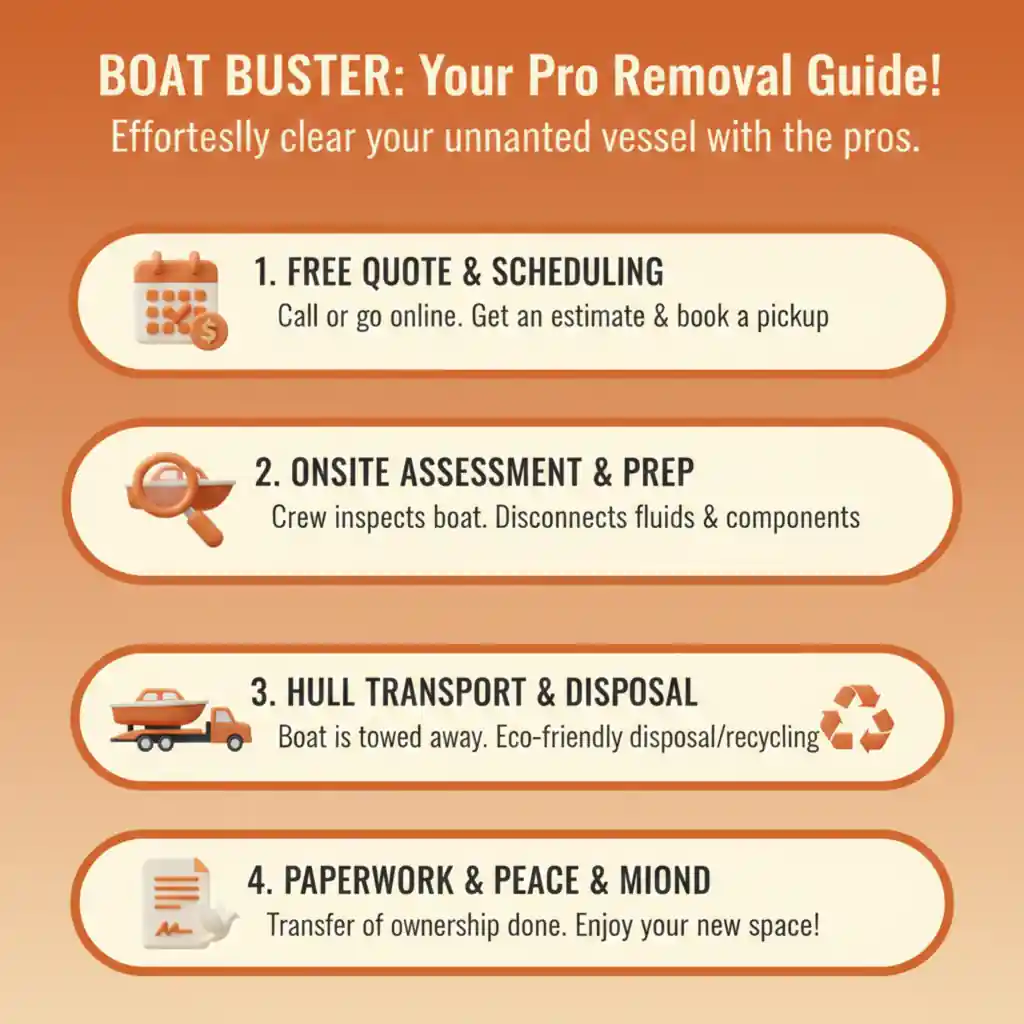
Every professional boat removal starts with an evaluation. At Jiffy Junk, we assess the vessel's size, condition, location, and accessibility before providing a transparent, upfront quote. A boat wedged behind a garage requires a very different approach — and different equipment — than one sitting on a trailer or partially submerged at a dock.
During this stage, our team identifies potential complications like hazardous materials, structural instability, or limited access points that could affect the scope of work. This on-site or photo-based assessment is what separates experienced removal companies from those that surprise you with hidden fees on job day.
Step 2: Permitting and Regulatory Compliance
Depending on your location and where the boat is situated, removal may require permits from local, state, or federal agencies — especially for vessels in waterways, wetlands, or coastal zones. Environmental regulations around fuel, oil, fiberglass, and anti-fouling paint make compliance non-negotiable.
Our teams handle this paperwork as part of the service because we've learned that most boat owners don't realize permits are required until they're already facing a violation. A qualified removal provider manages this process so you don't have to.
Step 3: Preparation and Hazardous Material Handling
Before a boat moves anywhere, it needs to be prepped. That means draining fuel, removing batteries, pumping out holding tanks, and addressing any hazardous fluids or materials on board. Skipping this step is one of the most common — and most expensive — mistakes we see from DIY attempts.
Our crews follow EPA disposal guidelines for every fluid and material removed, ensuring nothing contaminates the surrounding soil or water during extraction.
Step 4: Extraction and Transport
This is where heavy equipment enters the picture. Depending on the vessel's size and location, removal may involve cranes, hydraulic trailers, marine lifts, or even barge-based extraction for boats still in the water. After thousands of removals, we've found that matching the right equipment to the specific job site is the single biggest factor in preventing property damage and keeping the project on schedule.
Once extracted, the boat is loaded and transported to the appropriate facility for the next phase.
Step 5: Disposal, Recycling, or Donation
Not every removed boat ends up in a landfill. Professional services like Jiffy Junk prioritize responsible outcomes. Fiberglass, aluminum, steel, engines, and usable hardware can often be recycled or salvaged. In some cases, boats in fair condition may qualify for donation programs that provide the owner with a tax deduction.
We work with licensed recycling facilities and disposal partners to ensure every vessel is handled in the most environmentally responsible way possible, with practices aligned to the clean air act. Customers consistently tell us that knowing their boat was disposed of properly — not just dumped — gives them real peace of mind.
How Long Does Professional Boat Removal Take?
Timeline varies based on vessel size, location complexity, and permitting requirements. Straightforward removals — a small boat on a trailer in a driveway, for example — can often be completed in a single day. Larger or more complex jobs involving waterway extraction or extensive hazmat prep may take several days to a week.
In our experience, the biggest timeline variable isn't the physical removal itself. It's the permitting process, which is why we recommend contacting a removal service as early as possible once you've decided to move forward.
What Does Boat Removal Typically Cost?
Cost depends on several factors including boat size, weight, condition, location, accessibility, and disposal method. Small boat removals may start in the low hundreds, while large vessel extractions requiring crane work and environmental remediation can run into the thousands.
The most reliable way to get an accurate estimate is through an on-site or photo-based assessment. At Jiffy Junk, we provide upfront, all-inclusive pricing with no surprise charges — because we've heard too many stories from customers who were blindsided by add-on fees from other providers.
"After removing thousands of boats across every scenario imaginable — backyard vessels that haven't moved in 20 years, half-sunk hulls in shallow waterways, even boats trapped behind fences with no clear path out — the one thing we tell every customer is the same: the longer a boat sits, the harder and more expensive it gets to remove. Fiberglass deteriorates, fluids leak into the ground, and what could have been a straightforward job turns into an environmental remediation project. The best time to call a professional is before it becomes an emergency."
Essential Resources
We know that figuring out what to do with an unwanted boat can feel like a project in itself. Before you even get to the removal part, there are regulations to navigate, disposal options to weigh, and environmental requirements you probably didn't know existed. That's why we've put together seven trusted resources we consistently reference — and recommend to customers — so you can feel confident about every step of the process.
1. Find Out What Boat Removal Programs Exist in Your State
NOAA Marine Debris Program — Abandoned and Derelict Vessels Info Hub
Every state handles vessel disposal a little differently. NOAA's state-by-state database is the single best place to find local programs, funding options, and agency contacts in your area — so you can explore all avenues before making a decision.
Resource URL: https://marinedebris.noaa.gov/resources/abandoned-and-derelict-vessels-info-hub
Source Type: Federal Government Agency
2. Understand What Environmental Steps Are Required Before Disposal
U.S. EPA — Disposal of Vessels at Sea
Boats carry fuel, oil, batteries, and other materials that require proper handling. The EPA lays out exactly what needs to be removed and how — keeping you compliant and keeping the waterways we all enjoy free from contamination. Any legitimate removal service should be following these guidelines on every job.
Resource URL: https://www.epa.gov/marine-protection-permitting/disposal-vessels-sea
Source Type: Federal Government Agency
3. Learn How Boat Donation Tax Deductions Actually Work
IRS Publication 4303 — A Donor's Guide to Vehicle Donations
Thinking about donating your boat instead of having it removed? This official IRS guide covers the real rules around tax deductions for donated vessels valued over $500 — including Form 1098-C requirements, fair market value determination, and what qualifies. Worth reading before you commit to any donation program.
Resource URL: https://www.irs.gov/pub/irs-pdf/p4303.pdf
Source Type: Federal Government Agency
4. Know Exactly What to Do If a Vessel Is Leaking or Blocking a Waterway
NOAA — Vessel Damage and Navigation Hazard Reporting
If a boat is sinking, leaking fuel, or obstructing navigation, it needs to be reported immediately — not next week. NOAA walks you through the correct reporting chain, including when to contact the U.S. Coast Guard National Response Center at 1-800-424-8802. This is one of those resources you hope you never need, but should have bookmarked just in case.
Resource URL: https://marinedebris.noaa.gov/why-marine-debris-problem/vessel-damage-and-navigation-hazard
Source Type: Federal Government Agency
5. Get Clear on Hazardous Material Disposal Requirements
BoatUS Foundation — Clean Boating and Waste Disposal
From used oil to old batteries to anti-fouling paint, this guide breaks down federal disposal requirements in plain, easy-to-understand language. Whether you're handling prep work yourself or hiring a professional removal service like Jiffy Junk, knowing what hazardous materials are involved helps you ask the right questions and avoid surprises.
Resource URL: https://www.boatus.org/clean-boating
Source Type: Nonprofit Organization (501c3)
6. See Why Abandoned Boats Are a Bigger Problem Than Most People Realize
NOAA Marine Debris Program — Abandoned and Derelict Vessels
We see it constantly — boats that sat too long become environmental hazards, navigation risks, and legal liabilities. NOAA's overview explains the full scope of the problem, outlines how to report abandoned vessels in your area, and details the federal grant programs supporting removal efforts nationwide. If you're on the fence about acting now versus waiting, this resource makes the case clearly.
Resource URL: https://marinedebris.noaa.gov/what-marine-debris/abandoned-and-derelict-vessels
Source Type: Federal Government Agency
7. Understand Your Legal Obligations Under Federal Wreck Removal Regulations
33 CFR Part 245 — Removal of Wrecks and Other Obstructions
Here's something most boat owners don't realize: federal law places primary removal responsibility on the vessel owner. This Code of Federal Regulations resource spells out owner liability, how abandonment is legally determined, and the enforcement roles of the U.S. Army Corps of Engineers and Coast Guard. It's not light reading — but it's important reading if you're trying to understand where you stand legally.
Resource URL: https://www.ecfr.gov/current/title-33/chapter-II/part-245
Source Type: Federal Government Regulation
These essential resources help you understand boat removal rules, environmental requirements, and legal responsibility upfront, which can reduce surprises and help you estimate estate cleanout costs related to vessel hauling, disposal, and compliance.
Supporting Statistics
What We've Learned About Boat Disposal in America
After removing thousands of vessels across the country, we've developed a clear picture of the boat disposal landscape. The federal data backs up what we see on the job every day — and understanding these numbers can help you make a smarter decision about your own vessel.
200,000 Boats Reach End of Life Every Year — and Most Owners Wait Too Long
We hear the same story from customers constantly. They knew the boat needed to go years ago but couldn't find anyone to give them a straight answer. So it just sat there.
Then the real problems started:
Fiberglass deteriorated beyond simple removal
Fluids leaked into the surrounding soil
The trailer rusted into the ground
A few-hour job became a multi-day project
They're not alone. The National Marine Manufacturers Association estimates 2–3% of all U.S. recreational boats reach end of life annually — roughly 200,000 vessels per year. NOAA has flagged this growing "legacy fleet" as a direct driver of rising boat abandonment nationwide.
The reality we see every day:
Donation programs reject anything that isn't seaworthy
Most owners don't know fiberglass can't go in a standard landfill
Fuel, oil, and batteries require environmental handling before a vessel can move
Finding a hauler who actually shows up with the right equipment is the hardest part
Disposal infrastructure hasn't kept pace with aging vessels. The sooner you act, the simpler and more affordable the removal is — that's not a sales pitch, it's what years of doing this work has taught us.
Source: NOAA Marine Debris Program — Building a Fiberglass Boat Recycling Program https://marinedebris.noaa.gov/prevention/building-fiberglass-boat-recycling-program
11.55 Million Registered Boats — and We're Seeing Who Owns the Aging Ones
We've noticed a clear shift in who's calling us. It used to be mostly marina owners and property managers. Now it's:
Retirees who can no longer maintain a vessel they bought decades ago
Families settling an estate who inherited a boat nobody wants
New homeowners who didn't realize a rotting hull in the backyard came with their purchase
The U.S. Coast Guard's 2023 Recreational Boating Statistics report puts it in perspective: approximately 11.55 million recreational vessels are currently registered in the United States. A significant portion were built between the 1970s and 1990s — meaning millions of fiberglass boats are now 30 to 50+ years old and well past their useful life.
That's the trend line we're living inside of every day. More aging boats. Fewer realistic disposal options. And a growing number of owners who just need someone to show up, give them an honest price, and make the problem disappear.
Source: U.S. Coast Guard — 2023 Recreational Boating Statistics (COMDTPUB P16754.37) https://www.uscgboating.org/library/accident-statistics/Recreational-Boating-Statistics-2024.pdf
One State. 1,205+ Vessels Removed. Still Growing.
Washington State's DNR Derelict Vessel Removal Program has pulled more than 1,205 abandoned or neglected vessels from state waterways since 2002. The program has been cited as a national model and holds a $17.1 million budget for the 2025–2027 biennium.
We bring this up because the pattern Washington documents at the state level is the same one we see at the individual level, job after job:
Owner gets hit with an unexpected repair bill
Marina fees stop making sense
No affordable disposal option exists
Owner walks away
Boat deteriorates
It becomes someone else's problem — at significantly higher cost
State programs like Washington's exist because enough people waited long enough that it became a public crisis requiring millions in government funding. We'd rather help you avoid that outcome with a single phone call.
Source: Washington State Department of Natural Resources — Derelict Vessel Removal Program https://dnr.wa.gov/aquatics/recovering-derelict-vessels
When the Federal Government Spends Millions, the Problem Is Real
NOAA has directly supported the removal of almost 400 abandoned vessels from U.S. waterways through its Marine Debris Removal Grant program. In 2024, NOAA partnered with the BoatUS Foundation on a $10 million grant — funded through the Bipartisan Infrastructure Law — dedicated specifically to abandoned vessel removal nationwide.
We've seen firsthand what these vessels do:
Crush sensitive marine and coastal habitats
Leak fuel and oil into surrounding water
Block navigation channels
Degrade property values for entire communities
Persist for years, breaking apart and spreading debris into ecosystems
Every vessel removed through a government program represents a boat someone walked away from — usually because they couldn't find an affordable path to disposal. That's the gap Jiffy Junk exists to fill. You don't need a government grant or a state program waitlist. You need a team that arrives equipped, handles the environmental requirements properly, and gets it done.
Source: NOAA Marine Debris Program — Abandoned and Derelict Vessels https://marinedebris.noaa.gov/what-marine-debris/abandoned-and-derelict-vessels
Source: NOAA Marine Debris Program — Bipartisan Infrastructure Law ADV Removal Grant Awards https://marinedebris.noaa.gov/funding-opportunities/noaa-marine-debris-program-awards-funding-14-new-projects-remove-marine-debris-under-bipartisan-infrastructure-law
Why These Numbers Should Shape Your Decision
These statistics confirm what thousands of removals have taught us:
The boat disposal problem is larger than most people realize
Available infrastructure is limited and underfunded
Waiting — even a year or two — makes everything harder and more expensive
Responsible boat removal doesn't require grant applications or state agency waitlists. It requires a team that gives you a straight answer, shows up when they say they will, and handles your boat the right way.
Final Thoughts & Opinion
Our Take: Boat Removal Shouldn't Be This Hard
After removing countless vessels across the country, we've developed strong opinions about boat disposal in America — and what owners deserve when they're ready to let go.
The boating industry makes buying easy. Dealerships, financing, boat shows, marina memberships — the path into ownership is paved and well-lit. The path out? That's where everything falls apart.
There's no trade-in program for aging hulls. No national recycling infrastructure. No standardized process for end-of-life disposal. Instead, owners are left to figure it out alone:
Weeks of research that leads nowhere
Donation programs that reject anything not seaworthy
Haulers who quote one price and charge another — or never show up at all
Abandonment starts looking easier than navigating a broken system
This isn't a failure of boat owners. It's a failure of the industry to take end-of-life responsibility seriously.
What Boat Owners Actually Need
Based on every removal we've completed — from 14-foot aluminum fishing boats to 40-foot cabin cruisers buried in backyards for a decade — owners need three things that are surprisingly hard to find:
Straight answers. Most people calling us have already spent hours searching, been ghosted by haulers, and read conflicting information about permits and fees. They need someone who will assess their situation honestly and explain exactly what happens next.
Reliable execution. The number of customers who tell us "the last company never showed up" is frustrating. You commit to a job, you show up and do it right. In this industry, basic professionalism has become a differentiator.
Environmental accountability. Every boat contains fuel, oil, batteries, fiberglass, and anti-fouling paint that require proper handling. Responsible disposal costs more than cutting corners — but it protects the waterways and communities we all share.
The Real Cost of Waiting
If there's one piece of advice we'd give every boat owner reading this, it's simple: don't wait.
The boats that become expensive, complicated problems are almost always the ones that sat too long. The progression is predictable:
Hulls deteriorate beyond simple removal
Hazardous materials leak into surrounding soil and water
Trailers rust into the ground and require separate extraction
A few-hour job becomes a multi-day project
Removal costs double or triple from just a few years of inaction
Waiting doesn't just cost you more money. It transfers the burden:
To neighbors who have to look at it every day
To local waterways if the vessel gets abandoned
To the next property owner who inherits the problem
To taxpayers funding programs like Washington's $17.1 million derelict vessel effort
The 200,000 boats reaching end of life every year won't dispose of themselves. Each one represents a choice: handle it now, or let it become someone else's problem later.
Where We Stand
Nobody buys a boat planning for disposal day. But that day comes — and when it does, owners deserve:
A service that treats them with respect
A company that delivers on its promises
A team that handles the vessel the right way — environmentally, legally, and professionally
That's what we've built at Jiffy Junk. Same White Glove Treatment on every job — whether it's a basement cleanout, estate clearing, or a 30-foot sailboat that's been sitting in a backyard since the early 2000s.
We're not happy until you are. That's not a tagline. It's the standard we hold ourselves to, job after job, boat after boat.
FAQ on Boat Removal Service
Q: How much does a boat removal service cost?
A: Most professional boat removal jobs cost between $500 and $5,000. Key cost factors include:
Size and weight — larger vessels need more equipment and labor
Accessibility — tight backyards cost more than open driveways
Vessel condition — boats with fuel, oil, or batteries need hazardous material handling
Location — distance to disposal facilities affects pricing
After thousands of removals, we've learned accessibility often matters more than size. We've removed 25-foot boats in two hours and spent all day on 16-foot vessels wedged behind fences. Jiffy Junk provides upfront pricing. The quote we give is the price you pay.
Q: What types of boats can a removal service take?
A: A professional boat removal service can handle virtually any vessel type, size, or condition. Common removals include:
Sailboats and motorboats
Fishing boats, pontoons, and cabin cruisers
Jet skis and personal watercraft
Canoes, kayaks, and houseboats
Boat trailers and marine equipment
The vessel does not need to:
Run or be seaworthy
Be intact or look presentable
Have a working engine or trailer
We've removed fiberglass hulls sitting 20+ years, aluminum boats with trees growing through them, and vessels that no longer resemble boats. Call us — nine times out of ten, the answer is yes.
Q: What happens to my boat after removal?
A: A responsible boat removal service processes every vessel with environmental accountability. Here's how Jiffy Junk handles disposal:
Aluminum and steel — recycled at certified facilities
Engines and usable hardware — salvaged when possible
Fuel, oil, coolant, and batteries — disposed of per federal and state regulations
Fiberglass hulls — processed through approved disposal channels
We've seen firsthand what happens when boats get dumped irresponsibly. NOAA spends millions annually addressing abandoned vessels that contaminate waterways and destroy habitats. We handle it the right way on the front end, every time.
Q: Do I need to prepare my boat before removal day?
A: Minimal preparation required.
What you do:
Clear a path to the vessel
Remove personal belongings you want to keep
Mention any access issues when scheduling
What we handle:
Draining all fluids
Disconnecting batteries
All disassembly and heavy lifting
Loading, transport, and disposal
Complete cleanup of the area
Debris inside the cabin, wasp nests, trailers rusted into the ground — none of it fazes us. Your only job is to point. That's White Glove Treatment.
Q: How long does professional boat removal take?
A: Most boat removals are scheduled within a few days to one week. Physical removal timelines depend on complexity:
Standard removals: 2–4 hours
Larger vessels or complex access: half day or more
Severely deteriorated boats: assessed and quoted upfront
The biggest timeline variable isn't the boat itself — it's how long it's been sitting. Vessels that have deteriorated for years require additional steps:
Fluids need draining
Environmental handling adds time
On-site dismantling may be required before anything moves
Every year a boat sits untouched adds complexity and cost. One more reason not to wait.