This guide is for the people who'd rather choose the right valet trash pickup service before something goes wrong. Whether you're a resident encouraging your board to improve convenience, an HOA member sourcing a first contract, or a property manager scoring three quotes ahead of renewal, here's how to evaluate the local market with confidence instead of relying only on a vendor's word for it.
TL;DR Quick Answers
valet trash pickup service
Valet trash pickup service is a doorstep waste collection amenity offered by multifamily and HOA-managed properties. A uniformed crew collects sealed trash bags from outside each resident's door on a set schedule and hauls them to the property's central dumpster or compactor.
Cost: $20 to $50 per unit per month [VERIFY], billed to the property and passed through to residents via rent or HOA dues
Frequency: Four to five nights per week, usually Sunday through Thursday, between 6 and 10 PM
Resident's role: Bag and tie household trash, then place it in the provided container outside your door during the pickup window
Where offered: Apartments, condos, HOA-managed neighborhoods, senior living communities, and a growing share of single-family suburban developments
Why properties adopt it: Cuts dumpster overflow and pest issues, improves common-area cleanliness, and consistently lifts tenant retention on properties that add it
Top Takeaways
Search by ZIP code first. Local route density drives both price and reliability.
Ask your property manager before sourcing yourself. Most multifamily communities already have a vendor or are evaluating one.
Compare three providers in writing. Pricing can vary 30–50% within a single metro .
Expect $20 to $30 per unit monthly for standard service . Premium tiers run $35 to $50, and single-family HOA service lands between $25 and $40 per home .
Verify licensing, insurance, and crew tenure. Reputable providers share all three on request.
Read only the last 12 months of reviews. Older ones may not reflect current ownership or crew quality.
Insist on a written missed-pickup credit policy. It's the single best predictor of how a provider handles service failures.
What Valet Trash Pickup Service Actually Is
Valet trash service is a doorstep waste collection amenity offered by multifamily and HOA-managed properties. The word "valet" comes from the personal-attendant tradition: a service worker handling a routine task on your behalf. In waste collection, that translates to a crew member walking your hallway or floor on a set schedule, picking up tied bags from a provided container outside your door, and hauling them to the property's central waste point. Pickups typically run four or five nights a week, between 6 and 10 PM.
Most communities run the service Sunday through Thursday. Premium tiers extend pickup into the weekend or add a separate recycling night. Residents almost never pay the provider directly. The property contracts the service, then either bundles the cost into rent or passes it through as a flat amenity fee.
How to Find Valet Trash Pickup Service Near You
1. Search by ZIP code, not just city name
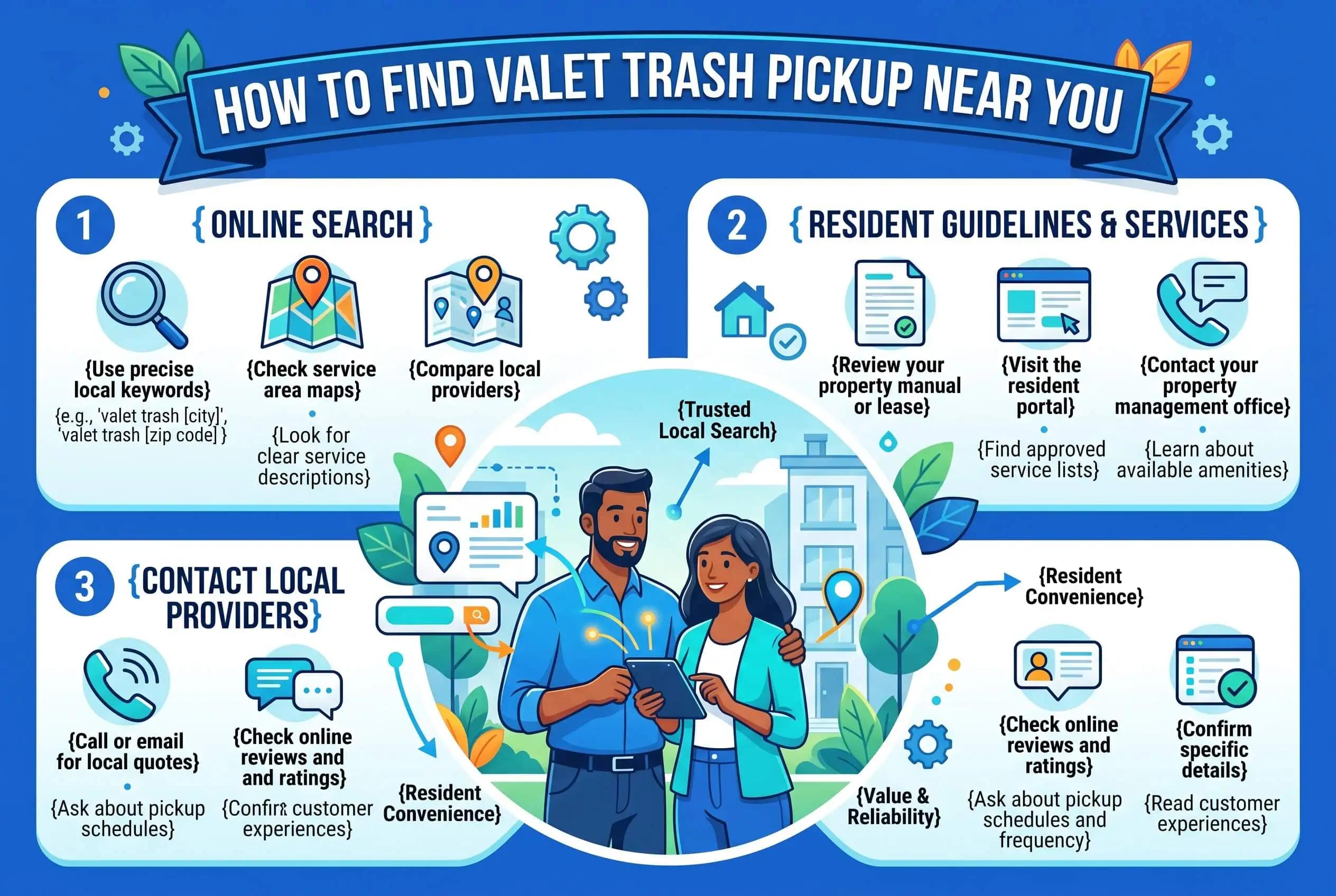
Routes are local. A provider running nightly routes through your specific ZIP will quote far lower than one driving in from across the metro. Search with your ZIP code attached to the phrase "valet trash pickup service" rather than the city name. City-only searches surface vendors whose actual coverage may not reach your block.
2. Ask your property manager first
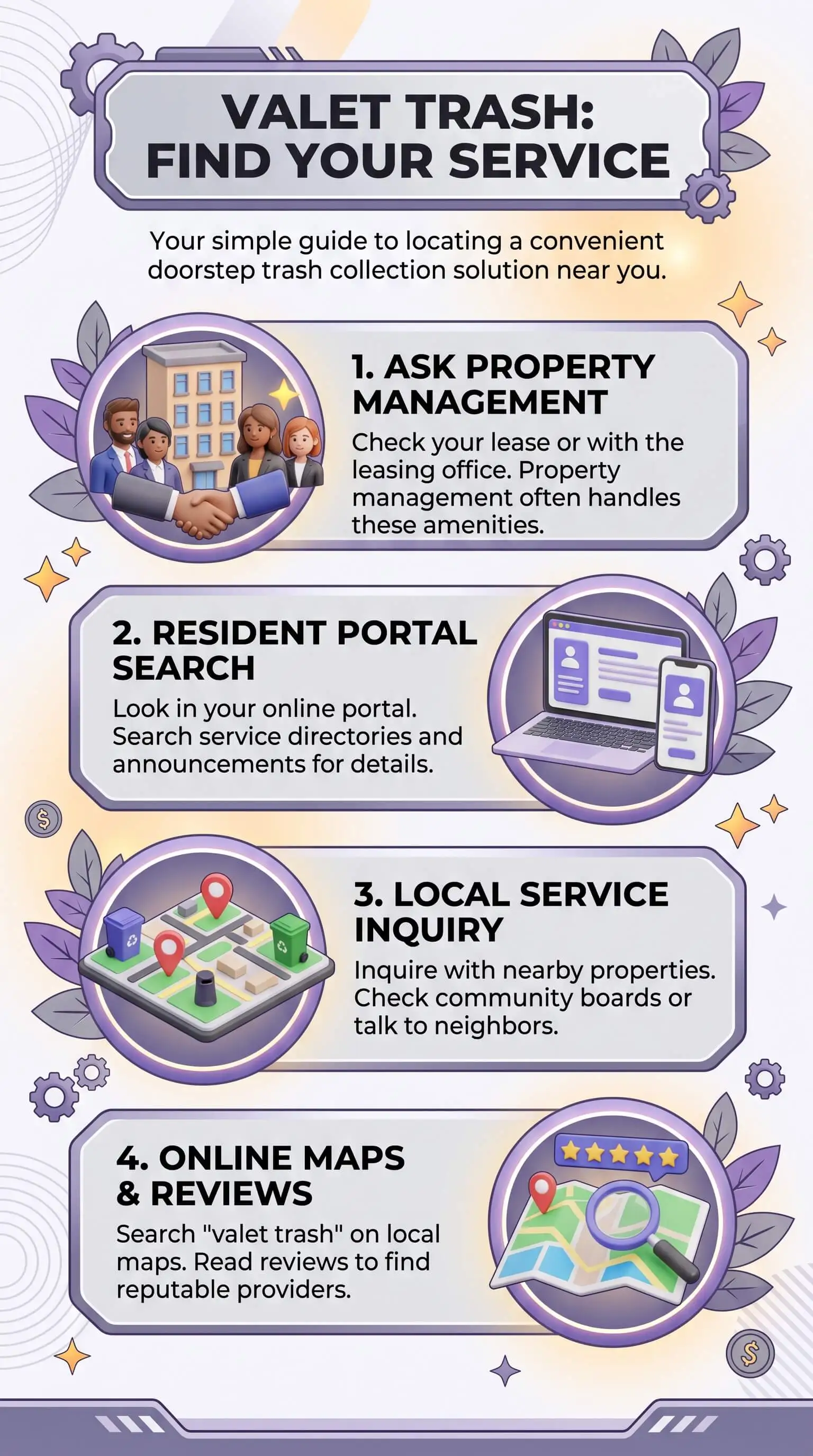
If you live in an apartment, condo, or HOA community, your property manager almost certainly already has a vendor relationship. Ask first whether service is included in rent, available as an add-on, or under evaluation for the next contract cycle. The conversation usually saves residents from having to source a provider on their own.
3. Compare at least three local providers
Pricing can swing 30–50% between providers in the same metro , driven mostly by route density and contract size. Get written quotes from three vendors before signing anything. For residents pushing an HOA toward a new vendor, bringing three comparison quotes to the next board meeting moves the decision faster than any single provider's sales deck.
4. Verify licensing, insurance, and references
A reputable valet trash company carries general liability insurance, holds whatever municipal hauling permits your county requires, and can name two property-manager references in similar-sized communities. If a provider hesitates on any of the three, move on.
5. Read recent reviews — last 12 months only
Filter Google Business Profile and Yelp reviews to the last year. Older reviews tend to reflect previous ownership, a different route crew, or pre-acquisition service quality. Skim for patterns: missed pickups, torn or unreplaced containers, and how the provider handles holiday weeks or severe weather. Patterns matter more than any single complaint.
What Valet Trash Pickup Service Should Cost
Standard four-to-five-night service in most U.S. metros runs $20 to $30 per unit per month . Premium and concierge tiers — five-to-seven-night pickup, separate recycling, app-based notifications — climb to $35 to $50 per unit . Single-family HOA service, the fastest-growing segment in suburban markets, lands between $25 and $40 per home for one to three weekly pickups .
Residents almost always pay through rent or HOA dues rather than directly to the provider. For a deeper breakdown of how unit count, pickup frequency, and metro location move pricing, including what property managers typically pay versus what residents see passed through, JiffyJunk publishes a valet trash pickup service cost for apartments and homes guide that walks the full math.
"Years of looking at multifamily service contracts have led me to one stubborn conclusion. The best valet trash providers aren't the cheapest, and the loudest pitch is rarely the right one. The good ones are the companies whose route crews have been on the same buildings for two or three years running. Tenure beats every other variable, because the thing that kills a valet trash contract isn't the headline rate. It's the third missed Tuesday in a row when residents start emailing the property manager. When I'm walking a community through provider evaluation, my first question is always: how long has the lead route worker been with the company? Eighteen months or more is usually a green light. Anything under six months means I keep shopping."
7 Essential Resources
These are the sources we lean on most often when researching providers, pricing, and the broader multifamily waste management landscape. Every link goes to primary, authoritative material — industry associations, government agencies, or trade press. Each entry includes what's actually in the resource and how to use it for your specific decision.
1. NMHC and Grace Hill Renter Preferences Survey Report. The biennial benchmark for what apartment renters actually want and pay for, published by the National Multifamily Housing Council since 2013. The 2024 edition pulled responses from 172,703 renters across 4,220 communities, with willingness-to-pay data broken down by amenity type.
Worth buying the executive summary alone if you're an HOA board building the financial case for adding valet service to next year's contract. The report cites specific dollar figures for what renters say they'd pay extra for individual amenities, which gives boards a defensible number to anchor any proposed fee increase. Available as executive summary, full national report, or any of 77 individual metro reports.
Link: nmhc.org/research-insight/research-report/nmhc-grace-hill-renter-preferences-survey-report/
2. National Apartment Association — Winning the Amenities Arms Race. NAA's editorial position piece on how the multifamily industry's amenity strategy has shifted from community-centric features (gyms, lounges, rooftop spaces) to resident-focused services (pet care, home cleaning, valet trash, package delivery).
Useful context for property managers trying to justify a service contract to ownership, or HOA boards trying to understand where valet trash sits in the broader competitive landscape. Cites Valet Living research showing 88% of renters would consider using a pet care service and 73% are open to home cleaning, which puts valet trash adoption rates in perspective against the next wave of premium amenities.
Link: naahq.org/winning-amenities-arms-race
3. NAA Recycling Programs Best Practice Guide. Worth reading before signing any contract that includes a separate recycling night. The guide draws from Eureka Recycling and Waste Management toolkits and covers what actually drives recycling participation in apartment communities: clear signage, color-coded bins, single-stream versus sorted collection, and resident outreach in preferred languages (the toolkit includes templates in Spanish, Korean, Mandarin, Vietnamese, and several others).
Includes specific guidance on how often to refresh educational materials (every four to six months at minimum) and how to spot contamination patterns before they turn into hauler complaints or surcharge fees. If your provider offers a recycling add-on, this is the reference for evaluating whether their program is actually built to succeed, supports cleaner community practices aligned with broader environmental goals like the Clean Air Act, or is just a line item on the contract.
Link: naahq.org/recycling-programs-best-practice
4. U.S. EPA — Apartments and Multi-Family Housing Waste Guidance. The federal baseline on waste reduction for multifamily properties. Documents why apartment buildings struggle with recycling participation under shared-dumpster setups, including what the EPA calls the contamination accountability problem: when waste is anonymous, residents stop sorting carefully.
Useful for property managers building a sustainability case for valet trash with recycling integration, or HOA boards facing pressure from residents to reduce community waste contamination. Also covers building-code recommendations for new construction and renovation, including separate chutes for recyclables and the cost considerations behind retrofit projects.
Link: archive.epa.gov/wastes/conserve/tools/payt/web/html/top11.html
5. Waste Dive — On-Site Sortation and Valet Services in Multifamily. Trade press reporting on how high-density cities are addressing multifamily waste contamination through on-site sortation and valet services. The reporting includes a survey of San Francisco-area providers showing fees in the $20 to $40 per unit per month range, plus operator interviews from Trash Butler, Ally Waste, and WasteXperts on how the industry is moving past pure doorstep pickup into broader waste-stream services.
Read this before assuming all valet trash providers offer the same service profile. They don't. Some now handle compactor management, recycling stream sortation, and bulk pickup as part of an integrated contract. Others run pure doorstep collections and stop there. The reporting also covers how stricter local ordinances (San Francisco's mandatory composting, for example) are reshaping what providers can charge.
Link: wastedive.com — multifamily recycling and trash valet coverage
6. Multifamily Dive — NMHC Survey on Renter Preferences. A plain-language summary of the NMHC survey findings, written for property managers who can't justify the cost of the full subscription report. Covers the headline numbers from the 2024 data: which amenities residents consider absolutely essential, willingness-to-pay figures (renters say they'd pay an additional $59.31 for on-site childcare, $57.12 for pet services, $56.53 for a pickleball court), and which features rank as deal-breakers in lease renewal decisions.
A useful free resource for bringing data to internal conversations about adding or upgrading valet trash service, especially when the budget for a full NMHC report subscription isn't there. The Multifamily Dive newsletter also covers ongoing industry shifts that affect amenity strategy.
Link: multifamilydive.com — NMHC survey reveals renters' top preferences
7. Better Business Bureau. The simplest due-diligence step in this entire guide, and the one most often skipped. Before signing any provider contract, search the company on BBB and review three things: accreditation status, the number of closed complaints in the last three years, and how the company responded to those complaints.
A provider with zero complaints in three years is unusual at any meaningful operating scale, and worth investigating further. A provider with several complaints all marked resolved is often a better bet than a provider with no record at all. The pattern of how a company handles complaints tells you more about future service quality than the absence of complaints does.
Link: bbb.org
3 Statistics
172,703 renters surveyed across 4,220 communities in 77 markets. The 2024 NMHC and Grace Hill Renter Preferences Survey is the largest study of its kind and the foundation most credible amenity research builds on. Source: National Multifamily Housing Council.
$20 to $40 per unit per month — the typical valet trash rate in major metros. A Waste Dive survey of San Francisco-area providers documented this range, which tracks closely with national pricing data. Source: Waste Dive.
40 million Americans live in apartments. That's the renter population NMHC's member companies serve, and the demand engine behind valet trash service expansion since the late 2010s. Source: NMHC.
Final Thoughts and Opinion
Valet trash is one of the few apartment amenities that genuinely earns its line item. Rooftop lounges and co-working spaces get heavily marketed and lightly used. Doorstep trash pickup, by contrast, is a service residents register every week. When it works, no one mentions it. When it fails, it owns the next HOA meeting.
Our position for 2026: the floor for acceptable service is four nights of pickup a week, a written missed-pickup credit policy, supplied containers replaced on request, and a route crew that's been in your community for at least twelve months. Anything below that floor isn't worth signing for, no matter how aggressive the introductory rate. The gap between a good provider and a mediocre one shows up in your maintenance calls, your dumpster pest control bills, and your tenant retention numbers. It rarely shows up on the invoice.
One underrated point: the cheapest provider in your market is almost never the same company two years running. Premium-tier providers earn their pricing through stable crews and route consistency. If your community is selecting a vendor on lowest quote alone, write a one-year out clause into the contract before you sign it.
Frequently Asked Questions
How much does valet trash pickup service cost?
Standard apartment valet trash service runs about $20 to $30 per unit per month for four-to-five pickups per week . Premium and concierge tiers reach $35 to $50 per unit . Most communities bill the cost to the property, which then passes it through as a rent line item or HOA fee. Residents rarely pay the provider directly.
Is valet trash pickup service worth it?
For multifamily properties, the service usually pays for itself through tenant retention, reduced chute maintenance, and cleaner common areas. For individual residents, the convenience tends to outweigh the $20 to $50 monthly fee, especially in elevator buildings, senior communities, or any property where the central dumpster sits far from your unit.
How often does valet trash pickup happen?
Most providers run four to five nights per week, typically Sunday through Thursday, between 6 and 10 PM. Premium services may add Friday and Saturday pickup or a dedicated recycling night. Your exact schedule is set by the property's contract.
What can I put out for valet trash service?
Standard policies cover sealed, tied household trash bags placed in the provided container. Most providers do not accept loose trash, hazardous waste, electronics, batteries, or oversized items without a separate bulk pickup arrangement. Check your community's posted guidelines for the full list.
Can I get valet trash service in a single-family home?
Yes. Single-family valet trash is the fastest-growing segment of the industry, particularly in HOA-managed neighborhoods and select urban markets. Pricing typically runs $25 to $40 per home per month for one to three weekly pickups .
Your Next Step
For residents: start tonight. Ask your property manager whether valet trash service is currently offered or under evaluation, and request the provider's name. For HOA boards and property managers: pull written quotes from three local providers this week. Use the questions in this guide to interview each one before signing anything.
Want the full pricing math before you commit? JiffyJunk's valet trash pickup service cost for apartments and homes guide breaks down national rates and what pushes pricing up or down.