Soil, rock, concrete, and sod are among the heaviest materials our crews haul. A container that looks barely loaded can already be over the legal transport limit. Customers who book the largest container available without understanding this dynamic do not get more capacity — they get an overweight container that cannot leave the site and an overage fee that exceeds the rental price.
The landscaping projects where the 40-yarder genuinely earns its cost are specific: large mixed debris hauls combining green waste, brush, and lightweight materials over extended project timelines. When those conditions are present, it is the most efficient single-haul solution available. When they are not, a smaller container with a higher weight allowance is almost always the smarter call.
This page gives you the field-tested framework our team uses to match container size to landscaping debris type — so you book the right container the first time, load it effectively, and finish the project without a weight overage, a mid-project swap, or a delivery failure that could have been avoided with one phone call before booking.
TL;DR Quick Answers
How to Use a 40 Cubic Yard Dumpster for a Large Landscaping Project
After thousands of landscaping hauls, here is the honest framework — the one most rental guides will not give you:
The 40-yarder is frequently the wrong container for landscaping projects. Here is why — and when it is right.
The weight reality most customers miss:
Soil: exceeds 2,000 lbs per cubic yard
Sod: 1,500 to 2,000 lbs per cubic yard
Concrete: 3,500 to 4,500 lbs per cubic yard
Brush and green waste: 200 to 400 lbs per cubic yard
At soil density, a 6-ton weight limit is reached at roughly 9 to 12 cubic yards — less than a third of the container's total volume. At brush density, the same container can be loaded to full capacity without approaching the weight limit.
When the 40-yarder is the right call:
Debris is dominated by brush, branches, and lightweight organic material
Volume — not weight — is the primary constraint
The project spans multiple days with continuous debris generation
When a smaller heavy-rated container is the smarter call:
Soil removal, sod clearance, concrete demolition, or hardscape debris
Mixed heavy and lightweight materials without a separation plan
Any project where weight limits will be reached before the container looks visually full
Loading rules our team applies on every landscaping haul:
Layer heavy and light alternately — never concentrate heavy materials in one area
Break down bulky organic material before loading — fits 15 to 20 percent more per haul
Separate heavy materials from lightweight organic debris when possible
Use the walk-in door for heavy debris — never lift over 8-foot walls
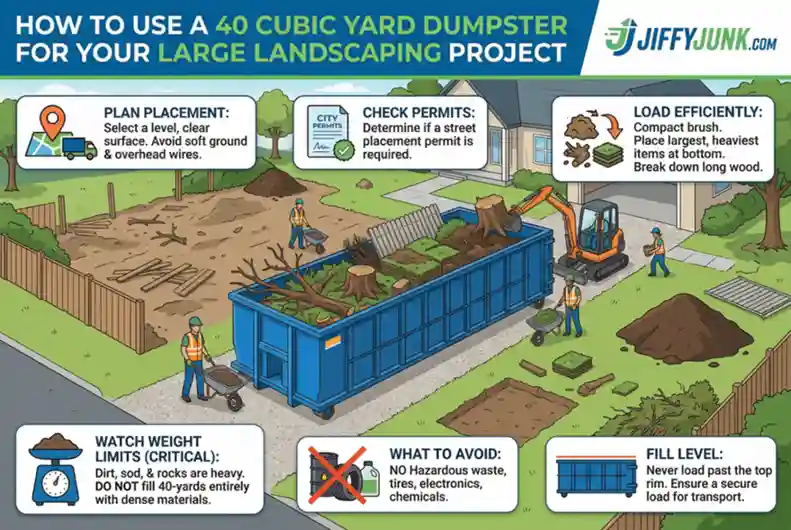
Never load above the fill line — illegal to transport on public roads
Site requirements to confirm before delivery:
Access path: minimum 10 to 12 feet of clear width
Ground conditions: plywood boards required on soft or disturbed soil
Overhead clearance: 8 feet plus truck boom height — tree canopy is the most common obstacle
Container placement: as close to the work area as possible — not as close to the street
Prohibited materials found on almost every large property clearance:
Pesticide and herbicide containers
Fuel cans and equipment fluids
Paint cans and chemical solvents
Batteries of all types
Walk every shed and storage area before the container arrives. One hour of sorting prevents the surcharges that show up most consistently on landscaping jobs.
From the Jiffy Junk team: the customers who get landscaping dumpster rentals right are the ones who ask the weight question before the volume question. If your project involves soil, concrete, or sod — book for weight, not volume. If it is dominated by brush and organic debris — the 40-yarder is built for exactly that load profile and will earn every cubic yard of its capacity.
Not sure which container fits your landscaping project? Send us photos of your site. We will give you a straight answer — because we are not happy until you are.
Top Takeaways
Landscaping debris is the most weight-deceptive category our team hauls. What customers consistently underestimate:
Soil: exceeds 2,000 lbs per cubic yard
Concrete: hits weight limits at less than 10% of a 40-yard container's volume
Sod: runs 1,500 to 2,000 lbs per cubic yard before it dries
A container that looks barely loaded can already be at its legal transport limit. Customers who select size based on visual pile volume — not debris weight — are the ones who call us after the overage fee arrives.
The 40-yarder is right for organic debris. It is wrong for heavy material removal. Right for:
Brush, branches, and green waste dominating the load
Multi-day projects where volume — not weight — is the constraint
Wrong for:
Soil removal, concrete demo, sod clearance, hardscape debris
Any job where heavy materials reach the weight cap before the container looks full
A smaller container rated for heavy debris almost always costs less in total and delivers more usable capacity per dollar.
Nearly two-thirds of yard trimmings are composted nationally — not landfilled. What that means before you book:
A meaningful share of most landscaping loads can be diverted before the container arrives
Green waste that stays out of the container reduces both volume and disposal fees
Identifying composable material before booking is the single most cost-effective step on any large landscaping rental — and the one most customers skip entirely
The weight calculation comes before the volume calculation on every landscaping project. The sequence our team uses before every landscaping rental recommendation:
Identify debris types — separate organic from heavy materials mentally first
Run the weight math on heavy materials against the container's weight allowance
If heavy materials alone approach the weight cap — volume capacity in a larger container is irrelevant
Choose the container that legally holds your heaviest debris at the lowest total cost
Mixed debris landscaping projects require separation planning before loading begins. What new homeowners tackling simultaneous outdoor projects generate most often:
Concrete, soil, sod, brush, and green waste all in the same load window
Mixed loading hits weight limits before the container looks visually full — every time
The smarter approach:
Separate heavy materials for a dedicated heavy-rated container
Load lightweight organic materials into a volume-rated container separately
Combined cost of two right-sized containers almost always beats one oversized roll-off loaded to its weight limit at a fraction of capacity
Understanding Landscaping Debris Before You Book a Container
Landscaping waste is not a single debris category — it is a collection of materials with wildly different weight profiles that behave completely differently in a roll-off container. This is the distinction most customers miss before booking, and the one that determines whether the 40-yarder is genuinely the right call for their project.
Here is how the most common landscaping debris types break down by weight per cubic yard:
Topsoil and fill dirt: 1,000 to 1,400 pounds per cubic yard
Sod: 1,500 to 2,000 pounds per cubic yard
Gravel and crushed stone: 2,400 to 2,900 pounds per cubic yard
Concrete and masonry: 3,500 to 4,500 pounds per cubic yard
Brush, branches, and green waste: 200 to 400 pounds per cubic yard
Mixed yard debris including leaves and light organic material: 100 to 300 pounds per cubic yard
A 40-yard container with a 6-ton weight limit can handle approximately 12,000 pounds of debris before the weight cap is reached. At soil density, that limit is hit at roughly 9 to 12 cubic yards of material — less than a third of the container's total volume. At brush density, the same container can be loaded to capacity without approaching the weight limit at all.
Understanding which materials your project generates — and in what proportion — is the single most important step before selecting a container size.
When a 40 Cubic Yard Dumpster Is the Right Choice for a Landscaping Project
The 40-yarder earns its cost on landscaping projects that generate predominantly lightweight, high-volume debris over an extended timeline. Based on the jobs our team handles regularly, it is the right call when:
The project involves large quantities of brush, branches, tree trimmings, and green waste that fill volume without approaching weight limits
The scope spans the entire property over multiple days and cannot be efficiently managed with multiple smaller hauls
The project combines multiple debris types — some heavy, some light — where the overall load averages out below the weight cap
Overgrown lot clearances involving significant vegetation removal across large acreage
Large-scale landscape renovation combining sod removal, planting bed clearance, and debris from dismantled garden structures
The key indicator: if the majority of your debris is organic, lightweight, and bulky — and the project timeline spans multiple days — the 40-yarder is likely the most cost-effective single-haul solution available.
When a Smaller Container Is the Smarter Call for Landscaping Debris
This is the guidance most rental guides skip — and the one our team considers most valuable for landscaping customers. Heavy landscaping materials reach weight limits long before they fill a 40-yard container, making the largest container both unnecessary and potentially more expensive.
Projects where a smaller container with a higher weight allowance is almost always the better choice:
Soil and fill dirt removal — even moderate volumes of topsoil hit weight caps fast. A 10-yard container specifically rated for heavy materials handles soil removal more efficiently and at lower total cost than a 40-yarder loaded to its weight limit at a fraction of capacity.
Sod removal — sod is one of the heaviest common landscaping materials per cubic yard. Large sod removal projects hit weight limits before the container looks significantly loaded.
Concrete removal — walkways, patios, retaining walls, and foundation borders generate extremely dense debris. Never load concrete into a standard 40-yard container without confirming the weight allowance first.
Gravel and stone removal — decorative gravel, river rock, and crushed stone all carry weight profiles that max out standard weight caps quickly.
Stump removal with attached root systems — root balls retain significant soil weight that multiplies rapidly in a large container.
Our field recommendation: for any landscaping project dominated by heavy materials, factoring in dumpster rental cost makes it clear that booking a smaller container specifically rated for heavy debris is often the smarter and more cost-efficient choice rather than defaulting to the largest available. The cost per ton is lower, the weight allowance is typically more generous relative to the container size, and the risk of an overweight container that cannot legally leave the site is dramatically reduced.
How to Calculate Volume for a Large Landscaping Project
Estimating debris volume before booking is the step most landscaping customers skip — and the one that most reliably prevents the wrong container size from derailing the project. Here is the practical calculation method our team recommends:
For green waste and brush:
Estimate the volume of accumulated debris in its uncompacted form
Green waste compresses significantly when loaded — factor a 30 to 40 percent compression rate for branches and brush
Large brush piles that look like 20 yards of material often compact to 12 to 14 yards in a container
For soil and heavy materials:
Measure the area being excavated or removed in length, width, and depth
Multiply length x width x depth in feet, then divide by 27 to convert to cubic yards
Add 30 percent for expansion factor — excavated soil occupies more volume than compacted soil in the ground
Always calculate weight before volume for heavy materials and confirm the container's weight limit before booking
For mixed landscaping projects:
Separate the debris mentally into heavy materials and lightweight materials
Calculate the weight of heavy materials first and confirm they fall within the container's weight allowance
Calculate the remaining volume available for lightweight materials after the weight limit is reached
If heavy materials alone approach the weight cap, book a smaller heavy-rated container for those materials and a separate container or haul for the lightweight debris
Loading Strategies That Maximize a 40 Yard Dumpster on a Landscaping Project
How debris is loaded into a 40-yard container on a landscaping project determines how much the container actually holds — and whether it can legally leave the site. These are the loading strategies our crews use on large landscaping hauls:
Layer heavy and light alternately:
Place a base layer of heavy materials — soil, concrete, stone — first
Follow with a layer of lightweight materials — brush, branches, organic debris
Alternate layers throughout the loading process
This distribution prevents weight concentration in one area and improves load stability during transport
Break down bulky material before loading:
Cut branches and brush into manageable sections rather than throwing in whole pieces
Break up concrete and masonry into smaller fragments rather than loading intact slabs
Compact soil and organic material as each layer is added
Strategic breakdown and compaction fits 15 to 20 percent more material per haul
Distribute weight evenly:
Avoid loading all heavy materials on one side of the container
Uneven weight distribution creates transport safety issues and can result in rejected loads at the landfill
Spread heavy debris across the full footprint of the container as each layer is added
Use the walk-in door:
The rear walk-in door on a 40-yard container makes loading heavy landscaping equipment and large debris sections significantly easier
Load large items through the door rather than lifting over the 8-foot walls
Close and latch the door securely before the container is transported
Never exceed the fill line:
Material loaded above the container's fill line cannot legally be transported on public roads
A container that is overfilled requires debris removal before pickup — which adds time, cost, and delays to the project schedule
Monitor fill level throughout loading and contact your provider before the container reaches capacity if the project generates more debris than expected
Site Requirements for Placing a 40 Yard Dumpster on a Landscaping Project
Landscaping projects present unique site placement challenges that differ from interior renovation jobs — primarily because the debris loading area is often at the back or sides of the property rather than near the street or driveway.
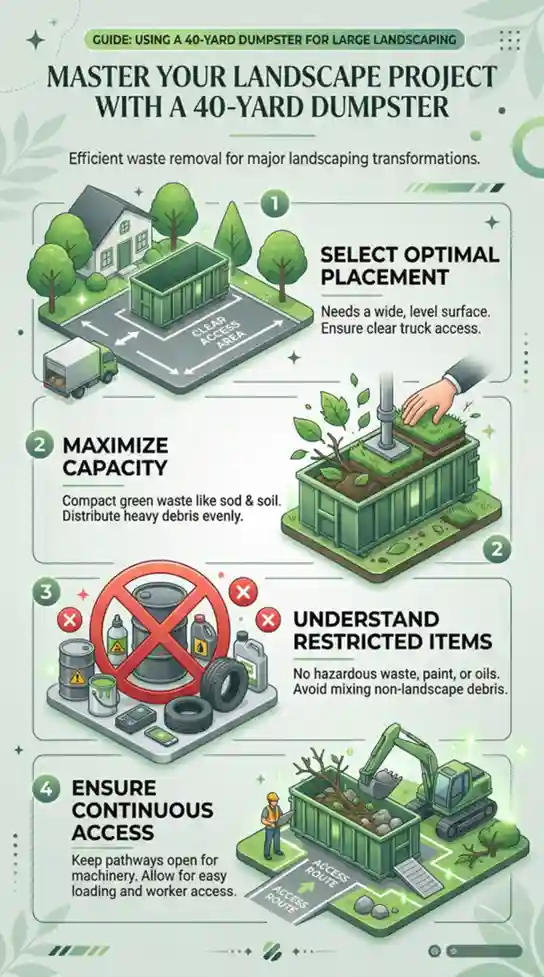
Before scheduling delivery, confirm the following:
Access path width: the delivery truck requires a minimum clear width of 10 to 12 feet to maneuver safely on residential properties
Ground conditions: soft or recently irrigated soil creates surface damage and stability risks under a loaded container. Plywood boards under the container wheels are essential on any soft ground surface.
Overhead clearance: 8 feet of vertical clearance plus truck boom height is required for safe placement — tree canopy and overhead irrigation systems are the most common obstacles on landscaping projects
Proximity to work area: the closer the container is to the primary debris generation area, the more efficiently the project loads. Every additional foot of carry distance slows the loading process and extends the project timeline.
Permit requirements: if the container needs to be placed on a street or public right-of-way because the property cannot accommodate it, confirm permit requirements and processing times with your local municipality at least one week before delivery.
Our field observation: landscaping projects are where placement logistics most frequently create day-of complications — because the natural instinct is to place the container near the house rather than near the work area. Walk the full property before booking and identify the placement location that minimizes carry distance from the primary debris source, not the one that is most convenient for the truck.
"Landscaping debris is the category that humbles the most experienced customers — because the weight math is completely counterintuitive until you have seen it play out on a real job site. A container that looks a quarter full can already be at its legal transport limit when it is loaded with soil and sod. We have watched customers book the largest container available for a landscaping project, load it to what looks like half capacity, and then get hit with an overweight fee that exceeded the rental price. The problem was never the container size — it was the debris type. Soil does not fill a 40-yarder. It overloads it. Rock does not fill a 40-yarder. It overloads it. Concrete does not fill a 40-yarder. It overloads it. The projects where the 40-yard container genuinely performs on a landscaping job are the ones dominated by brush, branches, and organic debris — materials that fill volume without punishing the weight allowance. When those materials are present and the project timeline spans multiple days, the 40-yarder is the most efficient single-haul solution we have. When they are not, the customer who books it anyway is paying for capacity they will never legally be able to use — and we would rather tell them that before the truck rolls than after the invoice arrives."
Essential Resources
Landscaping projects are where the most preventable booking mistakes happen — because most customers focus on project size rather than debris weight. The resources below are the ones our team recommends before any large landscaping rental to help customers avoid the weight overages, placement failures, and prohibited material surprises that show up most consistently on landscaping jobs.
1. Volume-to-Weight Conversion Factors for Solid Waste — U.S. EPA Run the Weight Math Before You Book — Not After the Container Is Overloaded
This is the reference our team uses most consistently before recommending a container size on any landscaping job involving heavy materials. This EPA document provides standardized weight-per-cubic-yard conversion factors for concrete, soil, asphalt, and wood — the calculation that determines whether your project needs a container sized for volume or one specifically rated for heavy debris weight before a single load goes in. https://www.epa.gov/smm/volume-weight-conversion-factors-solid-waste
2. Yard Trimmings Material-Specific Data — U.S. EPA Understand How Much Lightweight Green Waste Your Project Actually Generates — Before You Size the Container Around It
Brush, branches, grass clippings, and organic debris fill volume fast without approaching weight limits — which is exactly when the 40-yarder performs best on a landscaping job. This EPA data resource provides national benchmarks on yard waste generation and composting rates that help customers understand how much of their debris is divertable before it reaches the container — and how much genuinely needs a roll-off haul. https://www.epa.gov/facts-and-figures-about-materials-waste-and-recycling/yard-trimmings-material-specific-data
3. Comprehensive Procurement Guidelines for Landscaping Products — U.S. EPA Divert Organic Debris Before the Container Arrives — and Pay Less at the Landfill
One of the most consistent recommendations our team makes before large landscaping rentals: identify what can be composted or diverted before booking, because every cubic yard of organic material that does not go in the container reduces both volume and the disposal fees that follow. This official EPA resource covers sustainable practices and composting recommendations for landscaping projects that help customers lower total disposal cost before the container is booked. https://www.epa.gov/smm/comprehensive-procurement-guidelines-landscaping-products
4. Composting at Home — U.S. EPA Know Exactly Which Green Waste Can Stay Off the Truck Entirely
On virtually every large landscaping haul our team completes, a significant portion of the organic debris — grass clippings, leaves, branches, and yard trim — could have been composted rather than hauled. This EPA guide provides practical guidance on what can and cannot be composted, helping landscaping customers identify materials that can be fully diverted before loading begins and reduce container volume without reducing project scope. https://www.epa.gov/recycle/composting-home
5. Sustainable Management of Construction and Demolition Materials — U.S. EPA Know Your Recycling Options for the Heavy Materials Most Likely to Overload Your Container
Concrete walkways, retaining walls, pavers, and masonry borders are the debris types our team flags most often on landscaping jobs — because they hit weight limits long before the container looks significantly loaded. This EPA resource covers recycling and recovery options for heavy C&D materials, giving landscaping customers alternatives to loading dense debris into a standard roll-off that may not have the weight allowance to transport it legally. https://www.epa.gov/smm/sustainable-management-construction-and-demolition-materials
6. Best Practices for Reducing, Reusing, and Recycling C&D Materials — U.S. EPA Explore On-Site Reuse Options for Heavy Landscaping Materials Before They Become an Overage Fee
Concrete, stone, pavers, and gravel removed during landscaping projects do not always need to go in a dumpster — and loading them into a standard container without planning is the most common source of weight overages we see on landscaping jobs. This EPA resource outlines practical recycling, reuse, and on-site diversion strategies for the heavy materials that most frequently cause weight limit surprises on landscaping rentals — strategies most customers never consider before the truck arrives. https://www.epa.gov/smm/best-practices-reducing-reusing-and-recycling-construction-and-demolition-materials
7. Household Hazardous Waste — U.S. EPA Pacific Southwest Region Find the Restricted Materials That Large Property Clearances Almost Always Surface
Large landscaping projects that include clearing sheds, outbuildings, and storage areas are where our crews most consistently find restricted materials — old pesticide containers, herbicides, fertilizer chemicals, and stored treatments that have accumulated over years. This EPA resource identifies the hazardous materials most commonly uncovered during property clearances and outlines proper disposal protocols that prevent the container rejections and post-pickup surcharges that catch customers off guard when no one checked before loading began. https://19january2017snapshot.epa.gov/www3/region9/waste/solid/house.html
These essential resources are designed to help you make smarter decisions around roll off dumpster rental prices by accounting for debris weight, material type, and disposal strategies upfront—so you can keep costs lower and your landscaping project running efficiently.
Supporting Statistics
Landscaping projects generate the most preventable weight overages of any job category our team handles. Not because customers make bad decisions — but because landscaping debris looks lighter than it is. A container that appears manageable can already be at its legal transport limit before it looks significantly loaded.
35.4 Million Tons of Yard Trimmings Are Generated in the U.S. Every Year — and Nearly Two-Thirds Never Need to Go in a Dumpster at All
Before any large landscaping rental, our first question is always: what portion of your debris is organic? The answer usually reveals that a meaningful share of what customers planned to load does not need to go in a container at all.
According to the EPA, yard trimmings generation in the U.S. was 35.4 million tons in 2018 — 12.1 percent of total municipal solid waste. In 2018, landfills received approximately 10.5 million tons of yard trimmings, representing 7.2 percent of all municipal solid waste landfilled. US EPA
What our team reads into that data for every landscaping customer:
Nearly two-thirds of yard trimmings generated nationally are composted — not landfilled
Brush, grass clippings, leaves, and light trimmings are the most divertable materials on any landscaping job
Diverting composable material before booking consistently reduces container volume before the first load goes in
The volume that genuinely requires a roll-off haul is often significantly smaller than the initial estimate suggests
On large organic debris projects, diverting even a portion of green waste can be the difference between needing a 40-yard container and a 30-yard container. That savings exceeds the time invested in sorting by a margin that surprises almost every customer who tries it.
Source: U.S. Environmental Protection Agency — Yard Trimmings Material-Specific Data https://www.epa.gov/facts-and-figures-about-materials-waste-and-recycling/yard-trimmings-material-specific-data
Concrete Weighs Over 2,000 Pounds Per Cubic Yard — the Single Variable That Overloads More Landscaping Containers Than Any Other
This is the statistic we reference on every landscaping job involving hardscape removal. It reframes the entire container selection conversation — because volume becomes irrelevant once customers understand what concrete actually weighs.
According to EPA volume-to-weight conversion data, concrete weighs approximately 860 pounds per cubic foot for C&D applications, with soil exceeding 2,000 pounds per cubic yard in standard solid waste management conversion factors. EPA
What those numbers mean on a real landscaping job site:
A 40-yard container with a standard 6-ton weight allowance holds approximately 12,000 pounds before the legal transport limit is reached
At concrete density: weight cap is reached at roughly 3 to 4 cubic yards — less than 10% of total container volume
At soil density: weight limits are reached at approximately 6 to 9 cubic yards — still under a quarter of total capacity
A container that looks barely started can already be over its legal transport limit
The customers who avoid this outcome share one habit: they ask the weight question before the volume question.
For any project involving concrete removal, patio demo, or soil excavation:
A smaller container rated for heavy debris almost always costs less in total
The 40-yarder loaded to its weight limit at a fraction of capacity delivers no capacity benefit
The size upgrade adds cost without adding usable volume
Source: U.S. Environmental Protection Agency — Volume-to-Weight Conversion Factors for Solid Waste https://www.epa.gov/smm/volume-weight-conversion-factors-solid-waste
New Home Buyers Spend Over $3,167 on Landscaping in Their First Year — Generating the Mixed Debris Profiles That Catch Customers Off Guard Most
New homeowners are the landscaping customers our team hears from most after a weight overage fee. Not because they made unreasonable decisions — but because first-year landscaping projects generate a debris mix that behaves nothing like what it looks like from the driveway, with regulations like the Clean Air Act shaping how certain materials must be handled and disposed of.
According to the National Association of Home Builders, new home buyers spend over $4,000 on outdoor patios, walks, fences, pools, and driveways — plus an additional $3,167 on landscaping in the first year after purchase — compared to $250 and $192 respectively for non-moving homeowners. National Association of Home Builders
What our team sees behind that spending pattern on job sites:
New homeowners tackle multiple outdoor projects simultaneously
Sod removal, hardscape installation, planting bed creation, tree removal, and fence work all generate debris in the same project window
Combined scope creates a concentrated surge of mixed heavy and lightweight materials
Mixed loading — concrete, soil, and organic debris together — hits weight limits before the container looks visually full
The perspective we share with every new homeowner planning a large landscaping project:
First-year property overhauls are never a single material type
Selecting a container based on volume alone — without accounting for concrete, soil, and hardscape weight — is the most consistent cause of overage fees on landscaping jobs
Separate heavy materials before loading begins — every time
Source: National Association of Home Builders — Home Purchases Trigger Big Spending on Remodeling, Appliances and Furnishings https://www.nahb.org/blog/2022/06/home-buyers-spend-big
Final Thoughts
After thousands of landscaping hauls — from residential yard overhauls to commercial property clearances — our team has arrived at a perspective most rental guides will never offer: landscaping is the one project category where the 40 cubic yard dumpster is most frequently booked and most frequently wrong.
Not because customers make bad decisions. Because landscaping debris is uniquely deceptive — and the industry rarely takes the time to explain why.
The Weight Problem Nobody Talks About
Every other large project category generates debris that behaves roughly the way it looks. Landscaping debris does not follow those rules.
What customers consistently underestimate:
Soil looks manageable. It is not. It exceeds 2,000 pounds per cubic yard.
Concrete looks like a small pile. It is not. It hits weight limits at less than 10% of a 40-yard container's total volume.
Sod looks light. It is not. It runs 1,500 to 2,000 pounds per cubic yard before it dries.
The customers who call us after a landscaping weight overage are almost never the ones who underestimated project scope. They are the ones who selected a container based on visual volume — without running the weight math on what that pile actually contains.
The Right Container for a Landscaping Project Is Rarely the Largest One
This is the opinion that runs counter to how most rental providers approach large landscaping jobs — and the one our team holds most firmly after thousands of hauls.
The 40-yarder earns its cost when:
Debris is predominantly organic — brush, branches, green waste, and lightweight material
The project spans multiple days and cannot be managed with a single smaller haul
The combined load averages out below the weight cap across the full volume
When those conditions are not present — when the project involves soil removal, concrete demo, or hardscape clearance — the 40-yarder often delivers the least usable capacity at the highest price.
In those scenarios, a smaller container rated for heavy debris is not a compromise. It is the smarter call — and the one that produces the lowest total invoice.
The Framework That Changes Everything Before You Book
Most landscaping customers select a container by looking at what is in the yard and estimating how much space it will take up. That mental model works for renovation debris. It fails for landscaping debris — because weight, not volume, determines what container can legally leave the site.
The sequence our team uses before every landscaping rental recommendation:
Identify debris types — separate organic from heavy materials before a single load goes in
Run the weight math on heavy materials first — soil, concrete, sod, and stone against the container's weight allowance
Identify what can be composted or diverted before booking — green waste that stays out of the container is the cheapest cost reduction available
Choose the container based on the weight limit that will be reached first — not the volume that looks largest from the driveway
That sequence takes less than fifteen minutes. It has saved our customers hundreds of dollars in overage fees more times than we can count.
Our Honest Opinion
The 40-yarder is a powerful tool on the right landscaping project. It is an expensive mistake on the wrong one.
Right for:
Overgrown lot clearances with large brush volumes
Multi-day vegetation removal dominated by lightweight organic debris
Large green waste hauls where volume — not weight — is the constraint
Wrong for:
Projects involving significant soil, concrete, sod, or hardscape removal
Any job where heavy materials will reach the weight cap before the container looks visually full
Customers selecting container size based on visual pile volume rather than debris weight
The customers who understand this before they book make better decisions. The ones who learn it from the overage fee on the final invoice wish they had called us first.
Not sure which container fits your landscaping project? Send us photos of your site and a description of what you are removing. We will give you a straight answer — because we are not happy until you are.
FAQ on How to Use a 40 Cubic Yard Dumpster for a Large Landscaping Project
Q: Is a 40 cubic yard dumpster the right size for a large landscaping project?
A: Usually not — and that answer surprises more customers on landscaping jobs than any other project category we handle.
The 40-yarder is the right choice when:
Debris is dominated by brush, branches, and lightweight organic material
Volume — not weight — is the primary constraint
Scope spans multiple days with continuous debris generation
Large-scale vegetation removal across significant acreage is involved
The 40-yarder is the wrong choice when:
Soil removal, concrete demolition, sod clearance, or hardscape debris is involved
Heavy materials will reach the weight cap before the container looks visually loaded
Mixed heavy and lightweight materials will be loaded without a separation plan
Our honest assessment after thousands of landscaping hauls: most large landscaping projects involving any meaningful amount of soil, concrete, or sod are better served by a smaller container rated for heavy debris. We have watched customers pay for 40 yards of space they could never legally use — because weight limits were reached at a fraction of total capacity.
Q: How much does landscaping debris weigh per cubic yard and how does that affect container selection?
A: This is the question most customers never ask before booking — and the one that most directly determines whether the 40-yarder is a smart choice or an expensive one.
Heavy materials — weight-limit sensitive:
Topsoil and fill dirt: 1,000 to 1,400 lbs per cubic yard
Sod: 1,500 to 2,000 lbs per cubic yard
Gravel and crushed stone: 2,400 to 2,900 lbs per cubic yard
Concrete and masonry: 3,500 to 4,500 lbs per cubic yard
Lightweight materials — volume sensitive:
Brush and branches: 200 to 400 lbs per cubic yard
Mixed yard debris and leaves: 100 to 300 lbs per cubic yard
Green waste and organic trim: 150 to 350 lbs per cubic yard
What this looks like on a real job site:
A 40-yard container with a 6-ton allowance holds approximately 12,000 lbs before the legal transport limit
At soil density: weight cap is hit at roughly 9 to 12 cubic yards — less than a third of total volume
At brush density: the container can be loaded to full capacity without approaching the weight limit
The rule our team applies before every landscaping booking:
Heavy debris — book for weight, not volume
Lightweight organic debris — book for volume
Mixed debris — separate before loading or expect to hit weight limits before the container looks full
Q: What landscaping materials cannot go in a standard 40 cubic yard dumpster?
A: Most landscaping debris is accepted. Large property clearances consistently surface restricted materials customers never anticipated. This is the gap between a clean landscaping haul and a post-pickup surcharge.
What our crews find on virtually every large property clearance:
Pesticide and herbicide containers stored in sheds for years
Old fertilizer bags pushed to the back of storage areas
Fuel cans stored alongside lawn mowers and power tools
Paint and chemical containers mixed in with standard debris
Equipment batteries and automotive fluids from outbuildings
Confirmed prohibited materials on landscaping jobs:
Pesticide containers and herbicide bottles — even empty containers with chemical residue
Fertilizer bags with restricted chemical compounds
Fuel cans and containers from lawn equipment storage
Motor oil and automotive fluids
Paint cans and chemical solvents from outbuildings
Batteries of all types
Treated lumber with arsenic or chemical preservatives in some markets
Our standing advice before any large property clearance:
Walk every shed, outbuilding, and storage area before the container arrives
Pull out anything restricted and stage it separately
Contact your local household hazardous waste program for proper disposal
One hour of sorting prevents the surcharges that show up most consistently on landscaping jobs involving full property clearances.
Q: How should a 40 cubic yard dumpster be loaded for a large landscaping project?
A: Loading strategy affects total cost more than most customers expect on landscaping jobs. How debris is distributed determines whether the container can legally leave the site — and how much it actually holds.
Layer heavy and light alternately:
Base layer: heavy materials — soil, concrete, stone
Follow with lightweight materials — brush, branches, organic debris
Alternate layers throughout the loading process
Prevents weight concentration and improves load stability during transport
Break down bulky material before loading:
Cut branches and brush into sections — never load whole pieces
Break concrete and masonry into smaller fragments
Compact soil and organic material as each layer is added
Strategic breakdown fits 15 to 20 percent more material per haul
Separate heavy from lightweight materials:
Mixed concrete and brush hits weight limits faster than separated loads
Heavy materials concentrated in one layer create transport and stability issues
Customers who separate loading phases get more usable capacity — consistently
Two rules our team follows on every landscaping haul:
Use the walk-in door for heavy debris — never lift heavy materials over 8-foot walls
Never load above the fill line — material above it cannot legally be transported
Q: What site requirements should be confirmed before placing a 40 cubic yard dumpster on a landscaping project?
A: Landscaping projects create placement challenges that interior jobs rarely produce. The work area is almost always at the back or sides of the property — not near the street where placement is straightforward. This is where our drivers encounter the most day-of complications on landscaping jobs.
Confirm these before scheduling delivery:
Access path:
Minimum 10 to 12 feet of clear width required for the delivery truck
Side yard and perimeter paths are common — measure before booking, not on delivery day
Ground conditions:
Soft, recently irrigated, or freshly tilled soil creates stability and surface damage risks
Plywood boards under container wheels are essential on soft ground — not optional
Landscaping projects frequently involve disturbed soil that compounds this risk
Overhead clearance:
8 feet of vertical clearance plus truck boom height required
Tree canopy and irrigation systems are the most common obstacles
Walk the full access path before booking
Container proximity to work area:
Every extra foot of carry distance from debris source to container slows loading
Position the container as close as possible to the primary work area — not the street
This single placement decision affects loading efficiency more than any other site factor
Permit requirements:
Confirm requirements at least 1 week before delivery if street placement is needed
Fees: $25 to $150 depending on municipality
Processing: 1 to 2 weeks in most markets
What we tell every landscaping customer before booking:
Walk the full property and identify the placement location closest to the debris source
Confirm the access path is wide enough, stable enough, and clear enough for a loaded container to leave safely
Ask these questions before the truck is scheduled — not after it arrives