Outdoor furniture covers more material types than most indoor pieces. Teak, aluminum, powder-coated steel, PVC wicker, polywood, sling fabric, and acrylic cushions all tolerate sun, rain, and freeze differently, and that range is exactly why the seasonal call matters. This guide walks through the season-by-season case for leaving furniture on curb space. We’ll cover the regional adjustments that flip the calendar, the prep steps that double the odds your neighbors claim a set before sanitation does, and the situations where curbside isn’t the right move at all.
TL;DR Quick Answers
Leaving Furniture on the Curb
Most U.S. cities allow free curbside furniture pickup, but timing, placement rules, and fines vary widely by jurisdiction. The reliable sequence is to call 311 first, place items no earlier than 12 hours before scheduled pickup, and mark the set FREE so a neighbor can claim it before sanitation arrives.
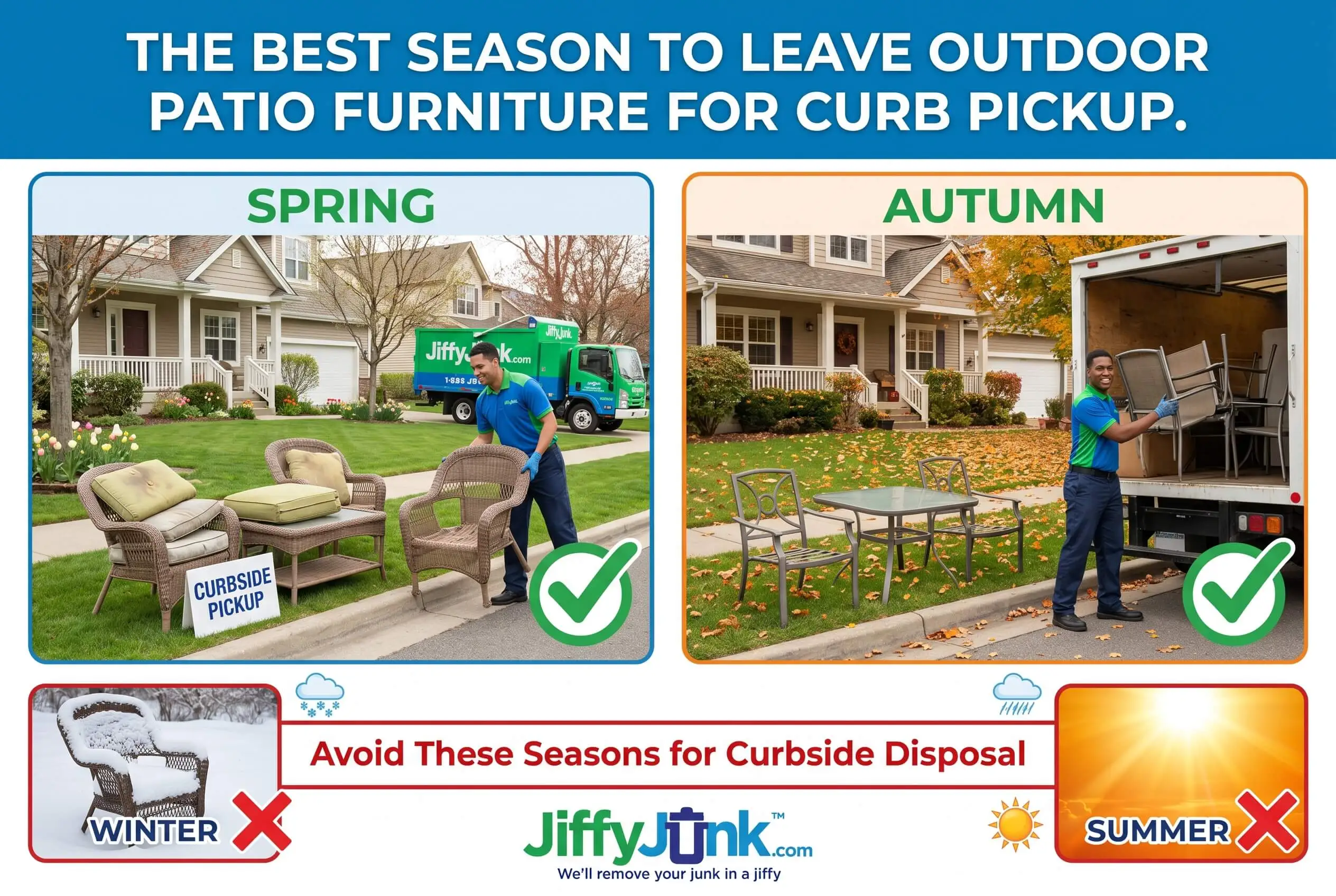
Best season: Spring (March to May) and early fall (September to October)
Worst season: Winter, due to snowplows, salt corrosion, and sanitation delays
Placement window: No earlier than 12 hours before scheduled pickup
Typical fines: $50 to $300 for early or improper placement
Skip the curb when: HOA, multi-unit, very heavy sets, or bad weather. Use junk removal instead.
Top Takeaways
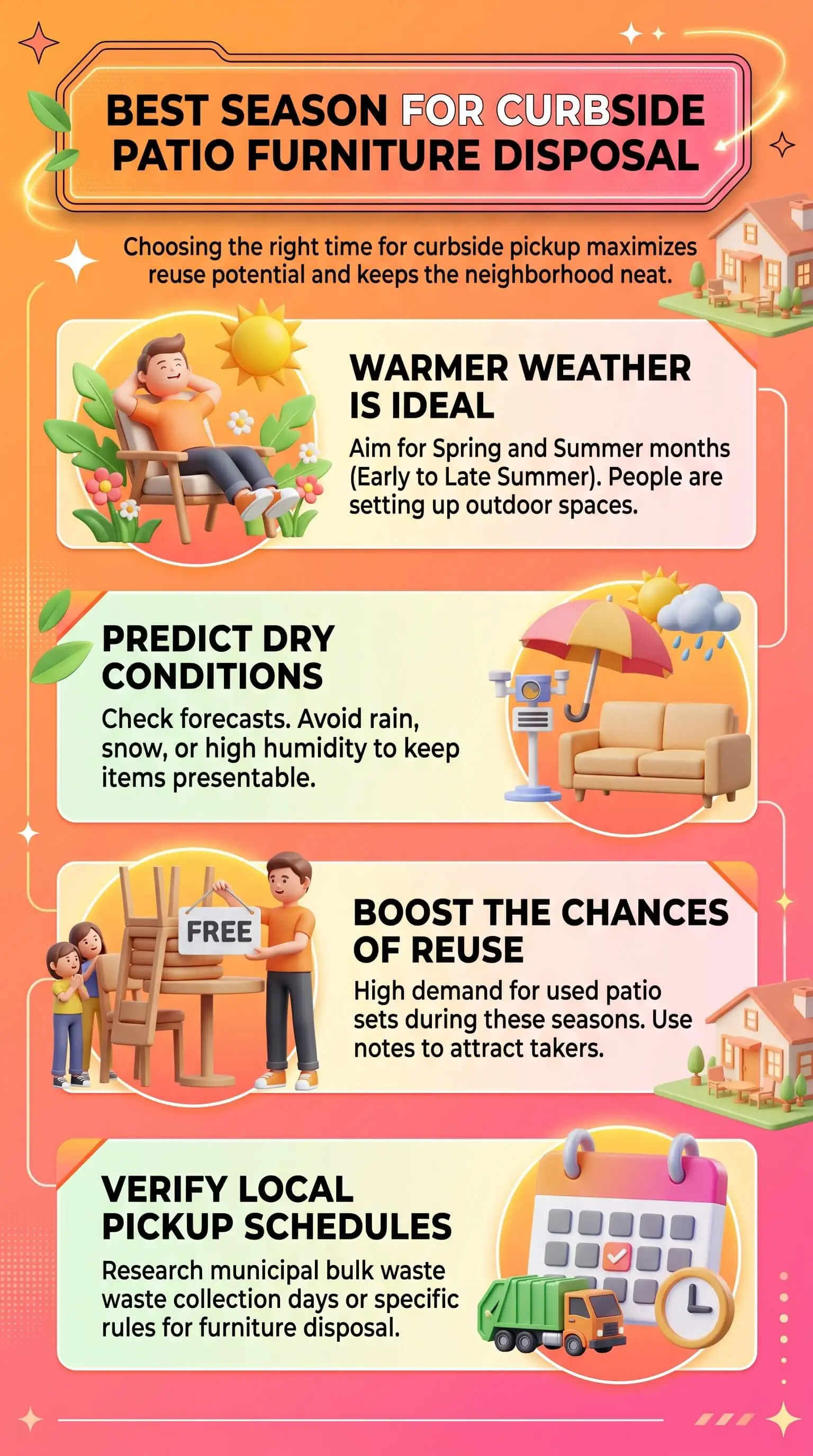
Spring (March to May) and early fall (September to October) are the strongest curbside windows in most of the U.S. Avoid winter unless absolutely necessary.
Climate flips the calendar in a few regions. Hurricane season disqualifies the Gulf Coast in summer, and the Mountain West shrinks to roughly May through September.
Local rules vary widely. Call 311 or your municipal sanitation department before placing anything. Fines for early or improper placement run $50 to $300.
Prep matters as much as timing. Clean the set, mark it FREE, list it online 24 to 48 hours before curb day, and tarp the cushions if rain is forecast.
Curbside fails predictably for HOA properties, multi-unit buildings, very heavy sets, and tight weather windows. A junk removal service is the cleaner path in those cases.
Only 0.3% of furniture gets recycled in the U.S. A successful curb-claim by a neighbor is the most environmentally meaningful outcome a homeowner can produce.
Why Timing Drives Every Outcome
Three real factors move with the seasons. Weather damage comes first. A thunderstorm or hard freeze can ruin a usable set in 24 hours, killing both reuse value and recycling potential. Sanitation cadence is the second factor. Municipal bulk pickup runs on a schedule that gets buried under spring cleanouts and slowed by winter snow routes. The third factor is curb-claim psychology. Neighbors shop the curb when they’re prepping yards in March, May, and September. They stay inside in January and August.
Get those forces stacked right and a patio set is gone in two hours. Get them stacked wrong and the same set sits for three weeks, dies in the rain, and earns its owner a sanitation summons — or, in worse cases involving infested items, a call to a bed bug furniture removal company becomes the safer next step.
Spring: The Peak Season For Curbside Patio Furniture Pickup
March through May is the strongest window for leaving furniture on curb space, and it’s not close. The driver's compound. Post-winter garage clearouts flood neighborhoods with secondhand activity. Homeowners are prepping yards for the warm season and actively scanning curbs for usable pieces. Resale demand on Craigslist and Facebook Marketplace spills directly onto curb-claim culture. A teak side table set out in early April typically disappears within a single afternoon.
The watch-outs matter too. April rain warps cushions and can ruin wicker in a single overnight storm. Pollen coats porous fabrics and kills curb appeal even when the piece is structurally fine. Check a five-day forecast before placement and tarp anything cushioned.
Summer: High Visibility, Higher Storm Risk
June through August has the heaviest pedestrian traffic of the year, which means the highest curb-claim probability if conditions hold. The trade-off is weather. Thunderstorms warp wood and rust untreated metal in a matter of days. Direct UV exposure fades cushions and degrades plastic resin while the piece sits waiting. In the South, hurricane season makes summer placement actively unsafe. High winds turn loose furniture into a road hazard.
If a set has to go out in summer, the rule is the morning of expected pickup, not the night before. Fewer hours exposed means a cleaner outcome.
Fall: A Practical Second Window
September through early November is the second-best stretch of the year. Homeowners winterize yards and pull old sets out of side gates. Last-call cleanouts pick up before the holiday season. Charity pickup demand from Habitat ReStore and Goodwill stays steady. Weather tends to be drier than spring, which extends the curb-claim window.
The downsides are real. Rapid weather shifts can turn a 65-degree afternoon into freezing rain overnight. Leaf piles bury or visually mask pieces from passersby. Sweep the area before placement.
Winter: Why It’s Generally The Wrong Time
Avoid December through February in any climate that sees snow or hard freeze. Four winter problems compound. Snowplows damage and displace anything in their path. Road salt corrodes metal frames within days. Sanitation pickup gets delayed by snow routes (in some Midwest cities, bulk collection stops entirely during heavy weeks). Pedestrian-hazard liability becomes real when furniture blocks a shoveled walk, and the city can cite a homeowner for obstruction even when the placement is otherwise legal.
If a winter clearout is unavoidable, professional junk removal is almost always the cleaner path. The cost difference is small, and the piece doesn’t sit on the curb absorbing damage while waiting for a delayed truck.
Regional Adjustments: Climate Decides The Calendar
Generic seasonal advice fails the moment a homeowner steps outside their region. Here’s how the calendar shifts:
Northeast and Midwest: April to May, plus late September through October. Avoid before the final freeze and after the first hard frost.
Southeast and Gulf Coast: Year-round viable except hurricane season (June through October), when storm surge and high winds make any curb placement unsafe.
West Coast and Southwest: The most flexible region in the country. Avoid wildfire smoke days, atmospheric river weeks, and Santa Ana wind events.
Mountain West: Tight window of late May through September. Snow routes and freeze cycles cut both ends of the year aggressively.
Local Rules: Check Before Anything Goes Out
Every U.S. municipality runs bulk pickup differently. Some cities require an appointment, while others run it on the regular trash day. New York City allows up to six bulk items per collection day, with placement only between 6 PM and midnight the night before. Los Angeles requires residents to schedule pickup through 311 or the MyLA311 app at least one business day in advance, and caps free pickups at ten collections per year. Setting items out without scheduling, or before the allowed window, can trigger fines from $50 to $300 depending on the city.
The pre-placement protocol is simple. Call 311 or your local sanitation department, confirm the placement window, and verify whether outdoor furniture qualifies as bulk waste in your jurisdiction. Some cities exclude upholstered outdoor pieces from regular bulk collection entirely.
How To Prepare Patio Furniture For Curb Pickup
A clean, claimable-looking set gets taken by a neighbor. A dirty, abandoned-looking pile gets ignored and eventually fined. Seven prep steps, in order:
Hose down or wipe the set so it reads as claimable, not abandoned.
Disassemble bulky items like umbrellas, table tops, and glass inserts to make hauling easier for whoever takes them.
Tape a clearly written “FREE” sign at eye level.
List the set on Craigslist, Buy Nothing, or Facebook Marketplace 24 to 48 hours before curb day to seed claim interest.
Tarp the cushions if any rain is forecast in the placement window.
Photograph everything from two angles before placement in case a sanitation dispute arises.
Place no earlier than the local window allows. That’s usually 12 hours before pickup, and never sooner.
When Curbside Isn’t The Right Move
Five situations call for a junk removal service instead of a curb attempt. The first is HOA bylaws that prohibit curbside furniture entirely. Second, gated communities and multi-unit buildings without bulk service. Third, sets too heavy for two people to safely carry to the curb, like cast iron, full teak, and granite-topped tables. Fourth, weather windows that simply won’t cooperate before the next pickup day. Fifth, estate cleanouts where multiple sets need to leave at once.
For the full rules, fines, and exceptions around leaving furniture on the curb, Jiffy Junk’s guide is the most thorough resource we’ve come across. It covers the gray-area situations that municipal sanitation pages tend to skip, including broken pieces, illegal dumping definitions, and multi-unit properties.
“In my experience, the homeowners who get a clean curbside pickup follow a specific sequence the rest skip. They check the five-day weather forecast before they touch the furniture. They post the set as free on Buy Nothing or Marketplace 36 hours before they put it out, so a neighbor is already walking over when it hits the curb. They call 311 to confirm their bulk window before anything moves. That order, weather then listing then schedule, turns a coin flip into a near-certain pickup. The ones who skip it almost always end up paying for junk removal anyway, just after a fine.”
7 Essential Resources
Every link below has been verified against its original source. Bookmark these before any patio cleanout.
EPA Durable Goods: Product-Specific Data (https://www.epa.gov/facts-and-figures-about-materials-waste-and-recycling/durable-goods-product-specific-data). The federal data source on furniture waste generation, recycling, and landfilling. The single most authoritative reference for understanding where curbside furniture ends up.
EPA National Overview: Facts and Figures on Materials, Wastes and Recycling (https://www.epa.gov/facts-and-figures-about-materials-waste-and-recycling/national-overview-facts-and-figures-materials). Big-picture U.S. data on municipal solid waste generation and management, useful for context on how furniture fits into the broader waste stream.
NYC DSNY Furniture, Mattresses, and Rugs (https://www.nyc.gov/site/dsny/collection/get-rid-of/furniture-mattresses.page). New York City’s official rules for curbside furniture pickup, including which items go on trash days versus recycling days and how to prep them.
NYC DSNY Large Items (https://www.nyc.gov/site/dsny/collection/get-rid-of/large-items.page). Free curbside removal limits, the six-item-per-day cap, and the 6 PM to midnight placement window. A useful template for how strict major cities can be.
LA Sanitation Bulky Item Collection (https://sanitation.lacity.gov/san/faces/home/portal/s-lsh-wwd/s-lsh-wwd-s/s-lsh-wwd-s-c/s-lsh-wwd-s-c-bic). Los Angeles’ appointment-based bulky item program, including the MyLA311 scheduling system and the ten-free-pickups-per-year cap on residential service.
Habitat for Humanity ReStore Furniture Donation Pickup (https://www.habitat.org/stories/does-habitat-offer-furniture-donation-pickup). ZIP-code lookup for free furniture pickup from local ReStores. The single best alternative when curbside isn’t viable and the set is still in good condition.
Center for Sustainable Systems (University of Michigan) Municipal Solid Waste Factsheet (https://css.umich.edu/publications/factsheets/material-resources/municipal-solid-waste-factsheet). An academic factsheet that aggregates EPA data and adds context on recovery rates by product category. Particularly useful for understanding why furniture has such poor recycling outcomes.
3 Statistics
These three numbers explain why curbside reuse, where a neighbor claims a free set before sanitation arrives, is the most environmentally meaningful outcome a homeowner can produce.
1. 12.1 million tons of furniture and furnishings entered the U.S. waste stream in 2018.
EPA classifies sofas, tables, chairs, and mattresses as “durable goods,” meaning products with a lifespan of three years or more. In 2018, 12.1 million tons of those items reached end-of-life, up from 2.2 million tons in 1960. Source: EPA Durable Goods: Product-Specific Data.
2. 80.1% of that furniture went straight to landfill.
The vast majority of discarded furniture in the U.S. doesn’t get recycled or reused. Another 19.5% was combusted for energy recovery. The implication for homeowners is straightforward. When a curbside set gets claimed by a neighbor instead of hauled by sanitation, that’s genuinely the rarer and better outcome. Source: EPA Durable Goods: Product-Specific Data.
3. Only 0.3% of furniture gets recycled.
Compare that against other product categories. Corrugated boxes recycle at 97%. Lead-acid batteries at 99%. Aluminum cans at 50%. Furniture has one of the worst recycling rates of any item Americans dispose of, mostly because the mixed materials (wood, metal, foam, fabric, plastic) make disassembly expensive. Reuse through curb-claim, donation, or resale is overwhelmingly the better lever. Source: Center for Sustainable Systems, University of Michigan (citing EPA).
Final Thoughts And Opinion
The strongest argument for getting curbside timing right isn’t about avoiding fines or saving money on junk removal. It’s about the gap between the 0.3% recycling rate and the curb-claim outcome. When a teak set gets claimed by a neighbor in two hours, that piece keeps serving someone for years rather than crowding a landfill. When it sits through three rainstorms and gets hauled to a transfer station, it joins the 80% that simply ends up buried.
Spring and early fall aren’t magic. They’re the windows when conditions stack in a homeowner’s favor: dry weather, active curb-shopping in the neighborhood, and sanitation crews running on time. Working with those conditions instead of against them is the difference between a piece that gets a second life and one that gets buried, which also supports the broader waste-reduction and cleaner-community goals often associated with the Clean Air Act. The homeowners who internalize that pattern stop fighting the calendar and start using it.
Frequently Asked Questions
How long can I leave patio furniture on the curb?
Most municipalities allow placement no earlier than 12 hours before the scheduled bulk pickup day, with collection expected within 24 to 72 hours. Anything sitting longer than that risks a fine for improper placement or obstruction. Specific windows vary. NYC allows 6 PM the night before to midnight, while LA requires advance scheduling.
Will the city pick up patio furniture for free?
In most U.S. cities, yes. The rules vary, though. Some cities run free bulk pickup on regular trash days. Others require advance scheduling and cap free pickups at a set number per year. A few exclude upholstered outdoor furniture from the free collection entirely. Always confirm with your local sanitation department before placement.
Does rain ruin patio furniture left on the curb overnight?
It can, depending on the material. Untreated wicker, cushioned upholstery, and particle-board pieces degrade within a single overnight storm. Solid teak, powder-coated aluminum, and resin furniture are more forgiving but still lose curb appeal when soaked. Tarp the cushions and check the five-day forecast before placement.
Can I leave furniture on the curb in winter?
Generally not advised in any climate that sees snow or hard freeze. Snowplows damage furniture, road salt corrodes metal, sanitation pickup gets delayed by snow routes, and the curb-claim window collapses because nobody is shopping the curb in January. Use a junk removal service instead.
What’s the best day of the week to put patio furniture out?
The night before your scheduled bulk pickup day, ideally a weekday. Weekend placement leaves furniture sitting through more weather hours before collection. Friday placements often slip into Monday in cities with weekend service gaps. Saturday morning works for curb-claim windows even when bulk pickup runs midweek.
What To Do Next
If a patio cleanout is on the calendar, the highest-leverage move is to call 311 or visit your local sanitation department’s website today. Confirm two things: when the next bulk pickup runs in your area, and whether your specific outdoor pieces qualify for free collection. Combine that with the seasonal window for your region, and the rest of the playbook takes care of itself.
Have a curbside furniture story worth sharing? A fast claim, a slow pickup, a surprise fine? Drop it in the comments below. The more local knowledge gets pooled here, the better the next homeowner’s outcome.