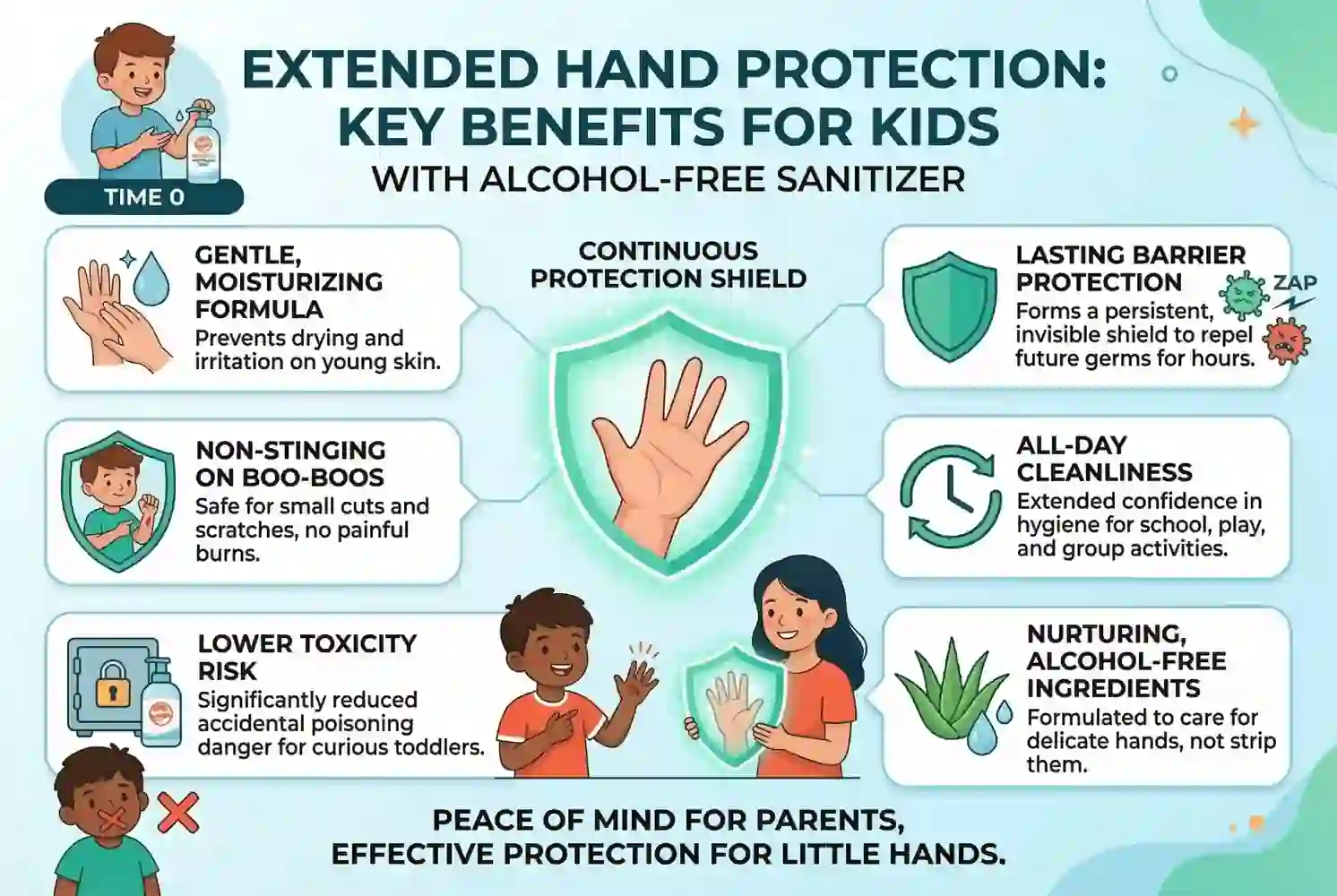
Extended protection does not mean the product keeps working longer. No sanitizer does. The active window on any formula closes the moment it dries. What extended protection actually means for a child is a clean that is complete enough to matter — against the right pathogens, on biology that does not work the same way adult skin does.
Here is what that looks like in practice:
Coverage against norovirus — the virus behind most school stomach bugs — which alcohol cannot touch at any concentration, ever.
No residue left on skin that, in children under five, absorbs topical ingredients at a measurably different rate than yours does.
No alcohol in a product small enough to fit in a backpack — where scented, brightly colored sanitizers generate tens of thousands of poison control calls every year.
Physical removal of pathogens from the skin entirely — not a kill rate that leaves what it missed behind.
We built NOWATA™ after seeing what conventional sanitizers could not do — first in our emergency departments, then in our own lives as parents. This page covers what genuine extended protection means when the patient is a child and how non-alcoholic hand sanitizer for kids changes the standard for safer everyday hygiene, and why we held our formula to a standard the market was not asking for.
TL;DR Quick Answers
How Does Extended Protection From Alcohol-Free Hand Sanitizer Benefit Kids?
No sanitizer — alcohol-based or alcohol-free — provides residual protection after it dries. The active window is roughly 20 seconds. Extended protection is not a duration claim the science supports.
What it actually means for a child:
Coverage against norovirus — the pathogen behind most school GI outbreaks — which alcohol cannot touch at any concentration, ever.
A formula that leaves nothing behind on skin that absorbs topically at a higher rate than adult skin until approximately age five.
No alcohol in a product carried by a child — where conventional sanitizers generate nearly 85,000 poison control calls over four years.
Physical removal of pathogens from skin entirely — not a kill rate that leaves what it missed behind.
The clinical standard that matters:
Completeness at the moment of application — not duration after drying.
Pathogen coverage against norovirus — not just a 99.9% kill claim against pathogens the product was never tested against.
Physical removal — the same mechanism that makes soap and water the gold standard.
NOWATA™ was independently tested to physically remove over 99.9% of bacteria and viral particles — including a norovirus surrogate — under a modified ASTM E1174 protocol at Microbe Investigations AG, Switzerland.
We built it because we could not find it. We tested it the way we did because our own children were going to use it.
Top Takeaways
No sanitizer provides residual protection after it dries. The active window is roughly 20 seconds. Every surface a child touches after that resets exposure entirely.
Alcohol has zero efficacy against norovirus — at any concentration, for any contact duration. Norovirus drives the majority of school GI outbreaks. Conventional sanitizers offer zero protection against the illness most likely to send a child home sick.
Facilities relying on alcohol sanitizers experienced confirmed norovirus outbreaks at 53%. Facilities using soap and water more frequently: 18%. The gap is not a rounding error. It is the measurable cost of a product never tested against the right pathogen.
The right questions are not whether alcohol-free works as well as alcohol. The right questions are:
Does it cover the pathogens my child actually encounters?
Does it physically remove — or just kill and leave residue behind?
Is it safe for skin that absorbs topically at a different rate than adult skin until age five?
Physical removal is not the same as killing. Removal takes the pathogen off the skin entirely. NOWATA™ was independently lab-tested to physically remove over 99.9% of bacteria and viral particles — including a norovirus surrogate — under a modified ASTM E1174 protocol at Microbe Investigations AG, Switzerland. Not killed. Removed.
Why "Extended Protection" Means Something Different When the Patient Is a Child
The sanitizer industry uses duration as its primary protection metric. Longer-lasting. Residual defense. All-day shield.
These claims assume the product is being used on adult skin, in adult environments, against a pathogen profile the formula was actually tested against.
Change the patient to a child and all three assumptions break.
A child's skin barrier is more permeable than an adult's until around age five. What sits on the surface of a child's hand does not stay on the surface the same way. A formula that leaves residue — dead pathogens, inactive chemical compounds, fragrance carriers — is not leaving that residue on inert tissue. It is leaving it on skin that is actively absorbing it.
Extended protection for a child does not start with duration. It starts with what the product leaves behind, which is why many parents look for the same skin-conscious standards found in hypoallergenic hand soap.
Why Reapplication Frequency Matters More Than Any Duration Claim
No hand sanitizer — alcohol-based or alcohol-free — maintains active germ-fighting capacity after it dries. The NIH confirms that alcohols are swiftly germicidal on contact but carry no noticeable persistent residual activity after evaporation.
What this means for parents:
The protection window on any sanitizer closes in roughly 20 seconds.
Every surface a child touches after that resets exposure entirely.
A product that performs more completely at the moment of application matters more than one that claims to last longer.
Reapplication at every high-risk moment — before eating, after shared surfaces, after outdoor play — is the only reliable strategy. The product's job is to make each of those moments as clean as possible. Duration is a secondary concern. Completeness at the moment of application is the primary one.
Why the Pathogen Profile of Childhood Changes Everything
Children are not small adults in terms of what they are exposed to or how they respond to it. The pathogens most likely to make a child sick at school are not the same pathogens that conventional sanitizers were primarily designed and tested against.
Norovirus causes the majority of school GI outbreaks in the United States. It is non-enveloped — meaning its protein capsid prevents alcohol from penetrating and inactivating it at any concentration. The CDC states this plainly. Facilities relying on alcohol-based sanitizers experienced confirmed norovirus outbreaks at a rate of 53%, compared to 18% for facilities using soap and water more frequently.
A parent sending a child to school with an alcohol-based sanitizer is sending them with zero protection against the illness most likely to bring them home early.
Extended protection means coverage against the right pathogens. For children, norovirus belongs at the top of that list.
Why Physical Removal Provides More Complete Protection Than Killing Alone
Killing is not the same as removing. This distinction is the foundation of everything we built with NOWATA™.
When a sanitizer kills pathogens, it leaves them on the skin. Dead cells, viral particles, chemical residue — all remain on the surface. In most adults, in most situations, this is a manageable outcome. In a child whose skin absorbs topically at a higher rate, and whose hands move from surfaces to mouth repeatedly throughout the day, it is a different calculation.
Physical removal takes the pathogen off the skin entirely. It is the same principle that makes soap and water the gold standard — friction, a removal mechanism, and a way to carry contaminants away from the skin surface.
NOWATA™ uses a plant-based clumping technology that traps and lifts germs, dirt, and oil from the skin and allows them to be wiped away. No water needed. No rinsing. No residue left behind.
Independent testing at Microbe Investigations AG, Switzerland confirmed over 99.9% physical removal of bacteria and viral particles — including a norovirus surrogate — under a modified ASTM E1174 protocol on real hands under controlled conditions.
That is what extended protection looks like when the standard is clinical rather than marketing.
Why Alcohol-Free Means More Than Just Removing One Ingredient
Removing alcohol from a hand sanitizer is not the whole answer. It is the starting point.
Most alcohol-free sanitizers on the market replace alcohol with benzalkonium chloride — a different chemistry achieving a similar outcome. They still kill rather than remove. They still leave residue. They address the ingestion risk but do not address the pathogen coverage gap or the removal question.
What parents should look for beyond the alcohol-free label:
Independent lab testing against norovirus or a recognized surrogate — on real hands, not lab surfaces.
A removal mechanism, not just a kill mechanism.
An ingredient profile free from synthetic fragrance, harsh preservatives, and chemical compounds that should not be applied repeatedly to developing skin.
A formula developed with children's biology as the design parameter — not adult skin with a child-friendly label applied afterward.
NOWATA™ was built from the patient up. The patient was a child. The design constraint was their biology, their exposure profile, and the real-world conditions in which a parent needs clean hands without a sink.
That is what extended protection actually means. We could not find it. So we built it.
"Parents ask us how long alcohol-free hand sanitizer protects their kids. We ask them a different question: protected against what? Duration without pathogen coverage is not protection — it is a feeling of protection. We have treated children in our emergency departments whose parents did everything right. They sanitized before school. They reapplied before lunch. They bought the brands with the highest kill-rate claims. Those same brands have zero efficacy against norovirus — the virus most likely responsible for why that child was in front of us. The sanitizer market optimizes for duration because duration is a number you can print on a label. Pathogen coverage against the illnesses children actually get, formulated for skin that absorbs topically at a fundamentally different rate than adult skin, tested on real hands by an independent laboratory against a recognized clinical standard — none of that fits neatly on a bottle. It is, however, the standard we built to. Not because the market asked for it. Because our own children were going to use it."
Essential Resources
We did not build NOWATA™ and then went looking for research to support it. We read everything below first — and built it because the research made it impossible not to. These are the seven resources every parent deserves to read before putting anything on their child's hands.
The Page That Explains Why We Tested Against Norovirus Before We Tested Against Anything Else
CDC — Norovirus Prevention
Alcohol-based hand sanitizer does not work well against norovirus. The CDC says it plainly on this page. Norovirus drives the majority of school GI outbreaks. We read this before we wrote a single formula specification — and it told us exactly where the bar needed to be set.
https://www.cdc.gov/norovirus/prevention/index.html
The Government's Own Admission That Sanitizers Do Not Eliminate All Types of Germs
CDC — Hand Sanitizer Guidelines and Recommendations
The CDC's own guidance confirms that sanitizers cannot replace soap and water against key pathogens — and that protection ends the moment the product dries. Most parents have never seen this page. Most sanitizer brands would prefer to keep it that way.
https://www.cdc.gov/clean-hands/about/hand-sanitizer.html
The Federal Record We Read in Our Emergency Department Break Room — and Could Not Unsee
CDC — Hand Sanitizer Facts
Nearly 85,000 poison control calls involving children in four years. Confirmed zero efficacy against norovirus. Documented inability to remove harmful chemicals from skin. This is the unvarnished federal record on what conventional sanitizers do and do not do. We built NOWATA™ knowing every parent deserved access to this information before choosing a product.
https://www.cdc.gov/clean-hands/data-research/facts-stats/hand-sanitizer-facts.html
The Research That Confirmed Our Clinical Instinct About Why Child Biology Changes Everything
NIH/PMC — Change in Skin Properties Over the First 10 Years of Life
Peer-reviewed research confirming that a child's skin barrier does not reach adult permeability values until around age five. What sits on the surface of a child's hand after sanitizer application does not behave the same way it would on yours. We used this research to define who we were actually formulating for.
https://pmc.ncbi.nlm.nih.gov/articles/PMC5606948/
The Outbreak Data That Made Us Certain Pathogen Coverage Was the Wrong Standard for the Market — and the Right Standard for Us
NIH/PMC — Hand Sanitizers May Increase Norovirus Risk
Facilities relying on alcohol-based sanitizers: 53% experienced confirmed norovirus outbreaks. Facilities using soap and water more frequently: 18%. This CDC-affiliated study of 161 U.S. care facilities is the data behind why we held NOWATA™ to a removal standard rather than a kill standard. The numbers made the decision easy.
https://pmc.ncbi.nlm.nih.gov/articles/PMC3168661/
The Poisoning Data We Had Already Seen Come Through Our Doors Before We Saw It in Print
America's Poison Centers — Hand Sanitizer Safety
15,941 exposure cases. Children 12 and under. One year. We treated some of those cases in our emergency departments before this data was published. An alcohol-free formula was never a positioning decision for NOWATA™. It was the only conclusion available to us as physicians who had seen what the alternative looked like in a pediatric exam room.
https://www.poisonhelp.org/hand-sanitizer/
The Clinical Evidence Behind Why We Stopped Talking About Duration and Started Talking About Completeness
NIH/PMC — Alcohol Sanitizer: StatPearls
Peer-reviewed clinical confirmation that alcohols are swiftly germicidal on contact but carry no noticeable persistent residual activity after drying. The science is unambiguous: the protection window closes the moment the product evaporates. Duration is not a meaningful metric. Completeness at the moment of application is. This is the research that shaped how we talk about what NOWATA™ does — and why we never use the word "lasting" on our label.
https://www.ncbi.nlm.nih.gov/books/NBK513254/
These essential resources highlight the clinical research, federal data, and pediatric evidence that shaped safer hygiene decisions, reinforcing why many families are turning to organic non-toxic hand soap as a healthier, child-conscious alternative for everyday hand cleaning.
Supporting Statistics
We did not find these numbers after building NOWATA™. We found them years earlier — in journals, in federal databases, and in outcomes we were documenting in our own emergency departments. They are the reason we could not stop asking why the products on the shelf were not changing in response to them.
No Sanitizer Provides Residual Protection. The Clinical Evidence Is Unambiguous.
The belief that hand sanitizer keeps working after it dries is one of the most consequential misunderstandings in pediatric hand hygiene. We held it ourselves before we read the research.
What the clinical record actually says:
Alcohols are swiftly germicidal on contact. They carry no noticeable persistent residual activity after evaporation. (NIH)
The CDC places the entire active protection window at roughly 20 seconds — the time it takes the product to dry.
After that, the next surface a child touches resets exposure entirely.
We have sat across from parents in our emergency departments who sanitized correctly — before school, before lunch, before the playground — and still ended up in front of us with a sick child. They did not fail. The product's implied promise did.
No label corrects this assumption. No formula overcomes it.
We built NOWATA™ around the moment of cleaning — making that moment as complete as possible — because that is the only standard the clinical evidence actually supports.
https://www.ncbi.nlm.nih.gov/books/NBK513254/ https://www.cdc.gov/clean-hands/about/hand-sanitizer.html
53% vs. 18%. The Number That Made Pathogen Coverage Non-Negotiable for Us.
Before NOWATA™ existed, we kept asking the same question: if families are sanitizing correctly and frequently, why are children still getting norovirus at school?
A CDC-affiliated survey of 161 U.S. long-term care facilities answered it:
Facilities relying primarily on alcohol-based sanitizers: 53% experienced confirmed norovirus outbreaks.
Facilities using soap and water more frequently: 18% experienced confirmed norovirus outbreaks.
Facilities with multiple outbreaks were significantly more likely to have staff relying on sanitizer over physical removal.
Why the gap exists:
Norovirus is non-enveloped.
Its protein capsid prevents alcohol from penetrating it at any concentration, for any contact duration.
Soap and water physically remove it. Alcohol does not touch it.
The CDC states it without qualification: hand sanitizer does not work well against norovirus.
We watched norovirus move through schools in our own community. We watched it reach families doing everything right by conventional standards. The 53% versus 18% gap is not a rounding error. It is the measurable cost of a product never tested against the pathogen most likely to send a child home sick.
NOWATA™ was independently tested against a norovirus surrogate under a modified ASTM E1174 protocol at Microbe Investigations AG, Switzerland. Physical removal was the standard we held ourselves to — because the data left us no other honest option.
https://pmc.ncbi.nlm.nih.gov/articles/PMC3168661/ https://www.cdc.gov/norovirus/prevention/index.html
15,941 Cases in One Year. The Number We Had Already Seen Before It Was Published.
Statistics land differently when you have treated the cases behind them.
The national poisoning record:
15,941 exposure cases involving hand sanitizer in children 12 and under. April 2023 to March 2024. One year. (America's Poison Centers)
Nearly 85,000 calls to U.S. poison control centers involving children and hand sanitizer. 2011 to 2015. Four years. (CDC)
The two factors driving these numbers:
The active ingredient: alcohol — present at concentrations higher than hard liquor in most conventional sanitizers.
The packaging: scented, brightly colored, small — the CDC specifically identifies these as factors making children more likely to ingest the product.
We did not need the surveillance data to know this was happening. We had already seen a toddler brought in after ingesting a sanitizer that smelled like candy. We had already documented the outcome. We had already asked how the bottle got within reach.
An alcohol-free formula was not a competitive positioning decision for NOWATA™. It was the only conclusion available to two physicians who had seen what the alternative looked like from the other side of a pediatric exam room — and who were then sending their own children to school.
https://www.poisonhelp.org/hand-sanitizer/ https://www.cdc.gov/clean-hands/data-research/facts-stats/hand-sanitizer-facts.html
These statistics emphasize the importance of stronger health and safety standards in everyday environments affecting children. In the same way the Clean Air Act established national protections to reduce harmful exposures and protect public health, the data here highlights why safer hygiene approaches and product standards are necessary to better protect children.
Final Thought & Opinion
There is a version of this story where two emergency physicians read the research, shook their heads, and moved on. The sanitizer market is crowded. The conventional wisdom — that alcohol-based sanitizers are good enough — is deeply entrenched.
We could not move on. We had seen too much.
What Two Decades in Emergency Medicine Taught Us About Extended Protection
"Extended protection" does not mean what the sanitizer industry implies. We know this not because we read a study — though the studies confirm it — but because we have treated the outcomes of that misunderstanding over the course of our careers.
What extended protection actually requires when the patient is a child:
Coverage against norovirus — the pathogen behind most school GI outbreaks — which alcohol cannot touch at any concentration, ever.
A formula that leaves nothing behind on skin that, in children under five, absorbs topical ingredients at a measurably different rate than adult skin.
No alcohol in a product designed to be carried by a child — where scented, brightly colored sanitizers generate nearly 85,000 poison control calls over four years.
Physical removal of pathogens from skin entirely — not a kill rate that leaves what it missed behind.
None of this is a novel clinical insight. All of it is documented in federal databases and peer-reviewed research. The gap is not in science. The gap is between what the science says and what the market built in response to it.
What We Saw That the Industry Chose Not to Address
We are not the first physicians to read the norovirus data. We are not the first parents to read an ingredient label with unease. We are not the first clinicians to document a pediatric sanitizer ingestion and wonder why the packaging was designed to appeal to the child who ingested it.
What made NOWATA™ necessary was not a gap in knowledge. It was a gap in response.
The evidence the market did not act on:
Facilities relying on alcohol sanitizers experienced norovirus outbreaks at nearly three times the rate of facilities using soap and water.
No sanitizer provides residual protection after drying — confirmed in the NIH's biomedical library for years.
Tens of thousands of pediatric poisoning exposure cases every year — publicly documented in federal surveillance data for years.
The market did not change. We did.
Our Honest Opinion
We are not objective. We built NOWATA™ because we are emergency physicians who are also parents — and we could not find a product that met the clinical standard we would have required before recommending it to a patient.
Our honest opinion on extended protection from alcohol-free hand sanitizer for kids:
Duration is not the right metric. Completeness at the moment of application is.
Pathogen coverage matters more than kill rate. A 99.9% kill claim means nothing against norovirus.
What a product leaves on a child's skin is not a neutral outcome — not at ages when skin absorbs topically at a fundamentally different rate than adult skin.
Physical removal is a higher standard than killing. It is the same standard soap and water — the gold standard in hand hygiene — are built on.
Most alcohol-free sanitizers today address the ingestion risk. Most do not address pathogen coverage. Most do not address removal. They replace one active ingredient with another and call it improved.
We held NOWATA™ to a different standard:
Independent lab testing at Microbe Investigations AG, Switzerland — modified ASTM E1174 protocol, real hands, controlled conditions — confirmed over 99.9% physical removal of bacteria and viral particles, including a norovirus surrogate.
Not killed. Removed.
That result mattered to us as physicians before it mattered to us as founders. It is the only version of extended protection we were willing to put our names on — as doctors, as parents, and as the people handing this product to our own children every morning before school.
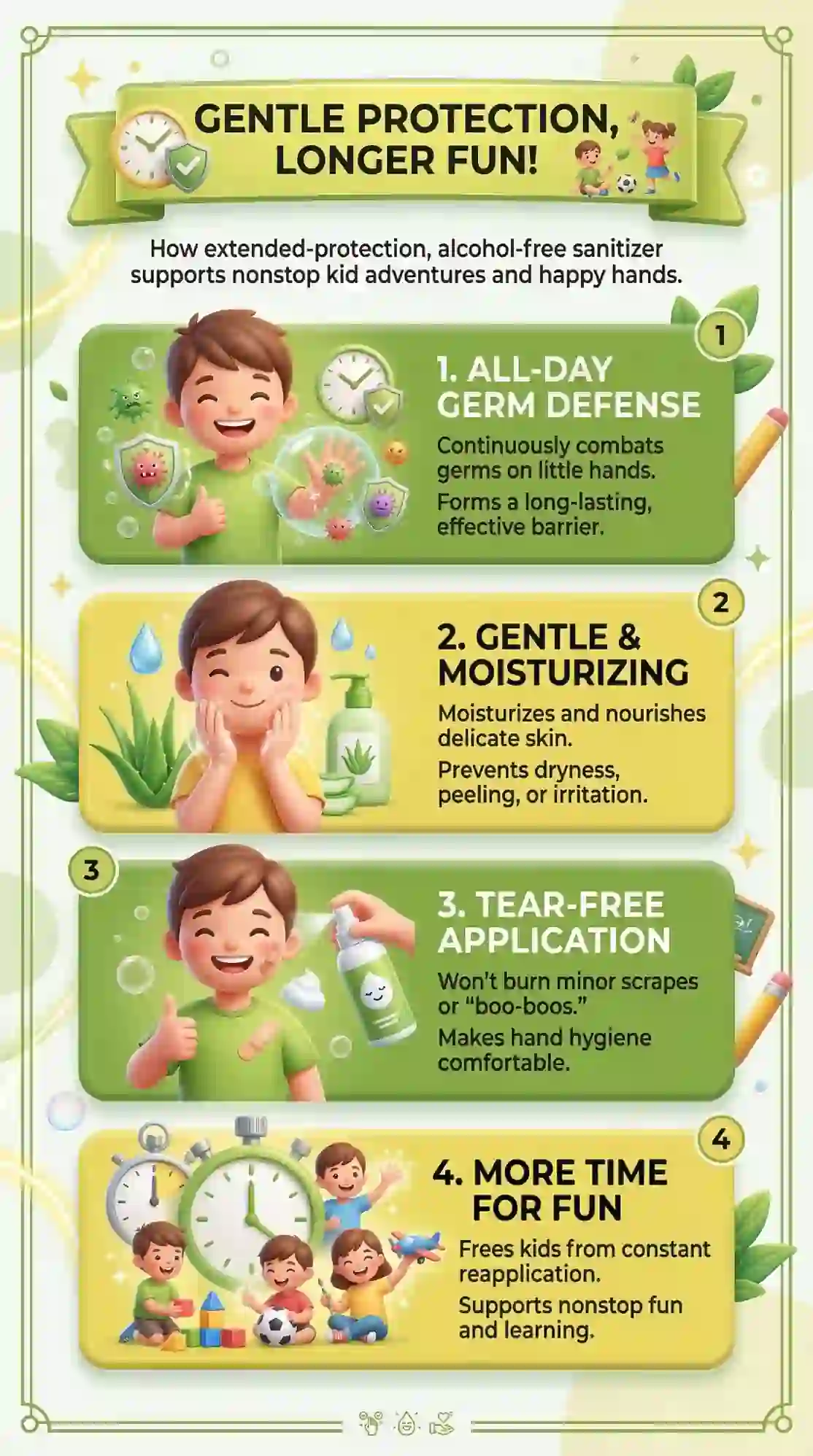
FAQ on Non-Alcoholic Hand Sanitizer for Kids
Q: Does alcohol-free hand sanitizer provide extended protection on kids' hands after it dries?
A: No. And we say that as the people who built one.
Key facts:
Every sanitizer — alcohol-based or alcohol-free — loses active protection the moment it dries.
The active window is roughly 20 seconds.
After that, the next surface a child touches resets exposure entirely.
We have explained this to parents in our emergency departments, in our own families, and in our lives as parents sending children to school.
The label says "extended protection." The research directly contradicts it.
The right standard is not how long the product lasts. It is how complete the clean was at the moment it mattered — and whether the product covered the pathogen your child was actually exposed to.
Q: Is alcohol-free hand sanitizer effective against norovirus — the stomach bug most likely to hit a child's school?
A: Most are not. Neither is any alcohol-based sanitizer — at any concentration, ever.
Why alcohol fails against norovirus:
Norovirus is non-enveloped.
Its protein capsid blocks alcohol from penetrating it — regardless of concentration or contact time.
The CDC states this directly. Physical removal is the only mechanism that works.
This has been federally documented for over a decade. The market did not change in response to it. We did.
NOWATA™ was tested against a norovirus surrogate under a modified ASTM E1174 protocol at Microbe Investigations AG, Switzerland — because we would not send it to school with our own children without that data.
Result: over 99.9% physical removal confirmed. Not a kill rate. A removal rate.
Q: Why does a child's biology make hand sanitizer ingredient selection more consequential than most parents realize?
A: Because a child's skin does not work the same way adult skin does.
What the research confirms:
Children's skin barrier does not reach adult permeability values until approximately age five. (NIH/PMC)
What sits on a child's hand after sanitizer application is not inert.
Residue, inactive compounds, and dead pathogen particles remain on skin that absorbs topically at a measurably higher rate than adult skin.
We did not design NOWATA™ for adult skin with a child-friendly label applied afterward. We designed it for the biology of the actual patient using it — starting with what we were comfortable leaving in our own children's hands, and working backward from there.
Q: How does a hand sanitizer that physically removes germs differ from one that kills them — and why does it matter for kids?
A: Killing leaves. Removing takes away.
The difference:
Kill mechanism: pathogens are inactivated but remain on the skin — dead cells, viral particles, chemical residue all stay on the surface after drying.
Removal mechanism: pathogens are lifted off the skin entirely and wiped away — the same principle that makes soap and water the gold standard.
Why it matters more for children:
Skin under age five absorbs topically at a higher rate than adult skin.
Children's hands move from surfaces to mouth repeatedly throughout a school day.
What remains on the skin after application is not a neutral outcome at these ages.
NOWATA™ uses plant-based clumping technology to trap and lift germs, dirt, and oil from skin — no water, no rinsing, no residue left behind. Over 99.9% physical removal confirmed by independent laboratory testing. We chose that standard because we were designing for the patient it would actually be used on.
Q: What should parents look for when evaluating extended protection claims on alcohol-free hand sanitizers for kids?
A: Here is the four-point standard we built NOWATA™ to meet — and use ourselves as parents before we use it as founders:
Mechanism. Does it kill and leave residue, or physically remove? Removal is the standard soap and water are built on.
Norovirus coverage. Is there independent lab data — on real hands, under a recognized clinical protocol — confirming efficacy against norovirus or a recognized surrogate? Most products have never been tested for this. We were not comfortable releasing NOWATA™ until we had that data.
Ingredient safety. Is it free from alcohol, synthetic fragrance, and compounds that should not be applied repeatedly to skin that absorbs topically at a higher rate than adult skin?
Testing credentials. Was it tested by an independent laboratory under a recognized clinical standard — not just on a lab surface? NOWATA™ was tested under a modified ASTM E1174 protocol at Microbe Investigations AG, Switzerland.
Extended protection is not a duration claim. It is:
A pathogen coverage claim.
A removal standard.
A formulation decision.