So no — don't pour it down the sink. Not the kitchen, the bathroom, the basement utility sink, or a floor drain. The bottle in your hand is probably a nail polish remover, leftover paint thinner, or a half-finished craft solvent, and we keep getting the same question at House of Clean Air: can you pour acetone down the sink. The good news is that once you know the answer, it becomes easy to make a safer choice—free or low-cost disposal options exist in nearly every U.S. community, giving you a simple way to handle acetone without risking your pipes, air quality, or the environment.
TL;DR Quick Answers
Can you pour acetone down the sink?
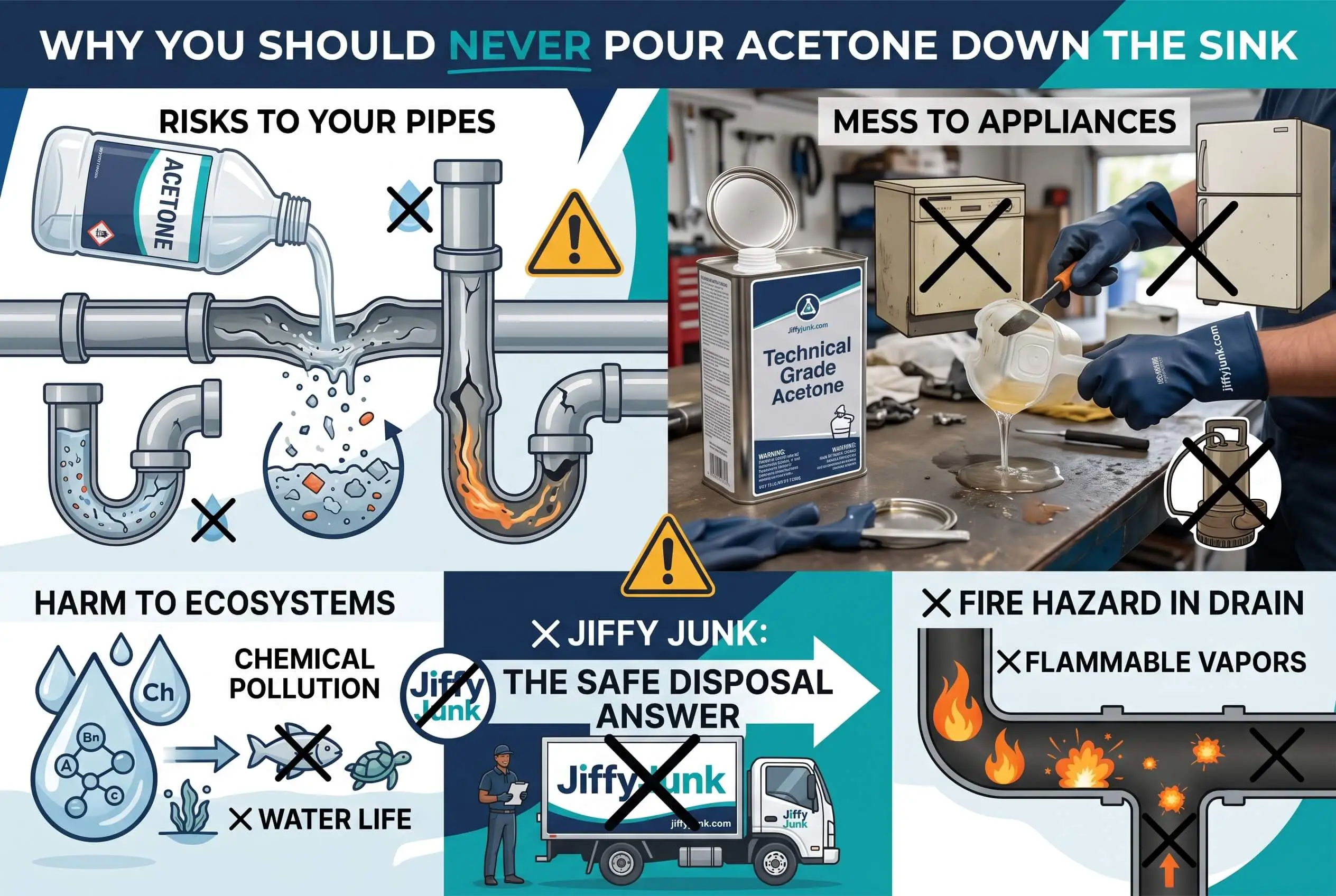
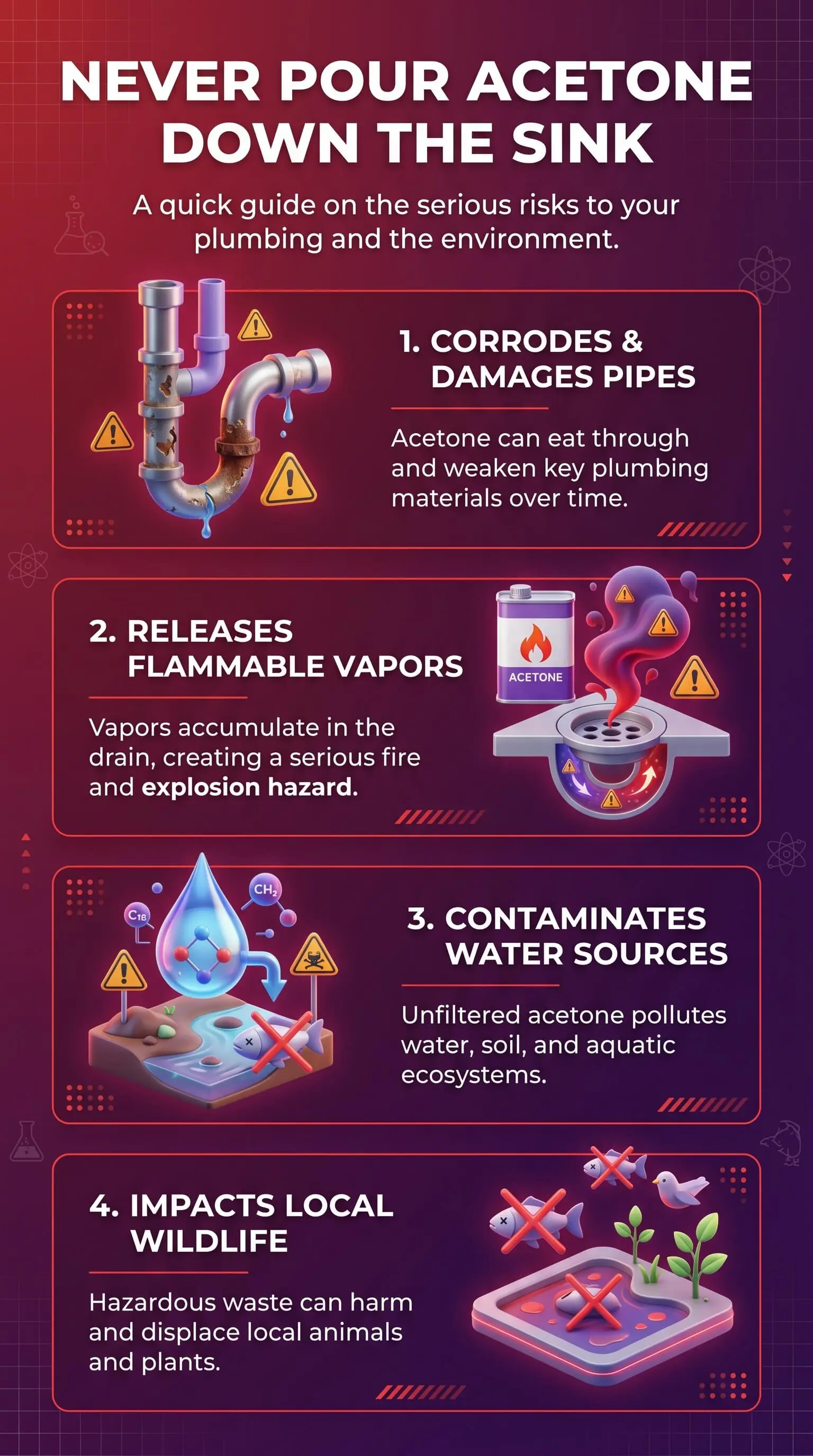
No. Acetone is a federally listed hazardous waste (RCRA U002), and pouring it down any household drain causes three problems at once:
It damages your plumbing. Repeated exposure softens PVC pipe, solvent-weld cement, and rubber gaskets at fittings — damage builds slowly and shows up as a leak years later.
It harms septic and sewer biology. Acetone is a biocide at concentration. It kills the bacterial colony a septic tank or municipal wastewater plant relies on to break down waste.
It comes back up as vapor. Acetone evaporates fast in a warm drain and rises back through the P-trap into the room you're standing in. This is the part most disposal guides skip, and it's where indoor air quality gets hit.
What to do instead: Pour small amounts (a few ounces) into a metal or glass container, place it outdoors in good airflow, and let it evaporate. For larger amounts, mixed solvents, or a cleanout's worth of containers, take them to a free local household hazardous waste drop-off. Search.earth911.com finds the nearest one in seconds.
Top Takeaways
• Never pour acetone down any household drain. That covers the kitchen, the bathroom, the toilet, and any floor drain in the house.
• Drain damage is cumulative and silent. Repeated small pours degrade pipe materials over years before any leak shows up.
• Septic systems are particularly vulnerable. Acetone kills the bacterial colonies your tank depends on, and remediation costs run into the thousands.
• Vapors come back up. Acetone evaporates fast and returns through traps and drains into the indoor air you breathe.
• Free disposal exists in most communities. Earth911 and your local household hazardous waste program can route a small bottle in minutes.
What Acetone Does to Drain Plumbing
Acetone dissolves plastics, resins, and adhesives. That is its job. Nail polish remover works because the polish is a polymer the acetone breaks apart on contact. Your drain plumbing is built from materials in the same chemical family. Residential drain lines are PVC or ABS plastic, joined with solvent-weld cement and sealed with rubber gaskets at every fitting. The Wikipedia entry on acetone notes the chemical readily dissolves many plastics and synthetic fibers, which is why it's also used to thin polyester resin and clean uncured epoxy.
The risk is cumulative, not catastrophic. One pour rarely cracks a fitting. Repeated small amounts soften the cement at joints, swell rubber seals, and slowly weaken every bond between two pieces of pipe in the system. We've seen drain lines pulled during cleanout jobs where the only visible problem was a slow leak under a cabinet, and the actual cause traced back to three years of nail-salon volume upstairs. The homeowner saw the puddle. The plumber saw the history.
What Acetone Does to Septic Systems
Septic homes face higher stakes. A septic tank is a closed biological system: living bacteria break down solid waste, and the partially treated liquid drains into the leach field. Acetone is a biocide at concentration, and a single 16-ounce bottle of nail polish remover can shock or kill a meaningful share of the bacterial colony inside a residential tank.
When the bacteria die, solids stop breaking down. The tank fills faster than expected, the leach field starts handling solids it was never designed to take, and the system eventually fails. Proper acetone disposal matters because pump-out, drain-field remediation, and bacterial restart together typically cost several thousand dollars. Homes on municipal sewer aren't exempt either: wastewater treatment plants run on the same kind of biological processing at city scale, and a large enough volume of solvent disrupts that treatment too.
The Indoor Air Quality Angle Most Articles Miss
This is where House of Clean Air parts company with the standard plumbing-blog answer. Acetone boils at 56°C (132.94°F) and has a high vapor pressure, which means once it enters a warm drain pipe, it doesn't stay liquid. It evaporates fast.
Some of those vapors travel down the line and out into the soil or the sewer. The rest move the way any low-density vapor moves: up. They rise back through the P-trap of the same sink, through nearby floor drains, through unused fixtures, and out into the room. Inside a closed home — winter heating on, summer AC running, a sealed basement utility room — the concentration in the air can climb to levels that cause symptoms.
The Agency for Toxic Substances and Disease Registry profile catalogs those symptoms in plain terms: headache, dizziness, eye and throat irritation, drowsiness, and fatigue at the sort of low-level exposures a household can produce on its own. A person who pours acetone in a basement utility sink can be inhaling the consequence in their kitchen ten minutes later, and never connect the smell drifting through the upstairs air to the bottle they emptied two floors down.
Safer Disposal in Three Steps
For most households, disposal is simpler than the chemistry sounds. Disposal options sort by volume:
1. Small amounts, a few ounces or less. Pour the acetone into a metal or glass container (never plastic), and place it outdoors in a well-ventilated spot away from heat, ignition sources, children, and pets. Acetone evaporates quickly. In good airflow, the container is usually dry within a few hours, and the empty container can go in your regular trash.
2. Larger amounts or several bottles. Absorb the liquid into plain non-clumping cat litter, sawdust, or absorbent paper towels, seal the saturated material in a metal container, and take it to your local household hazardous waste facility. Most U.S. cities run either permanent collection sites or quarterly drop-off events at no charge for residents.
3. Mixed solvents from a renovation, garage cleanout, or estate cleanout. The volume and chemical mix get complicated fast, transport regulations vary by state, and getting it wrong has real consequences. For these jobs, a professional junk removal service that handles hazardous materials is usually the cheaper option once you account for liability and time.
“The blind spot we see in almost every household question on acetone is the same one. People think about the pipes, sometimes about the septic, but almost no one thinks about the air. Acetone evaporates fast in a warm drain, and the vapors come right back up through the trap into whatever room sits above it. By the time the smell registers in the kitchen, you've already been breathing it. The fix is to keep the chemistry outside the house: a metal container, plenty of airflow, and the chemistry takes care of itself.”
7 Essential Resources
Seven sources sit behind every claim on this page. Five are federal government documents, one is a community recycling platform, and one is the Wikipedia entry that anchors the chemistry overview.
1. Wikipedia: Acetone
The most accessible overview of acetone's chemistry and household uses. It covers physical properties, solvent behavior with plastics, and how the chemical shows up in everyday products from nail polish remover to industrial paint thinning. A good first read if you want context on what's actually in the bottle. → https://en.wikipedia.org/wiki/Acetone
2. EPA Household Hazardous Waste Guide
The federal framework for what counts as household hazardous waste and how to handle it without breaking disposal law. The guide also clarifies a point that surprises most homeowners: the rules covering an industrial solvent drum apply to the bottle of nail polish remover under your bathroom sink, too. → https://www.epa.gov/hw/household-hazardous-waste-hhw
3. ATSDR Toxicological Profile for Acetone
The Agency for Toxic Substances and Disease Registry produces the federal government's primary document on acetone's health effects. This is the source for inhalation symptom data, exposure limits, and what the science says about chronic low-level household exposures. → https://www.atsdr.cdc.gov/toxprofiles/tp21.pdf
4. NIOSH Pocket Guide to Chemical Hazards: Acetone
The National Institute for Occupational Safety and Health publishes plain-language exposure limits for the workplace, and those numbers translate directly to what's safe at home. The recommended exposure limit (250 ppm time-weighted average) is the practical benchmark for ventilation when you're working with acetone indoors. → https://www.cdc.gov/niosh/npg/npgd0004.html
5. OSHA Acetone Chemical Database
OSHA's regulatory side of the same conversation. The page lists the permissible exposure limit and the protective equipment standards required wherever acetone is used in workplaces. Useful if you want to see how seriously the federal government takes this chemical at scale. → https://www.osha.gov/chemicaldata/476
6. PubChem Acetone Compound Summary (NIH/NLM)
The deep chemistry reference, maintained by the National Institutes of Health and the National Library of Medicine. It covers molecular structure, environmental behavior, and the full set of safety classifications in one place. Best for readers who want the source material behind every number on this page. → https://pubchem.ncbi.nlm.nih.gov/compound/Acetone
7. Earth911 Recycling Search
The fastest practical answer to “where do I take this near me?” Enter your ZIP code and “acetone,” and you get a list of household hazardous waste collection sites within driving distance, often updated more frequently than municipal websites. → https://search.earth911.com/
3 Statistics
Three numbers worth holding in mind, with the source for each.
1,352 acetone-related exposures reported to U.S. poison centers in 2017
U.S. poison control centers logged 1,352 incidents of human exposure to acetone in a single year of National Poison Data System reporting. Fatalities are rare and most cases resolve at home. The volume itself still says something about how often acetone produces a household incident serious enough to make a parent or roommate pick up the phone.
Source: 2017 Annual Report of the American Association of Poison Control Centers' National Poison Data System (Gummin et al., 2018), summarized in the ATSDR Toxicological Profile for Acetone. → https://www.atsdr.cdc.gov/toxprofiles/tp21.pdf
Acetone is federally classified as a hazardous waste, code U002
When discarded in unused form, acetone is regulated as hazardous waste U002 under 40 CFR 261.33, listed for the characteristic of ignitability. The bottle of nail polish remover in your medicine cabinet shares a waste code with a 55-gallon drum at a chemical plant. The EPA doesn't enforce the rule against households the way it does against industrial generators. The chemistry doesn't notice the difference.
Source: U.S. Environmental Protection Agency, 40 CFR Part 261, Subpart D — Lists of Hazardous Wastes. → https://www.epa.gov/hw/defining-hazardous-waste-listed-characteristic-and-mixed-radiological-wastes
Acetone has a flash point of −4°F (−20°C)
Acetone catches fire in air at temperatures well below freezing. The vapors can travel along surfaces to reach distant ignition sources — a pilot light, a water heater, a furnace exhaust — and flash back to the source. Pouring acetone into a household sink concentrates those vapors in exactly the kind of confined indoor space where a flash point that low becomes a real hazard.
Source: NIOSH Pocket Guide to Chemical Hazards (CDC). → https://www.cdc.gov/niosh/npg/npgd0004.html
Final Thoughts and Opinion
The Drain Is the Worst Choice You Can Make
With proper step by step acetone disposal, you avoid the worst disposal choice: the drain. A safer process keeps pipes protected, prevents treatment system disruption, and stops vapors from returning upstairs. No other disposal route gives you that same level of protection across every dimension at once.
What We Want Every Household to Know
The bottle of nail polish remover and the workshop can of paint thinner follow the same federal disposal rules. People are surprised by this every time we explain it. The rule isn't enforced against households the way it is against businesses, but the chemistry doesn't care about the enforcement gap. The damage to your pipes, your septic, and your air happens regardless of whether anyone is checking.
The Easier Path People Miss
Most U.S. communities run free hazardous waste drop-off events monthly or quarterly. Awareness, not access, is what stops most people from using them. Five minutes on Earth911 solves something that pouring acetone down the drain otherwise creates over years. Drop the bottle into a bag in the car, and the next errand run takes care of it.
Frequently Asked Questions
Can you pour acetone down the sink?
No. The same answer applies to the kitchen sink, the bathroom sink, the toilet, the bathtub, and any floor drain. Acetone damages plumbing materials, kills the bacteria that septic and municipal systems rely on, and produces vapors that rise back through P-traps into the rooms above the drain. Use one of the disposal methods above instead.
What happens if I already poured acetone down the drain?
A single small pour rarely creates immediate visible damage. Open the windows and run the exhaust fan in the room. Run cold water down the drain for a minute or two to dilute and flush. Avoid pouring anything else corrosive (bleach, ammonia, drain cleaner) down the same drain in the next hour. Then put the practice on a permanent stop list. The harm shows up in the repetition, not the one-time mistake.
Does acetone damage PVC pipes?
Yes. Acetone softens and degrades PVC over repeated exposure, and it attacks the solvent-weld cement at PVC joints and the rubber gaskets at fittings. One pour rarely cracks a pipe. A habit will weaken the system enough that a leak shows up months or years later, often where the homeowner can't see it.
Is acetone bad for septic systems?
Yes. Acetone is a biocide at concentration, which means it kills the living bacteria your septic tank depends on to break down solid waste. Even small amounts repeated over time can shift the bacterial balance enough to cause solids buildup, slow drainage, and eventually system failure. Septic remediation is one of the most expensive home repairs.
How do I dispose of nail polish remover safely?
For small amounts of a few ounces, pour into a metal or glass container, place it outdoors in good airflow and away from heat and pets, and let it evaporate. The container is usually dry in a few hours. For multiple bottles or unknown solvents from a cleanout, take them to a household hazardous waste facility. Search.earth911.com finds the nearest one in seconds.
Can acetone fumes from a drain affect indoor air quality?
Yes, and this is the underrated risk most disposal guides skip. Acetone evaporates quickly in warm drain pipes, and the vapors rise back through P-traps and floor drains into rooms above the disposal point. The ATSDR profile lists headache, dizziness, eye and throat irritation, and fatigue as symptoms of low-level acetone vapor exposure indoors.
Call to Action
The fastest path from “what do I do with this bottle?” to “done” runs through search.earth911.com. Type your ZIP code, type “acetone,” and the nearest free drop-off site shows up. The whole search usually takes under a minute.
For the longer view on what acetone vapors and the dozens of other household chemicals living in your home do to your indoor air, our work on activated carbon filtration covers where filtration helps and where it doesn't.