After manufacturing filters for over a decade and shipping to more than two million households, we know this distinction matters more than most homeowners realize. What surprises people most isn't that filter quality varies — it's how dramatically it varies within the exact same 20x20x1 size. The frame looks identical. The performance doesn't even come close.
Here's what we've learned from the factory floor: your HVAC system cycles all the air in your home multiple times a day, and your filter is the only line of defense between your family and what's floating in it. In this guide, we'll show you exactly what a 20x20x1 filter captures at each MERV rating, how that translates into real air quality improvements, and how to match the right filter to your home's specific needs — so you can protect what matters most with confidence.
TL;DR Quick Answers
20x20x1 Air Filter
A 20x20x1 air filter is a standard 1-inch residential HVAC filter measuring 19½" x 19½" x ¾" in actual dimensions. It installs in your home's return air slot and captures airborne particles — including dust, pollen, pet dander, mold spores, and fine particulate matter — on every air cycle your HVAC system runs.
Key facts:
Available in MERV 8, MERV 11, and MERV 13 for standard residential use
MERV 8 captures 90% of airborne particles — best for standard homes
MERV 11 captures 95% of airborne particles — best for pets and mild allergies
MERV 13 captures 98% of airborne particles — best for asthma and health-sensitive households
Replace every 90 days for standard households; every 60 days for homes with pets; every 30 to 45 days for allergy and asthma households
Made in the USA by Filterbuy — manufactured directly and shipped to your door in 24 hours
The right 20x20x1 filter matched to your household's needs and changed on schedule is one of the most cost-effective investments a homeowner can make in indoor air quality and long-term HVAC performance.
Top Takeaways
MERV rating is the single most important variable in a 20x20x1 filter. Two filters that look identical can perform completely differently. Here's how they break down:
MERV 8 — captures dust, lint, and pollen
MERV 11 — adds pet dander and mold spores
MERV 13 — intercepts fine particulate matter, smoke, and bacteria carriers
A clogged filter is worse than no filter at all. The most consistent pattern we see after serving two million households isn't the wrong MERV rating — it's the right filter left in place too long. A neglected filter:
Restricts airflow
Strains your blower motor and components
Stops capturing the particles it was rated to intercept
Your HVAC system cycles all the air in your home four to five times every hour. That makes your 20x20x1 filter the only barrier between your family and pollutants the EPA confirms are often 2 to 5 times more concentrated indoors than outdoors. The filter you overlook is the protection your family isn't getting.
A dirty filter costs you money every month it stays in place. ENERGY STAR confirms nearly half of all home energy use goes to heating and cooling. A neglected 20x20x1 filter drives up three costs simultaneously:
Monthly energy bills
HVAC repair and maintenance frequency
Long-term system lifespan
Match your filter to your household — not just your filter slot.
No allergies or pets → MERV 8
Pets or mild allergy sufferers → MERV 11
Asthma, wildfire smoke, or immunocompromised family members → MERV 13
What a 20x20x1 Air Filter Is Actually Doing Inside Your HVAC System
Your HVAC system doesn't just heat and cool your home — it continuously circulates all the air inside it. Depending on your system, that air passes through your filter four to five times every hour. That makes your 20x20x1 filter one of the hardest-working components in your home, operating quietly around the clock whether you're thinking about it or not.
The filter's job is mechanical interception. As air is pulled through the filter media, particles get trapped in a dense web of fibers. The tighter and more layered that fiber structure, the smaller the particles it can catch. This is exactly why two 20x20x1 filters that look nearly identical on a shelf can perform completely differently inside your home.
How MERV Rating Determines Real Air Quality Improvement
MERV — Minimum Efficiency Reporting Value — is the industry-standard scale that measures how effectively a filter captures airborne particles. The higher the MERV rating, the smaller the particles it intercepts. For a 20x20x1 filter, MERV rating is the single biggest driver of real-world air quality improvement.
Here's how it breaks down in practical terms:
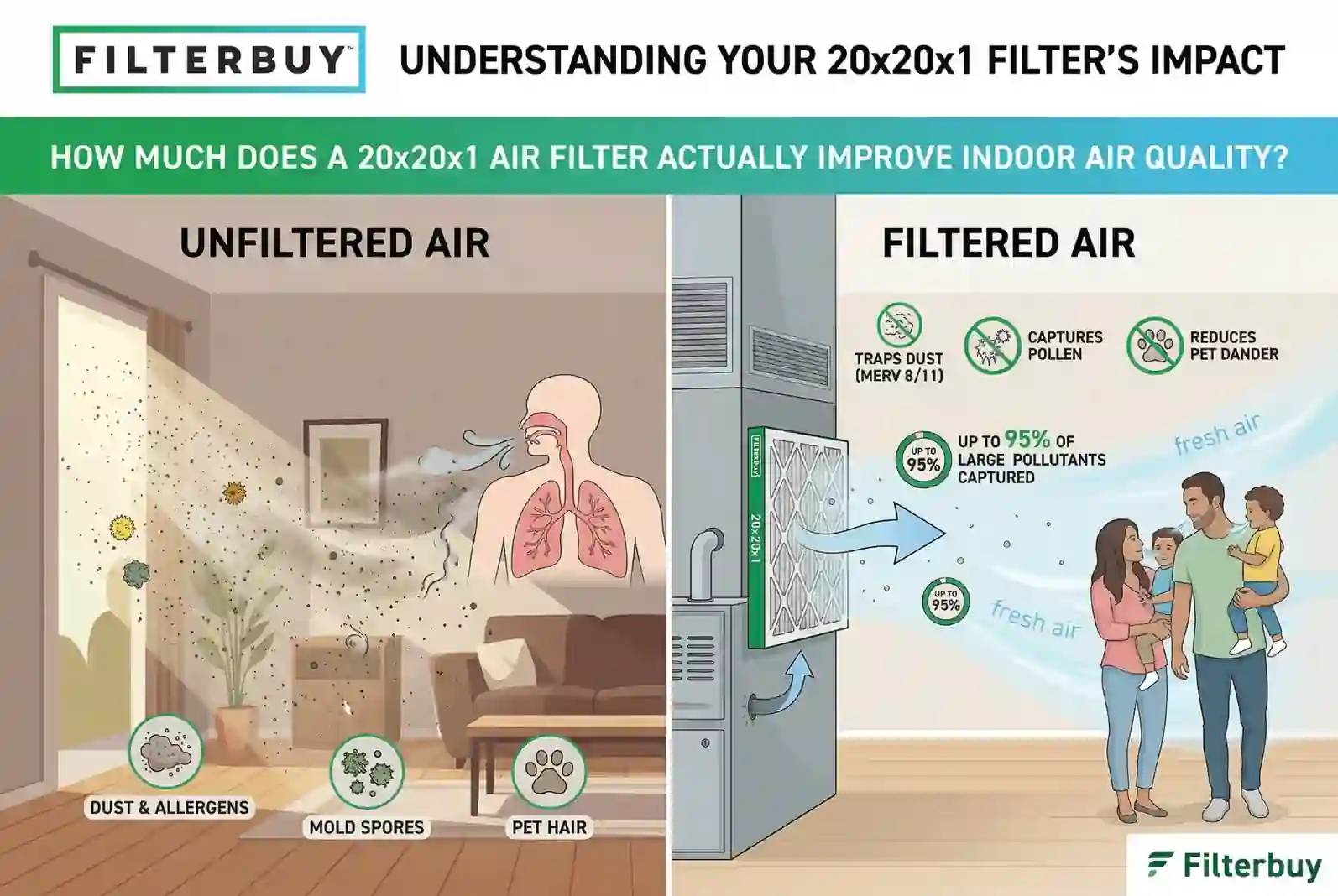
MERV 8 captures larger particles like dust, lint, pollen, and dust mite debris. It's a solid baseline for most homes and a significant upgrade over basic fiberglass filters.
MERV 11 extends that protection to smaller particles including pet dander, mold spores, and finer dust. In our experience, this is the most popular step-up for households with pets or mild seasonal allergies.
MERV 13 captures the microscopic particles that matter most for health — fine particulate matter, smoke particles, bacteria carriers, and virus-sized aerosols. It's the highest filtration level that still works safely in most residential HVAC systems without airflow restriction.
What this means practically: stepping from a MERV 8 to a MERV 13 filter in a standard 20x20x1 slot doesn't just incrementally improve your air — it fundamentally changes the category of contaminants your filter removes on every cycle.
The Household Factors That Affect How Much Improvement You'll Actually See
Filter performance in the real world depends on more than just the filter itself. After manufacturing filters for over a decade and working with more than two million households, we've identified the conditions that most directly affect how much improvement a 20x20x1 filter delivers:
Home size and HVAC runtime. Larger homes with longer system run times cycle air through the filter more frequently, which means your filter works harder and delivers more consistent results throughout the day.
Number of occupants and pets. More people and pets mean more dander, hair, and particulate load in the air. Households with pets consistently benefit from stepping up to at least MERV 11.
Change frequency. A MERV 13 filter that's been running for four months without replacement will underperform a fresh MERV 8. A clogged filter doesn't just stop working — it can restrict airflow enough to reduce your system's ability to circulate and clean air at all.
Duct sealing and system condition. Leaky ductwork pulls unconditioned air — and whatever particles are in your walls and attic — directly into your air supply, bypassing the filter entirely. A great filter can only clean the air that actually passes through it.
The Contaminants a 20x20x1 Filter Can and Cannot Remove
This is where homeowners often have inflated expectations — and it's worth being direct about what a 20x20x1 filter genuinely does and doesn't do.
A properly rated filter absolutely reduces the concentration of:
Dust and dust mite debris
Pollen and mold spores
Pet dander and hair
Fine particulate matter (at MERV 13)
Smoke particles (at MERV 13)
What an air filter cannot address: gaseous pollutants, volatile organic compounds (VOCs), radon, carbon monoxide, and odors from cooking or cleaning products. These require different solutions — activated carbon filtration, ventilation, or source control. Knowing this distinction is important because it helps you build the right, complete approach to indoor air quality rather than relying on any single product to do everything.
How to Match Your 20x20x1 Filter to Your Home's Specific Needs
There's no universal right answer — but there is a right answer for your home. Here's how we recommend approaching it:
Standard home, no allergies or pets: MERV 8 delivers reliable baseline protection and is the most cost-effective option for maintaining healthy air.
Pets or mild allergy sufferers: MERV 11 is the most impactful upgrade for most households in this category. The jump in dander and mold spore capture is immediate and meaningful.
Allergy or asthma households, wildfire smoke exposure, or immunocompromised family members: MERV 13 provides the strongest protection available in a standard 1-inch residential filter. Verify with your HVAC technician that your system can handle the slightly higher static pressure before making the switch.
The right filter — changed on schedule — is one of the most cost-effective investments a homeowner can make in their family's health and their HVAC system's long-term performance.
"Most homeowners focus on filter size and price — and we understand why. But after manufacturing millions of filters and seeing the data from households across the country, the variable that consistently separates genuinely cleaner air from air that just feels cleaner is MERV rating combined with change frequency. A MERV 13 filter changed every 60 days will outperform a MERV 13 filter left in place for six months every single time. The filter is only half the equation. The habit is the other half."
Essential Resources
Don't take your indoor air for granted. We've done the research so you don't have to — pulling together the seven most authoritative resources on 20x20x1 air filter performance, MERV ratings, and indoor air quality from U.S. government agencies, independent research institutions, and over a decade of our own manufacturing experience. Everything you need to protect your family, your home, and your HVAC system is right here.
Understand the MERV Rating That Determines How Well Your Filter Actually Works
After manufacturing filters for over a decade, we know the single question that matters most: what's the MERV rating? The U.S. EPA breaks down exactly how MERV ratings are calculated, what airborne particles each rating intercepts, and how to use that information to choose the right 20x20x1 filter for your home. Start here before you buy anything. https://www.epa.gov/indoor-air-quality-iaq/what-merv-rating
Know Exactly What Your 20x20x1 Filter Protects Against — and What It Doesn't
Here's something most homeowners don't realize: your air filter can't do everything. The EPA's Guide to Air Cleaners in the Home makes clear what HVAC filters genuinely capture — dust, dander, pollen, and fine particulate matter — and what requires a different solution entirely, like gaseous pollutants and VOCs. Knowing the difference helps you build real protection, not just confidence in a product. https://www.epa.gov/indoor-air-quality-iaq/guide-air-cleaners-home
The Technical Evidence Behind Upgrading Your Filter's MERV Rating
In our experience, the most common mistake homeowners make isn't choosing the wrong MERV rating — it's not knowing whether their HVAC system can support a higher one. This EPA technical bulletin covers real-world MERV performance thresholds, airflow pressure considerations, and system compatibility requirements. Essential reading before stepping up from MERV 8 to MERV 11 or 13. https://www.epa.gov/sites/default/files/2020-06/documents/2019.11_tech_bulletin_filtration.pdf
Find Out When MERV 13 Is the Right Filter for Your Home — and When It Isn't
We recommend MERV 13 to households dealing with allergies, asthma, wildfire smoke exposure, or immunocompromised family members — and the U.S. Department of Energy's Building America Solution Center backs that up with independent research. This resource outlines the specific scenarios where MERV 13 makes the biggest difference, including airborne virus management, and how to confirm your system can handle the added static pressure. https://basc.pnnl.gov/resource-guides/high-merv-filters
The Industry Testing Standard Behind Every MERV Rating on Every Filter We Make
Every MERV rating on every Filterbuy 20x20x1 filter is earned through the testing protocol established in ASHRAE Standard 52.2 — the national consensus standard that defines how air filters are evaluated across particle size ranges. Understanding this standard helps you cut through marketing language and evaluate filter performance claims the right way. https://www.ashrae.org/technical-resources/bookstore/ashrae-standard-52-2
The Baseline Filtration Standard Every Home HVAC System Is Required to Meet
ASHRAE Standard 62.2 establishes the minimum ventilation and filtration requirements for residential buildings, including the MERV 6 threshold for mechanical systems. Understanding the floor gives you important context for why MERV 8 — the entry point for all Filterbuy filters — represents a genuinely meaningful step up in protection for your family. https://www.ashrae.org/technical-resources/bookstore/ashrae-62-2
Match Your 20x20x1 Filter to Your Home's Specific Needs — With Confidence
After serving more than two million households, we've built a straightforward guide that removes the guesswork from choosing between MERV 8, MERV 11, and MERV 13. From households with pets to allergy sufferers to homes in wildfire-prone regions, this resource walks you through exactly which 20x20x1 filter protects your family's air — and how often to change it to keep that protection working. https://filterbuy.com/resources/air-filter-basics/which-merv-rating-should-I-use/
Supporting Statistics
We've spent over a decade on the manufacturing side of air filtration. The data from the country's most trusted public health and energy authorities consistently reinforces what we see in our own customer interactions every day. The invisible problem is real, it's measurable, and the right 20x20x1 filter is one of the most accessible tools a homeowner has to address it directly.
The air inside your home is likely more polluted than the air outside it.
The U.S. EPA reports that Americans spend approximately 90 percent of their time indoors — where pollutant concentrations are often 2 to 5 times higher than outdoor levels. Here's what that means at the filter level:
Your HVAC system cycles indoor air through your 20x20x1 filter four to five times every hour.
What surprises most customers isn't that their air is compromised — it's that the solution is already built into the system they own.
The filter is the mechanism. MERV rating and change frequency determine whether that mechanism is actually working.
Source: U.S. Environmental Protection Agency — Indoor Air Quality https://www.epa.gov/report-environment/indoor-air-quality
More than 26 million Americans are managing asthma in a home full of the triggers a good filter is built to intercept.
The American Lung Association reports that 26.8 million Americans — 8.2% of the population — are currently living with asthma, a public health concern closely aligned with the goals of the Clean Air Act. These are confirmed indoor asthma triggers that a properly rated 20x20x1 filter captures on every cycle:
Dust mites and dust mite debris
Pet dander
Mold spores
Fine particulate matter (at MERV 13)
In our experience working with millions of households, stepping up to a higher MERV rating and shortening the change interval produces one of the most consistent improvements we see among allergy and asthma households. Not because a filter cures anything — but because reducing trigger concentration in recirculated air makes a compounding difference over time.
Source: American Lung Association — Asthma Trends and Burden https://www.lung.org/research/trends-in-lung-disease/asthma-trends-brief/trends-and-burden
A neglected filter doesn't just compromise your air — it costs you money every month it stays in place.
ENERGY STAR confirms that nearly half of all home energy use goes to heating and cooling. A dirty filter forces your system to work harder, driving up energy costs and accelerating component wear. From our manufacturing side, here's exactly what filter neglect sets in motion:
A warped or collapsed filter frame creates bypass gaps around the filter media.
Unfiltered air moves around — not through — the filter.
That unfiltered air hits your evaporator coil and blower motor directly.
Contaminant buildup reduces system efficiency and shortens equipment lifespan.
Every Filterbuy 20x20x1 filter uses a beverage board frame engineered to hold its shape through humidity and temperatures up to 200°F — because a filter that fails structurally doesn't just fail at air quality. It becomes the problem your HVAC technician eventually bills you for.
Source: ENERGY STAR, U.S. Department of Energy — Heat and Cool Efficiently https://www.energystar.gov/saveathome/heating-cooling
Final Thoughts
A 20x20x1 air filter is one of the most underestimated components in any home. It sits behind a grille, out of sight, doing its job quietly — and most homeowners only think about it when something goes wrong.
After manufacturing filters for over a decade and serving more than two million households, we've developed an opinion that goes beyond what any specification sheet communicates:
The conversation about air filters focuses too much on the product and not enough on the habit.
Most homeowners dealing with poor indoor air quality aren't using the wrong MERV rating. They're leaving the right filter in place too long. A clogged MERV 13 is genuinely worse than a fresh MERV 8. It:
Restricts airflow through the system
Strains the blower motor and key components
Stops capturing the particles it was rated to intercept
Becomes the problem it was purchased to prevent
The data confirms what we see repeatedly in our own customer base:
Indoor air is often 2 to 5 times more polluted than outdoor air — U.S. EPA
26.8 million Americans are currently living with asthma, with dust mites, pet dander, and fine particulate matter among the primary indoor triggers — American Lung Association
Nearly half of all home energy use goes to heating and cooling — and a dirty filter makes that investment less efficient every day it stays in place — ENERGY STAR
These aren't abstract statistics. They describe conditions inside the homes we serve every day.
At any given moment, the 20x20x1 filter in your return air slot is doing one of three things:
Actively protecting your family
Losing its ability to protect your family
Working against the system it was installed to support
Our opinion, built from the factory floor out: the homeowners who get the most from their 20x20x1 filter aren't always the ones who choose the highest MERV rating. They're the ones who treat filter replacement as a non-negotiable household routine — the same way they treat changing smoke detector batteries or scheduling an annual HVAC tune-up.
The filter is a consumable. Its value is time-limited by design. Honoring that design is what turns a $6 filter into genuine, compounding protection for your family's health and your home's most expensive mechanical system.
That's what we mean by better air for all. Not just better filters — better habits around the filters you already have.
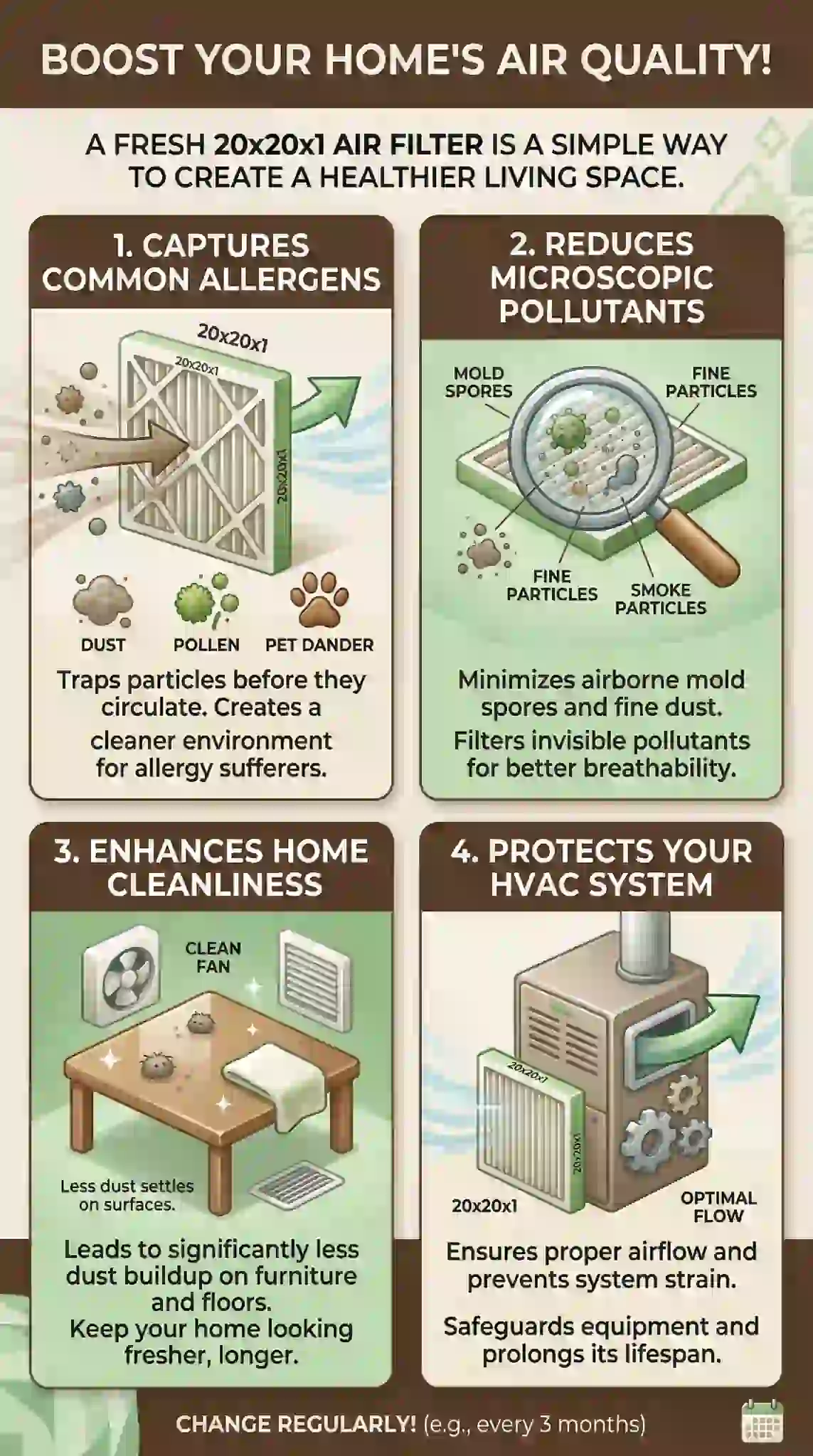
FAQ on 20x20x1 Air Filters
Q: What does the 20x20x1 size mean on an air filter?
A: The three numbers are the filter's nominal length, width, and depth in inches. Nominal means the labeled size — not the actual size.
A Filterbuy 20x20x1 filter measures 19½" x 19½" x ¾" in actual dimensions
This is industry standard for this nominal size
The most common sizing mistake we see: homeowners measure the old filter instead of the slot. Filters compress, warp, and shed material over their service life. That makes them an unreliable measuring tool. Follow these three steps instead:
Measure the filter slot — not the old filter
Match the nominal size on the replacement label
Confirm a tight seal with zero bypass air around the edges
Q: What MERV rating should I choose for my 20x20x1 air filter?
A: Match the filter to the people living behind it — not just the slot it fits in. After manufacturing filters for over a decade and serving more than two million households, this is the framework we rely on:
MERV 8 → Standard home, no pets or allergy concerns
MERV 11 → Pets in the home or mild allergy sufferers
MERV 13 → Asthma, wildfire smoke exposure, or immunocompromised family members
Important: MERV 13 requires confirmation that your HVAC system can handle the higher static pressure. Check your owner's manual or ask your HVAC technician before upgrading. A filter your system can't support strains your equipment — it doesn't protect your family.
Q: How often should I change my 20x20x1 air filter?
A: Every 90 days is the standard baseline. Most households need to shorten that interval. Here's what we recommend based on millions of filter change cycles:
Standard home, no pets → every 90 days
Pets in the home → every 60 days
Allergy or asthma sufferers → every 45 to 60 days
Multiple pets or severe allergy households → every 30 days
Active wildfire smoke events → inspect immediately, replace if visibly loaded
The insight most homeowners miss: a clogged MERV 13 underperforms a fresh MERV 8. Changing frequency is not a secondary consideration. It is half the equation.
Q: Can a 20x20x1 air filter remove odors, VOCs, or gaseous pollutants?
A: No — and being direct about this matters. A standard pleated 20x20x1 filter captures airborne particles. It is not designed to capture gases. Two separate problems require two separate solutions:
Particle pollutants — dust, dander, pollen, mold spores, fine particulate matter → captured by pleated MERV-rated media
Gaseous pollutants — VOCs, cooking odors, chemical off-gassing, cleaning product residue → require activated carbon media to adsorb molecules from the air
Adsorption and filtration are fundamentally different physical processes. If your household has both particle and odor concerns, Filterbuy's Odor Eliminator filter combines both media types in a single 20x20x1 filter. Knowing what your filter cannot do is as important as knowing what it can.
Q: Will upgrading to a higher MERV rating damage my HVAC system?
A: Not if your system is compatible. Most modern residential systems handle MERV 8 through MERV 13 without issue. The risk is real, though. Denser filter media creates more airflow resistance — called static pressure — that your blower motor works against. Here's how compatibility breaks down by MERV level:
MERV 8 to MERV 11 → Compatible with virtually all modern residential systems
MERV 11 to MERV 13 → Compatible with most systems — verify against your owner's manual
MERV 14 and above → Not recommended for standard residential HVAC systems
From the factory floor, the principle we return to consistently: the best filter is the highest MERV rating your specific system can support comfortably — not the highest rating available. A filter that exceeds your blower motor's capacity will:
Restrict airflow through the system
Strain the blower motor and key components
Shorten overall equipment lifespan
Cost more in repairs than the air quality improvement justifies
If you're uncertain, start at MERV 8 and work up. Your HVAC technician can confirm your system's maximum tolerance in a single maintenance visit.
Ready to See How Much a 20x20x1 Air Filter Can Actually Improve Your Indoor Air Quality?
Choose your MERV rating, and we'll ship your Filterbuy 20x20x1 air filter — manufactured in the USA and backed by over a decade of air quality expertise — directly to your door in 24 hours. Better air for your family starts with one simple change.