If you're reading this, the truck is probably already booked. Your couch won't fit through the new apartment's stairwell. The new tenants don't want the dresser. The guest-room bed you swore you'd sell three months ago is still in the guest room. Five ways out remain. They aren't equally fast or equally cheap, and the right one depends on how much time is left on the clock.
TL;DR Quick Answers
Getting rid of old furniture
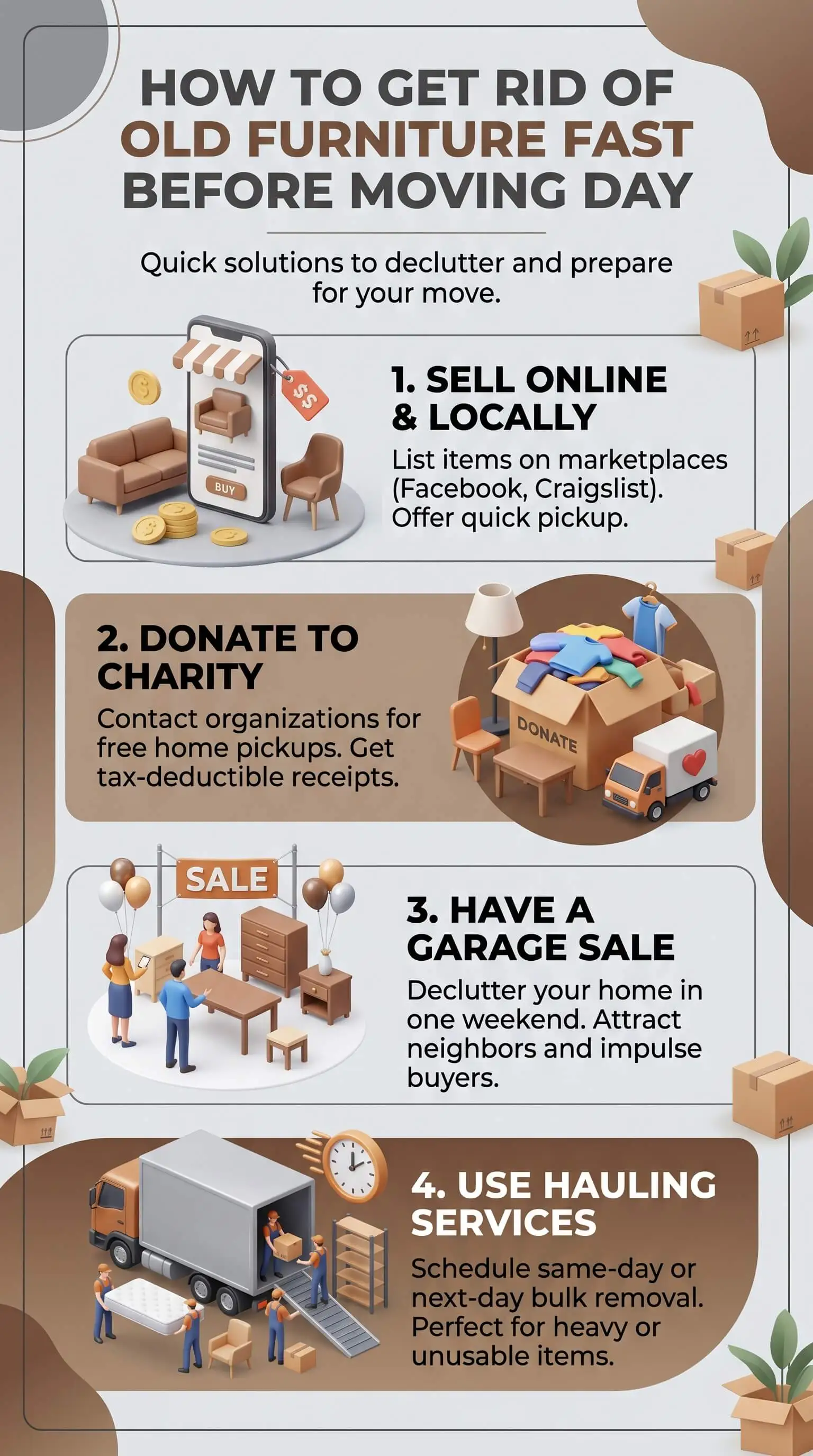
Five methods work for getting rid of old furniture, ranked from fastest to slowest:
Junk removal service: 24 to 48 hours, $75 to $600.
Local sale or Buy Nothing group: 24 hours to 2 weeks, free or earns money.
Roll-off dumpster rental: Same-week delivery, $300 to $900, best for whole-house cleanouts.
Curbside bulk pickup: Free in most U.S. cities, monthly schedule, item limits apply.
Charity pickup (Habitat ReStore, Salvation Army, VVA): Free, 1 to 3 weeks to schedule.
The choice comes down to lead time. Start the cleanout the same week you sign the new lease, not the week before truck day. Most last-minute movers pay premium prices for junk removal because the cheap options closed before they started looking.
Top Takeaways
Junk removal services offer 24- to 48-hour pickup. Expect $75 to $200 per item or $300 to $600 for a truckload.
Charity pickup is free but typically takes 1 to 3 weeks to schedule. Donate only items in genuinely good condition.
Selling or giving away locally is the cheapest option, and often the fastest if items are sellable.
Curbside bulk pickup is free in most U.S. cities, but it operates on a monthly schedule with strict item limits.
Per EPA data, Americans landfill 80.1% of discarded furniture. Planning ahead is the single biggest lever for diverting more of it to reuse.
Build your disposal timeline into your move from the day you sign the new lease, not the week before truck day.
Below is the at-a-glance comparison most readers come here for. The five options rank by typical speed.
Junk Removal Service. Timeline: 24–48 hours. Typical cost: $75–$600. Effort: low. Best for last-minute moves and broken or unsellable items.
Roll-Off Dumpster. Timeline: same-week delivery, with a 7- to 14-day rental window. Typical cost: $300–$900. Effort: medium. Best for whole-house or estate cleanouts.
Charity Pickup. Timeline: 1 to 3 weeks to schedule. Typical cost: free to $50. Effort: low. Best for items in genuinely good condition.
Local Sale or Giveaway. Timeline: 24 hours to 2 weeks depending on item and channel. Typical cost: free, or earns money. Effort: medium. Best for sellable items in decent condition.
Curbside Bulk Pickup. Timeline: monthly municipal schedule. Typical cost: free in most U.S. cities. Effort: low. Best for items rejected by donation channels.
If your move is within 72 hours, hire a junk removal service or stage items for curbside pickup if your municipality permits it. With one to three weeks of runway, mix donation pickups with local sales. With more than three weeks, the cheaper paths open up, and you'll often make money instead of spending it.
Option 1: Hire a Junk Removal Service (24–48 Hours)
Hiring a junk removal service is the fastest way to get rid of old furniture before moving day. Most national and regional companies offer same-day or next-day pickup. A two-person crew typically clears a single room in 30 to 60 minutes.
Expect to pay $75 to $200 for a single piece, and $300 to $600 for a full truckload, depending on volume and your region. Get at least two quotes. Pricing varies wildly market to market, and some haulers charge a flat rate while others price by truck volume. Use this option when time has run out. Skip it when you've got weeks of runway and the items are still sellable.
Option 2: Rent a Roll-Off Dumpster (Best for Whole-House Cleanouts)
If your move involves clearing a basement, garage, or estate alongside the household, a roll-off dumpster is usually the better economic choice. Sizes run from 10 cubic yards (a small bedroom's worth) to 30 cubic yards (a full-house cleanout). Rental windows typically last 7 to 14 days. Pricing varies by region but generally falls between $300 and $700 for a 10-yard, and between $500 and $900 for a 20-yard.
Option 3: Donate to a Charity That Picks Up
Charity pickup does the most good of any option in this article. It is also the slowest, and that's the trade-off you have to plan around. Habitat for Humanity ReStore, the Salvation Army, and Vietnam Veterans of America all offer free or low-fee furniture pickup. Scheduling typically takes 1 to 3 weeks. In some metros it can stretch longer.
Items must be in genuinely good condition: no rips, no stains, no structural damage, no recalled pieces. If your couch has a cushion that smells like the dog, donation isn't the play. If you've got a clean midcentury credenza you simply can't fit in the new place, this is the option that finds it a second life.
If you've decided donation is the right call but you're juggling timing against a tight move-out date, a full walkthrough of donating, throwing away, or removing a couch covers the trade-offs between charity pickup, curbside disposal, and on-demand removal in detail.
Option 4: Sell or Give Away Locally
Facebook Marketplace, OfferUp, Craigslist, Buy Nothing groups, and Nextdoor are the top channels for fast local moves. Two principles matter. Price aggressively, or list as free with curb pickup. Be brutally honest about pickup logistics: list exact dimensions, demand pickup-only, and set a firm pickup window.
A clean listing with three good photos and clear pickup terms moves in under 48 hours in most metros. On Buy Nothing the gift culture rewards quick replies and easy logistics, and items often go faster.
Option 5: Curbside Bulk Pickup or the Transfer Station
Most U.S. municipalities offer scheduled bulk-item pickup. It is often free, usually monthly, with item limits per household. Restrictions vary. Many cities won't take mattresses, upholstered items, or pressure-treated wood without a special tag. Always confirm rules with your local waste authority before staging items at the curb. Illegal dumping fines run $250 to over $1,000 in most U.S. cities.
If your area doesn't offer free pickup, or your move falls between scheduled dates, a self-haul to the local transfer station is the alternative. Expect to pay $20 to $80 per truckload depending on weight.
What Counts as Furniture for Disposal Purposes?
For disposal purposes, furniture refers to the movable household objects that support human activity: sofas, tables, chairs, beds, dressers, and desks. It excludes built-in cabinetry, appliances, and electronics, which face their own disposal rules. Mattresses are a gray-zone case. Technically furniture, they're governed by separate state-level recycling mandates in California, Connecticut, and Rhode Island, and treated as a special handling item in most municipalities elsewhere.
This distinction matters at the curb. A dresser and a refrigerator can look like the same problem on moving day. They aren't, and treating them the same way is what gets you a $500 illegal dumping ticket.
"In our reporting on residential cleanouts, the single most expensive mistake we see is people waiting until the day before the move to decide what's leaving. By then, donation pickups are booked out two weeks deep. Junk haulers in your area are reserving slots for premium pricing. The curbside window has already closed for the month. I've covered enough cleanouts to say this with confidence. The people who got out cleanly didn't hustle harder in the end. They started the disposal plan the same week they signed the new lease. A seven-day buffer is the difference between paying a junk hauler $600 and giving the same couch to a neighbor for free."
7 Essential Resources
These are the verified, currently active resources to bookmark before you start clearing out. Each one solves a specific piece of the moving-day disposal puzzle.
EPA Durable Goods Data. Official federal data on furniture waste, recycling rates, and disposal trends. Useful context for understanding what actually happens to items that get landfilled. epa.gov/facts-and-figures-about-materials-waste-and-recycling/durable-goods-product-specific-data
Habitat for Humanity ReStore Pickup. Schedule a free or low-fee furniture pickup that supports affordable housing. ReStores accept furniture, appliances, and building materials in good condition. habitat.org/stories/does-habitat-offer-furniture-donation-pickup
The Salvation Army Donation Pickup. Free pickup for furniture and household goods, available in most U.S. ZIP codes. Schedule online or call 1-800-SA-TRUCK. satruck.org
Vietnam Veterans of America Donation Pickup. Free pickup for clothing, household goods, and small furniture. Proceeds support veterans' services nationwide. vvapickup.org
Earth911 Recycling Locator. Search by item and ZIP code to find local recycling and disposal options for items that charities won't accept. search.earth911.com
The Buy Nothing Project. A global gifting network with more than 14 million members. The fastest free channel for moving items locally to neighbors. buynothingproject.org
Jiffy Junk's Furniture Disposal Guide. A deeper resource on the trade-offs between donation, curbside disposal, and on-demand removal. the full disposal guide on Jiffy Junk
3 Statistics
Numbers from federal data and industry research that explain why furniture disposal has gotten harder, and why planning the cleanout is now a real part of the move.
Americans discarded 12.1 million tons of furniture in 2018, a 450% increase from the 2.2 million tons discarded in 1960. The fast-furniture economy has accelerated disposal volumes faster than population growth, and most of what gets thrown out is mass-produced to be replaced rather than to last. (EPA data, via The New Republic)
Of that discarded furniture, 80.1% went to landfills, and recyclers handled only 0.3%. Modern furniture is built from a mix of wood, metal, foam, plastic laminate, and fabric. That mix makes recycling logistically hard, which is why donation and reuse channels matter more for individual diversions than recycling does. (EPA data, summarized at Recycle Track Systems)
The U.S. junk removal industry was valued at $10.4 billion in 2023, with the residential segment alone projected to reach $6.1 billion in 2024. Demand has scaled faster than donation infrastructure, which is part of why pickup windows at charities keep getting longer while same-day haulers can show up tomorrow. (IBISWorld and Statista data, summarized at Kale's Junk Removal Statistics)
Final Thoughts and Opinion
At House of Clean Air, we treat getting rid of old furniture before moving day as a planning problem more than a logistics one. Trucks, haulers, and donation forms all exist. What goes missing is the runway to actually use any of them.
Most people pay premium prices for last-minute junk removal not by choice but by default. The donation window closed two weeks back. The Marketplace listing went nowhere. Curbside pickup falls on the wrong week. The cause of death is always the same: not enough runway.
Fast furniture has made this harder every year. Twelve million tons going to landfills annually didn't come from the moving industry. It came from a national habit, and from particle-board sectionals built to be discarded. The supply chain is bigger than this article. The cleanout step on a single move is not. Plan it like it counts, because for your wallet and for what ends up buried, it does.
Build the cleanout into your move from the day you sign the new lease. Everything below this section assumes you have the runway to act on it.
Frequently Asked Questions
How do I get rid of old furniture before moving?
The fastest path is hiring a same-day or next-day junk removal service, especially if your move is within 72 hours. With 1 to 3 weeks of runway, mix charity pickups with local sales or giveaways. With more lead time, you can sell items, schedule curbside bulk pickup, or list to Buy Nothing groups for free.
What is the cheapest way to get rid of old furniture?
Selling or giving away items locally is the cheapest path. Often it costs nothing, and sometimes it earns you money. Curbside bulk pickup is free in many municipalities. Junk removal is the most expensive option, but the fastest when you're out of time.
Will charities pick up old furniture for free?
Yes. Habitat for Humanity ReStore, the Salvation Army, and Vietnam Veterans of America all offer free pickup for furniture in good condition. Scheduling typically takes 1 to 3 weeks, so book at least three weeks before your move date if donation is your plan.
How much does it cost to have furniture hauled away?
Junk removal services typically charge $75 to $200 for a single piece, and $300 to $600 for a full truckload. Pricing varies widely by region and by hauler. Get at least two quotes before booking.
Can I leave old furniture on the curb?
Only during your municipality's scheduled bulk-pickup window or with a permit. Illegal dumping fines run $250 to over $1,000 in most U.S. cities. Always confirm rules with your local waste authority before staging items at the curb.
How long does junk removal take?
Most companies offer same-day or next-day pickup. Once on-site, a two-person crew typically clears a single room of furniture in 30 to 60 minutes.
What should I do with furniture the day of my move?
Anything not loaded onto the moving truck should already have a confirmed exit plan. That means a scheduled pickup, a buyer en route, or items staged at the curb on a confirmed pickup day. Day-of dumping is rarely available. Lock in the plan at least 48 hours before the truck arrives.
Plan Your Cleanout Today
If your moving day is on the calendar, the cheapest and cleanest way to handle getting rid of old furniture is to start the plan today. Use the bulleted comparison near the top of this article to pick your option. Bookmark the seven resources above and start booking pickups this week.
Got a moving-day cleanout story of your own? Share what worked, or what went sideways, in the comments below. Your experience helps the next homeowner planning a move read this article and skip the same mistakes.