That single phone screen separates specialists from generalists faster than any review site can. Companies that remove bed bug infested furniture for a living already know pickup and pest treatment have to be coordinated, or the contaminated pieces come back to bite the customer within weeks. Companies that don't will book the truck and figure out the rest on pickup day. The difference shows up about ten seconds into the call.
An infested mattress, sofa, or dresser isn't ordinary junk. It's a containment job. Any company you hire has to seal items before they leave the room, transport them without contaminating the truck or the next customer, mark them so nobody else takes them in, and deliver them to facilities that accept biohazard-flagged materials. Skip any of those steps and the furniture simply moves the problem somewhere else. Sometimes back into the customer's own home.
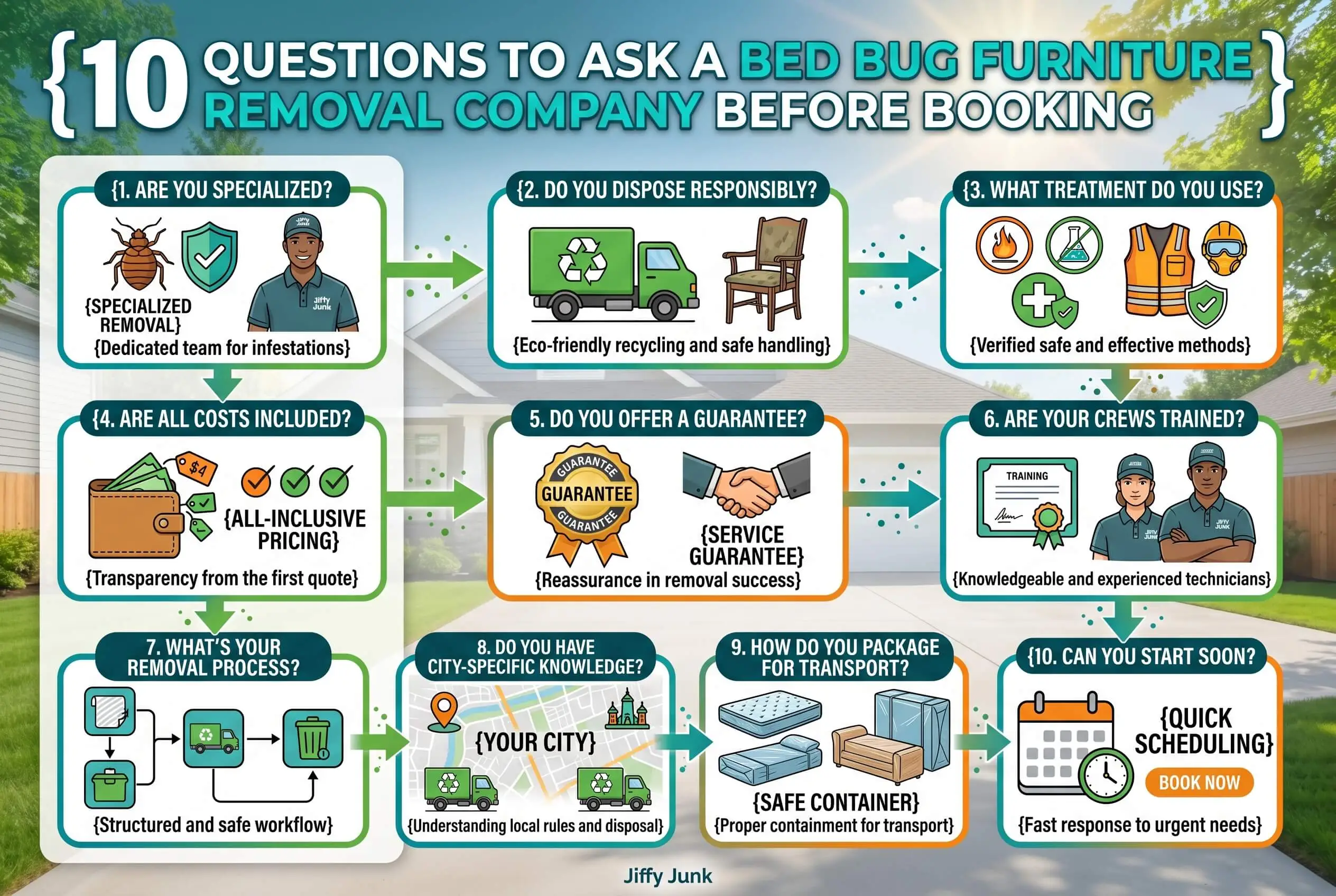
Below are the 10 questions we use to vet candidates ourselves. Run any provider through them before signing anything or paying a deposit.
TL;DR Quick Answers
Companies that remove bed bug infested furniture
Companies that remove bed bug infested furniture are specialty haul-away services that seal, transport, and dispose of contaminated mattresses, sofas, and case goods using biohazard containment protocols. They differ from general junk haulers in four specific ways:
On-site sealing. Items get bagged in heavy-mil plastic or mattress encasement bags inside the infested room, before any movement.
Marked disposal. Furniture is labeled "Bed Bugs" and rendered unusable to prevent curbside reuse, then taken to a licensed facility that accepts flagged biohazard materials.
Treatment coordination. Pickup is scheduled around the customer's pest-treatment timeline, since removing furniture without treating the room re-infests whatever comes in next.
Crew protocols. Disposable coveralls, sealed contractor bags, and HEPA-vacuumed trucks between jobs to prevent cross-contamination from one customer to the next.
How to vet one: ask for proof of insurance, a written itemized quote, references from bed-bug-specific jobs, and a description of the containment process before booking. Same-day or next-day pickup should be available for active infestations. Expect a surcharge over standard junk removal because of biohazard handling.
Cost reference: furniture removal is a separate line item from extermination. Whole-home professional bed bug extermination typically runs $1,500 to $5,000, with removal added on top.
Top Takeaways
Specialist companies and generalist haulers look identical online. Phone screening is the only reliable way to tell them apart.
Containment protocol is the single biggest differentiator. If they can't describe how they'll seal items in the room, they aren't a specialist.
Get answers in writing. Insurance proof, itemized quote, disposal destination, and crew protocol, all on paper before booking.
Coordinate with pest treatment. Removing furniture without treating the room sets the customer up for re-infestation.
Slashing and labeling matter. Public-health protocols call for rendering infested items unusable so others can't take them home.
Bed-bug-specific reviews only. A 4.9 rating on general junk hauling tells you nothing about a company's containment skills.
The premium for a specialist is almost always cheaper than a re-infestation.
What to Look for in Companies That Remove Bed Bug Infested Furniture
Three capabilities tell you whether a company can actually handle this work:
Containment protocol. The crew should describe, without prompting, how they'll seal items inside the infested room before any movement begins. Heavy-mil bags, mattress encasement bags, tape on every seam.
Disposal compliance. They should know your jurisdiction's rules for tagged or marked-infested items and have an established route to a facility that takes them.
Treatment coordination. They should ask about your pest-treatment timeline. Removing furniture without treating the room is the single most common reason infestations come back, and a real specialist won't let a customer make that mistake.
The 10 questions below operationalize that checklist into a phone screen you can run in five minutes with any junk removal company. The companies worth hiring welcome the questions. The ones that aren't will rush you off the call.
The 10 Questions to Ask Before Booking
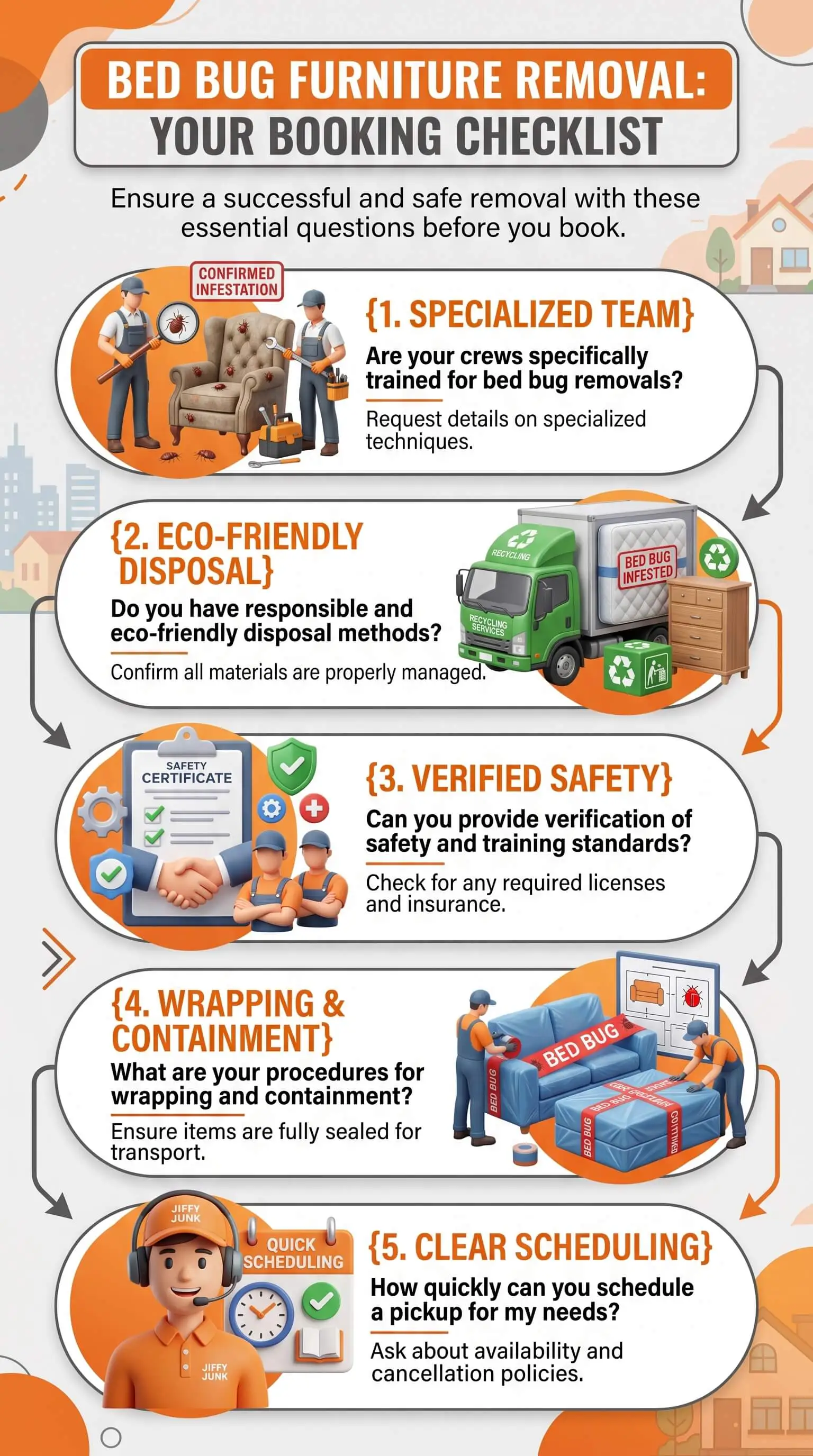
1. Are you licensed, insured, and experienced with bed bug furniture removal?
Ask for proof of general liability coverage and workers' comp, plus specific examples of past bed bug jobs. If a hauler can't describe their last bed bug pickup in detail, they don't have one. Walk away.
2. How do you contain infested items to prevent cross-contamination?
A qualified crew seals items in heavy-mil plastic bags or mattress encasement bags inside the room before anything moves. They should describe the path from the bedroom to the truck and how each transition stays sealed. “We just load it up” is the wrong answer.
3. Where will my bed-bug-infested furniture end up?
Acceptable: a licensed landfill that takes flagged biohazard materials, or incineration where local rules require it. Unacceptable: donation, illegal dumping, or vague “we handle it.” Local regulations may require labeling, and a competent operator knows the rules in your jurisdiction.
4. Do you mark or slash furniture to prevent curbside reuse?
Public-health protocols, including those documented by university extension entomology programs, recommend rendering infested furniture unusable. That means slashing upholstery and breaking wooden frames so the items can't be picked up and carried into another home. Most haulers skip this step. The good ones don't.
5. How much does bed bug furniture removal cost?
Expect a surcharge over standard junk removal because of the containment supplies, biohazard handling, and disposal-site fees. Get a written quote that itemizes labor, sealing materials, fuel, and tipping fees. Verbal estimates leave room for surprise charges on the day of pickup.
6. How quickly can you schedule a pickup?
Every additional night with infested furniture in the home accelerates the spread. Same-day or next-day service should be on the table for active infestations. Ask about emergency, weekend, and after-hours availability before you commit.
7. What types of bed bug furniture do you remove?
Soft goods (mattresses, box springs, upholstered chairs and sofas, headboards) and wood furniture (dressers, nightstands, bed frames) all need to be on the list. Bed bugs hide in joints, screw holes, and undersides, not just the obvious places. A specialist won't refuse pieces a generalist might balk at.
8. What equipment and crew precautions do you use?
Look for disposable coveralls, shoe covers, and sealed contractor bags. Crews should not sit on, lean against, or rest tools on your other surfaces. Premium operators HEPA-vacuum the truck between jobs to keep bugs from one customer's furniture from reaching the next.
9. Do you coordinate with pest control or recommend treatment first?
Removing furniture without treating the room can leave bed bugs behind in walls, baseboards, and outlet covers. Then they re-infest whatever the customer brings in next. The right company will ask about the treatment timeline and may recommend coordinating pickup around an exterminator's heat or chemical work. Order of operations matters.
10. What is your reputation, and can you show reviews from bed bug cases specifically?
Generic five-star reviews don't prove bed bug capability. Ask for references tied to infested-furniture jobs, and check the BBB, Google Business Profile, and pest-control forums. For an example of how a transparent operator documents their process, scope, and pricing, see this professional bed bug furniture removal service. The level of detail you see there is the level of detail you should expect from any company you're comparing.
“After years of vetting home-services categories, I've concluded the best and worst companies that remove bed bug infested furniture cannot be told apart from their websites. Every site shows the same trucks and the same smiles. The 10-question phone screen is the only filter I've found that separates them. The specialists answer cleanly. The rest try to change the subject. That difference is everything.”
7 Essential Resources
These are the references we lean on when researching disposal protocols. All are public-health, government, or university-extension sources, not vendor pages.
EPA: Bed Bugs Hub. The Environmental Protection Agency's central resource on identification, prevention, control, and IPM-based treatment. epa.gov/bedbugs
EPA: Top Ten Tips to Prevent or Control Bed Bugs. Practical, IPM-aligned guidance on what to do once you suspect an infestation. epa.gov/bedbugs/top-ten-tips
EPA: Do-It-Yourself Bed Bug Control. Includes the EPA's specific guidance on responsible disposal: ripping covers, removing stuffing, marking furniture with “Bed Bugs,” and arranging immediate pickup. epa.gov/bedbugs/do-it-yourself-bed-bug-control
Purdue University Extension: Bed Bug Furniture Inspection and Disposal Protocol. The most thorough public-source document we've found on infested furniture handling, including the rationale for slashing fabric and breaking frames before disposal. extension.entm.purdue.edu/bedbugs/furnitureDisposal
National Pest Management Association: Bed Bug Facts and Statistics. Aggregated industry research on infestation prevalence, geographic spread, and pest-professional treatment patterns. pestworld.org/bed-bug-facts-statistics
New York State Department of Health: Bed Bugs. State-level public health guidance, including landlord-tenant context and disposal recommendations. health.ny.gov/environmental/pests/bedbugs
Washington State Department of Health: Bed Bugs. Practical detection-and-control checklist plus a clear warning to never bring discarded mattresses or upholstered furniture into your home. doh.wa.gov/community-and-environment/pests/bed-bugs
3 Statistics
1 in 5 Americans has had a bed bug infestation in their home or knows someone who has. The infestation rate runs roughly three times higher in urban areas than rural ones, and bed bugs have been documented in all 50 states. Every region has demand, and every region has unqualified providers chasing it. has had a bed bug infestation in their home or knows someone who has. The infestation rate runs roughly three times higher in urban areas than rural ones, and bed bugs have been documented in all 50 states. Every region has demand, and every region has unqualified providers chasing it. Source: National Pest Management Association, Bed Bugs in America survey — pestworld.org
95% of U.S. pest-management companies have encountered a bed bug infestation in the past year, compared with just 25% before the year 2000. The resurgence is real and sustained. The haul-away category has had to develop bed-bug-specific protocols to keep up, and the gap between companies that learned them and companies that didn't has widened. Source: NPMA / University of Kentucky Bugs Without Borders Survey — pestworld.org
$1,500 to $5,000 is the typical national range for whole-home professional bed bug extermination. Furniture removal is a separate line item on top of that. Choose the wrong company once, and you may be paying for treatment twice. The upfront vetting is the most important hour you'll spend on this entire problem. Source: This Old House 2026 bed bug exterminator cost guide — thisoldhouse.com
Final Thoughts and Opinion
Most companies advertising bed bug furniture removal in your local search results are general junk haulers who added the keyword to their website. Some learned the protocol. Most did not. From the search-results page alone, a customer can't tell the difference. The websites all look the same.
The 10 questions above are the only reliable filter we've found. Run them on the phone with each candidate. The specialists answer cleanly, walk you through their containment process, give you a written itemized quote, and ask about your pest-treatment timeline before they confirm a pickup window. The generalists give vague reassurances and want to schedule the truck.
Our position is straightforward: pay the small premium for the specialist company. The downside risk of choosing wrong, whether that's a re-infestation that costs thousands more in treatment, replaced furniture, or a spread to neighboring units, dwarfs any savings on the pickup itself. Bed bugs are a containment problem first and a furniture problem second. Hire accordingly.
Frequently Asked Questions
How do I find reputable companies that remove bed bug infested furniture in my area?
Start with bed-bug-specific reviews, not general hauling reviews, on Google Business Profile, the BBB, and pest-control community forums. Then run each candidate through the 10-question phone screen above. The vetting framework matters more than the directory you start with: a 4.9-star general junk hauler may still be the wrong choice, while a smaller specialist with fewer reviews may be exactly right. Ask for references from infested-furniture jobs specifically, and confirm written, itemized quotes before booking.
Can I just put bed bug furniture on the curb?
Generally no, and in many municipalities it's against local ordinance. Curbside abandonment risks someone else carrying the furniture into a new home and spreading the infestation. The EPA's disposal guidance specifically calls for marking infested items “Bed Bugs,” rendering them unusable, and arranging immediate professional pickup.
Will throwing out my mattress fix my bed bug problem?
Almost never on its own. Bed bugs spread well beyond the mattress, into box springs, bed frames, baseboards, outlet covers, and other furniture. You need a treatment plan from a pest-management professional in addition to disposal. Disposal alone often leaves a population that re-establishes within weeks.
How do I know if my furniture is actually infested?
Look for rust-colored or dark fecal staining along seams and joints, shed exoskeletons, eggs that resemble tiny grains of rice, and live bugs themselves: reddish-brown, roughly the size of an apple seed. While the Clean Air Act speaks more broadly to air quality than bed bug identification, a pest professional can confirm before the customer commits to discarding pieces that might be salvageable.
Does my homeowner's or renter's insurance cover bed bug furniture removal?
Most standard policies do not cover bed bug treatment or related furniture loss. Infestations are usually classified as a maintenance issue. Read your policy carefully and call your carrier before assuming costs will be reimbursed.
Your Next Step
If you're staring at infested furniture right now, don't book the first hauler that returns your call. Run them through the 10 questions above first. Five minutes on the phone could save you thousands.
Ready to compare a provider that documents this level of detail upfront? Click here to see a vetted company that removes bed bug infested furniture, with transparent protocols, itemized pricing, and the bed-bug-specific experience this article asks you to demand. Use it as a benchmark against any company you're already considering. If your local provider can't match the detail you see there, you're talking to the wrong company.