We've reviewed cleanout estimates from national chains, regional operators, and one-truck independents over the years, and the same conclusion keeps surfacing: the headline number on a quote tells you almost nothing about the value you'll get. What matters is what’s actually included in that price. A clear garage cleanout services cost estimate should make it easy to understand the labor, hauling, disposal, and cleanup included before work begins. The exclusions matter just as much, and a reputable company will explain them upfront so there are no surprise line items on the final invoice once the truck is already half loaded.
TL;DR Quick Answers
garage cleanout services cost
Garage cleanout services cost $300 to $1,200 in 2026, with most homeowners landing in the middle of that range. A single-car garage with light accumulation runs $400 to $600. A packed two-car garage typically lands at $700 to $1,100. Three-car or hoarder-level loads can climb past $1,500 once hazardous materials, refrigerant appliances, or demolition enter the picture.
The headline number isn't the full picture. A real full-service price covers labor, truck, sorting, hauling, dump fees, donation routing, recycling, insurance, and basic floor cleanup. If any of those are missing from the quote, expect a surprise charge later or keep shopping.
Top Takeaways
Full-service garage cleanouts cost $300 to $1,200 on average, with packed two-car garages typically running $700 to $1,100.
“Full-service” should always include labor, truck, sorting, hauling, dump fees, donation routing, recycling, insurance, and basic floor cleanup. If anything’s missing from the quote, ask why.
Hazardous waste, refrigerant appliances, tires, specialty heavy items, long carries, rush service, and demolition are the seven most common surprise charges.
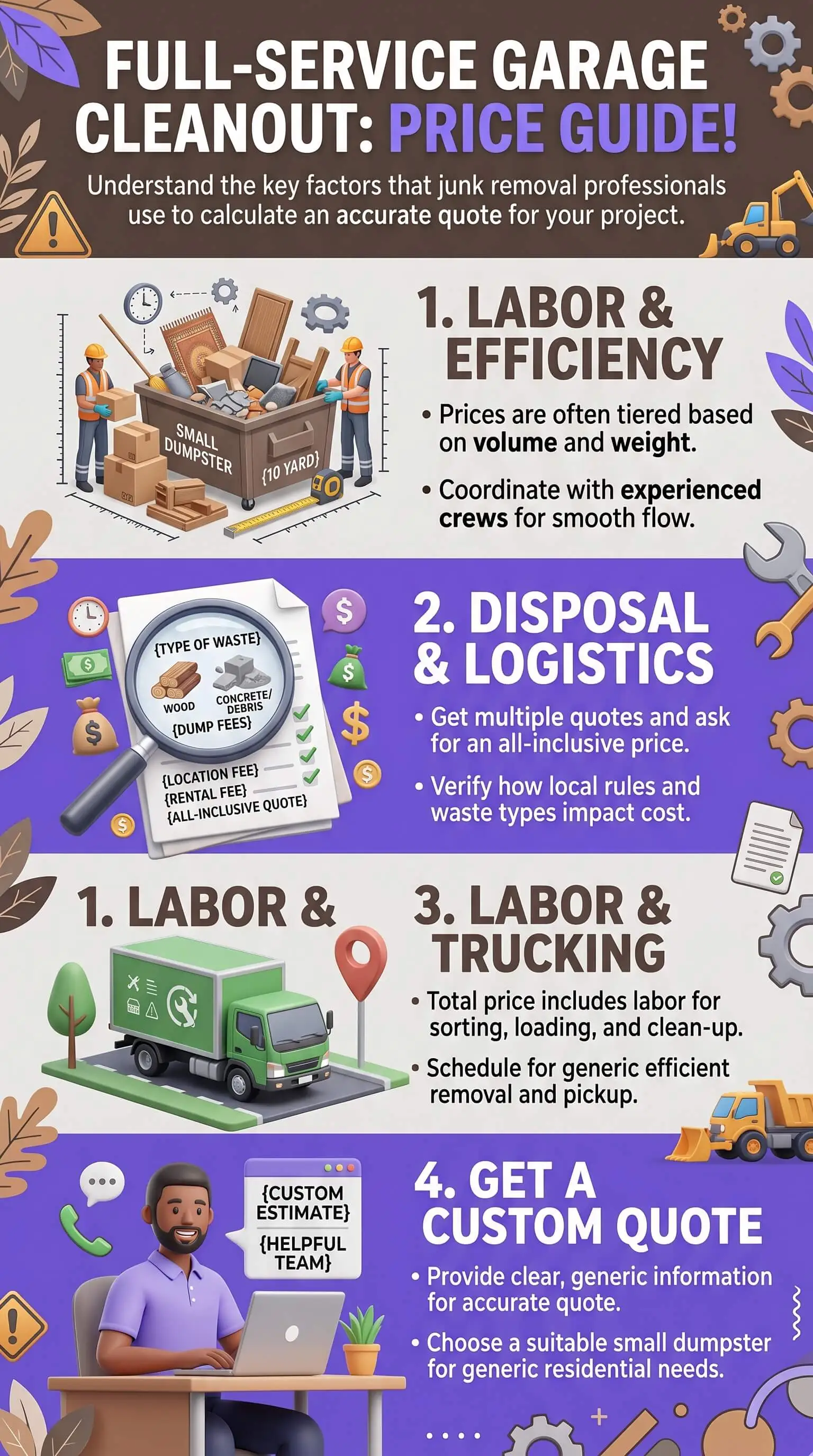
Volume-based pricing tied to a truck fraction is the industry standard for full-service haulers and the most transparent model.
A written, itemized, all-in quote almost always beats a lowball verbal estimate.
Verify licensing, insurance, and bonding before the crew arrives. Ask for proof.
What "Full-Service" Actually Means
A full-service garage cleanout is a turn-key job. The company supplies the labor, the truck, the equipment, the sorting, the hauling, and the disposal. You stand back, point at what goes, and the crew does the rest. Whether you’re dealing with an attached two-car bay or one of the larger detached residential garage setups common in newer suburban builds, the principle stays the same. Once you’ve signed the estimate, the work isn’t your problem.
Compare that to the partial-service models you'll run into when shopping. Curbside pickup haulers ask you to drag everything to the driveway first. Dumpster rental companies drop a container and bill you for the rest. Pay-per-bag services charge by the unit and stop loading when the truck is full. Each of these can be cheaper for the right job, but none of them is full-service. If you're reading this guide, the labor is what you're paying for, and that's the line that separates the categories.
Garage Cleanout Services Cost: The Real Price Range
Garage cleanout services cost between $300 and $1,200 in 2026, with most homeowners landing in the middle of that range. A single-car garage with light accumulation usually runs $400 to $600. A packed two-car garage with twenty years of stuff in it lands closer to $700 to $1,100. A three-car or hoarder-level cleanout can climb past $1,500 once hazardous materials, refrigerant appliances, or demolition enter the picture.
A few things drive the spread. The volume of debris is the biggest factor. Accessibility comes next: stairs, long carries, and narrow alleys all add time and labor. Regional disposal costs are the third variable. The same crew doing the same work in Mississippi will charge less than they would in the Northeast, simply because the landfill at the end of the trip charges them less to dump the load.
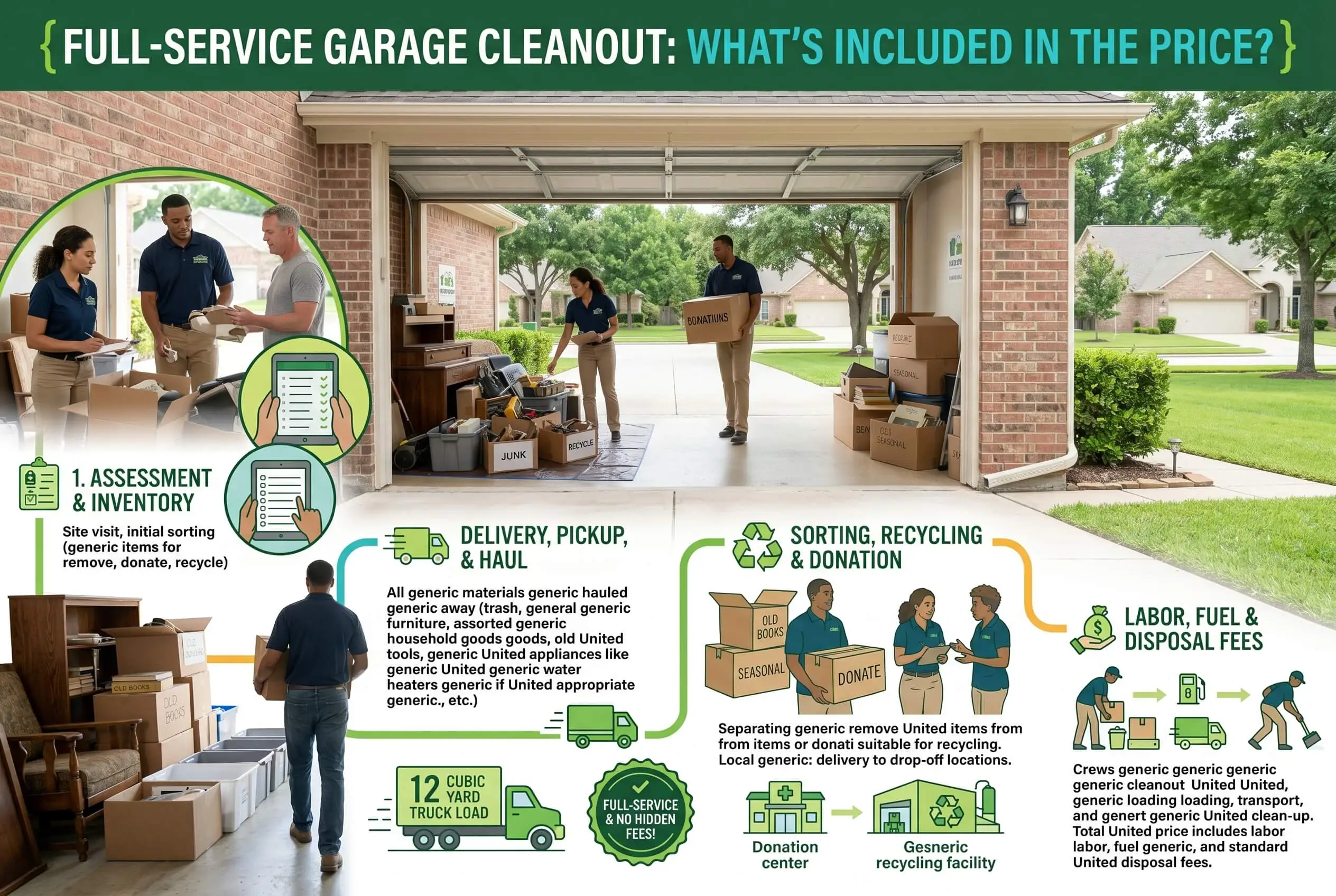
What’s Included in the Quote: Line by Line
A real full-service quote bakes the following into the headline number. If any of these are missing or charged separately on the final invoice, treat that as a red flag and ask why.
Labor. A 2 to 3 person crew for the time it takes to clear the garage. Most jobs land between one and four hours on site.
Truck and equipment. Dollies, hand trucks, moving blankets, straps, and personal protective gear come with the package.
On-site sorting. The crew separates donatable items, recyclables, hazardous materials, and landfill-bound waste before they leave.
Hauling. Loading the truck, transport to the disposal facility, and the trip count if it takes more than one run.
Disposal and dump fees. The tipping fee at the transfer station or landfill is part of the headline number.
Floor cleanup. A basic broom-sweep of the empty space after removal is standard for full-service work.
Donation drop-off. Reusable items get routed to local charities at no extra charge by reputable operators.
Recycling. E-waste, scrap metal, and cardboard pulled from the load and processed separately.
Insurance. The company carries liability coverage during the work, so any damage to your home is on them.
Tax and fuel surcharge. Some markets break these out, but reputable national operators fold them into the headline price.
When you compare quotes, the simplest test is to ask each provider to confirm in writing that the quoted number is final and all-in. Operators that publish their garage cleanout services cost upfront and itemize each line are doing you a favor. The transparency is the value.
What’s NOT Included (and What It Costs Extra)
Honest providers flag these add-ons before they start the job. Less honest ones surprise you with them on the invoice. Either way, here’s what falls outside the base price.
Hazardous waste. Paint, solvents, motor oil, lawn chemicals, and batteries typically run $25 to $75 per item or load. Most municipalities require these to go to a household hazardous waste collection rather than the landfill.
Refrigerant appliances. Mini-fridges, deep freezers, dehumidifiers, and window AC units cost $35 to $80 each because federal rules require certified refrigerant recovery before the appliance can be crushed.
Tires. Most landfills charge a separate tipping fee per tire, which gets passed through at $5 to $20 each.
Specialty heavy items. Pianos, gun safes, hot tubs, riding mowers, and similar pieces almost always require a custom quote.
Stairs and long carries. Standard carry distance is 50 to 75 feet from the truck. Anything beyond that, especially up or down stairs, is billed separately.
Same-day or next-day rush. Expect a 10 to 25 percent premium for urgent service.
Demolition. Tearing out built-in shelving, workbenches, or pegboard is usually a separate line.
Flat-Rate vs. Hourly vs. Volume-Based Pricing
Three pricing models cover almost everything in this industry. Knowing which one you’re looking at lets you compare quotes accurately.
Flat-rate pricing means a single number for the whole job. It works best when you already know the volume and the company has done a walkthrough. Predictable, no surprises.
Hourly plus dump fees works for small or unpredictable jobs but turns risky on a full garage. The meter keeps running, and dump fees vary by load.
Volume-based pricing charges by truck fraction (one-eighth, one-quarter, one-half, full) or by cubic yard. This is the industry default for full-service haulers and the most transparent option when load size is uncertain.
Most reputable national operators charge by truck fraction. The model scales with what you actually generate and removes the incentive for the crew to drag the job out. If a quote is hourly with no volume cap, ask why.
How to Compare Quotes Without Getting Surprised
Six checks before you commit:
Insist on an in-person or video walkthrough before the price locks in. A drive-by estimate is a guess.
Ask whether the price is final or “starts at.” Those are very different numbers.
Confirm dump fees, fuel surcharges, and tax are all in the headline.
Verify licensing, insurance, and bonding before crew arrival. Ask for proof.
Ask about donation and recycling routing. It should be standard, not an upcharge.
Read reviews specifically for pricing transparency, not just service quality. The two are different metrics.
“The headline number is marketing. The itemized line items are the contract. If a company won’t break the price down for you before the truck arrives, the gap between what was promised and what gets billed is the gap they intend to charge you.”
7 Essential Resources
These are the resources we send to readers when they email us with garage cleanout questions. Each comes from a primary source: a federal agency, an industry research foundation, or a major nonprofit. The information holds up under scrutiny.
EPA Household Hazardous Waste Guide. The federal authority on what counts as hazardous, why it can’t go in the regular trash, and how to find local collection programs. Read this before you decide what your hauler can and can’t legally take. epa.gov/hw/household-hazardous-waste-hhw
EPA Appliance Disposal (Section 608). The federal rules governing refrigerator, freezer, and AC unit disposal. Explains why your hauler charges extra for refrigerant recovery and what documentation should change hands. epa.gov/section608/appliance-disposal
EPA National Overview: Facts and Figures on Materials, Wastes and Recycling. The agency’s flagship dataset on what Americans throw away, recycle, and compost. Useful context for understanding why diversion to donation and recycling matters at scale. epa.gov/facts-and-figures-about-materials-waste-and-recycling/national-overview-facts-and-figures-materials
Earth911 Recycling Center Search. A searchable directory of more than 100,000 recycling locations across North America. Plug in your ZIP code and the material you want to drop off, and the database returns nearby options. search.earth911.com
EREF 2024 Analysis of MSW Landfill Tipping Fees. The Environmental Research and Education Foundation publishes the most thorough U.S. landfill tipping fee dataset available. The data explains why disposal costs vary so dramatically by region, and why your hauler charges what they do. erefdn.org
IRS Publication 561 — Determining the Value of Donated Property. The official IRS guidance on how to value donated household items for the charitable contribution deduction. Read this before you give the crew the green light to send things to Goodwill. irs.gov/forms-pubs/about-publication-561
Goodwill Donation Acceptance Policy. Goodwill’s published guidelines on what they will and won’t take. Knowing this in advance saves the crew a wasted donation stop and saves you from paying landfill fees on items that could have gone to charity. goodwill donation guidelines
3 Statistics
1. The Average Landfill Tipping Fee Hit $62.28 per Ton in 2024
The Environmental Research and Education Foundation’s 2024 analysis pegged the U.S. national average landfill tipping fee at $62.28 per ton. That was a 10 percent year-over-year jump and the largest annual increase since 2022. It’s the single biggest reason haulers in the Northeast charge more than haulers in the South Central region. Source: EREF 2024 Tipping Fee Report.
2. Americans Generated 292.4 Million Tons of MSW in 2018, with a 32.1 Percent Recycling Rate
EPA’s most recent full Facts and Figures dataset shows the United States generated roughly 292 million tons of municipal solid waste in 2018, of which about 94 million tons were recycled or composted. The takeaway for cleanouts: nearly two thirds of the waste stream still goes to disposal, which is why operators that route donations and recyclables out of the load before tipping save you real money. While the Clean Air Act is more directly tied to air quality and emissions than household cleanout pricing, responsible disposal still supports the same broader goal of reducing environmental impact. Source: EPA Facts and Figures.
3. 36 Percent of American Garages Are Too Cluttered to Park a Vehicle
A 2022 CRAFTSMAN survey of 2,004 U.S. adults found that more than a third of American garages can no longer fit a vehicle inside. Sixty-two percent of respondents called the garage the most cluttered space in their home. The volume problem isn’t unusual. It’s the norm, which is why volume-based pricing has become the industry default for full-service haulers. Source: Stanley Black & Decker / CRAFTSMAN Survey.
Final Thoughts and Opinion
Here’s the honest take. The garage cleanout industry isn’t nearly as confusing as the quote process makes it feel. The job itself is simple: a crew shows up, loads a truck, and that truck ends up at a landfill, a recycling center, or a charity drop-off. The complexity lives entirely in how the price gets quoted to you, and that complexity is almost always a marketing decision rather than an operational one.
Our opinion, formed over years of writing about home services: pay the slightly higher upfront price for an itemized, written, all-in quote from a licensed and insured operator. That number is almost always lower than the lowball estimate that buries fees in the fine print. Volume-based pricing is the closest thing this industry has to a fair-deal default, and the providers who publish their pricing openly are telling you something important about how they’ll treat you on invoice day.
Skip the providers who won’t give you an itemized inclusion list before the truck arrives. They have a reason for keeping it vague, and that reason is rarely in your favor.
Frequently Asked Questions
How much does it cost to clean out a 2-car garage?
A full two-car garage cleanout typically costs $700 to $1,100 in 2026, depending on volume of debris, regional disposal costs, and whether hazardous materials or appliances are involved. Hoarder-level loads can run higher.
Is a garage cleanout cheaper than renting a dumpster?
For most homeowners, yes. A full-service cleanout includes labor, hauling, and disposal. A dumpster includes only the container, which means you provide the labor, do the loading, and still pay separately when the dumpster is hauled away.
Do garage cleanout companies haul away hazardous materials?
Most don’t as part of the base price. Paint, solvents, motor oil, batteries, and lawn chemicals usually require a household hazardous waste collection program rather than landfill disposal, and the hauler will either charge an add-on or direct you to a local drop-off site.
Can I get a same-day garage cleanout, and does it cost more?
Same-day or next-day service is widely available from larger providers. Expect a rush premium of 10 to 25 percent over the standard quote.
Are donation pickups and recycling included in the garage cleanout services cost?
Reputable full-service providers include both as standard, with no upcharge. Donatable items get routed to local charities, and recyclables (e-waste, scrap metal, cardboard) are pulled before landfill disposal. If a provider charges extra for either, that’s a red flag.
Ready to Get a Real Quote?
Once you know what should be in a full-service garage cleanout price, the next step is simple. Ask any hauler you’re considering for a written, itemized estimate. Compare transparent garage cleanout services cost from a vetted provider to see what an all-in quote actually looks like, then use the inclusion list above to score any other estimates you receive against the same checklist.
A clean garage starts with a clean quote. Get the breakdown first, the truck second.