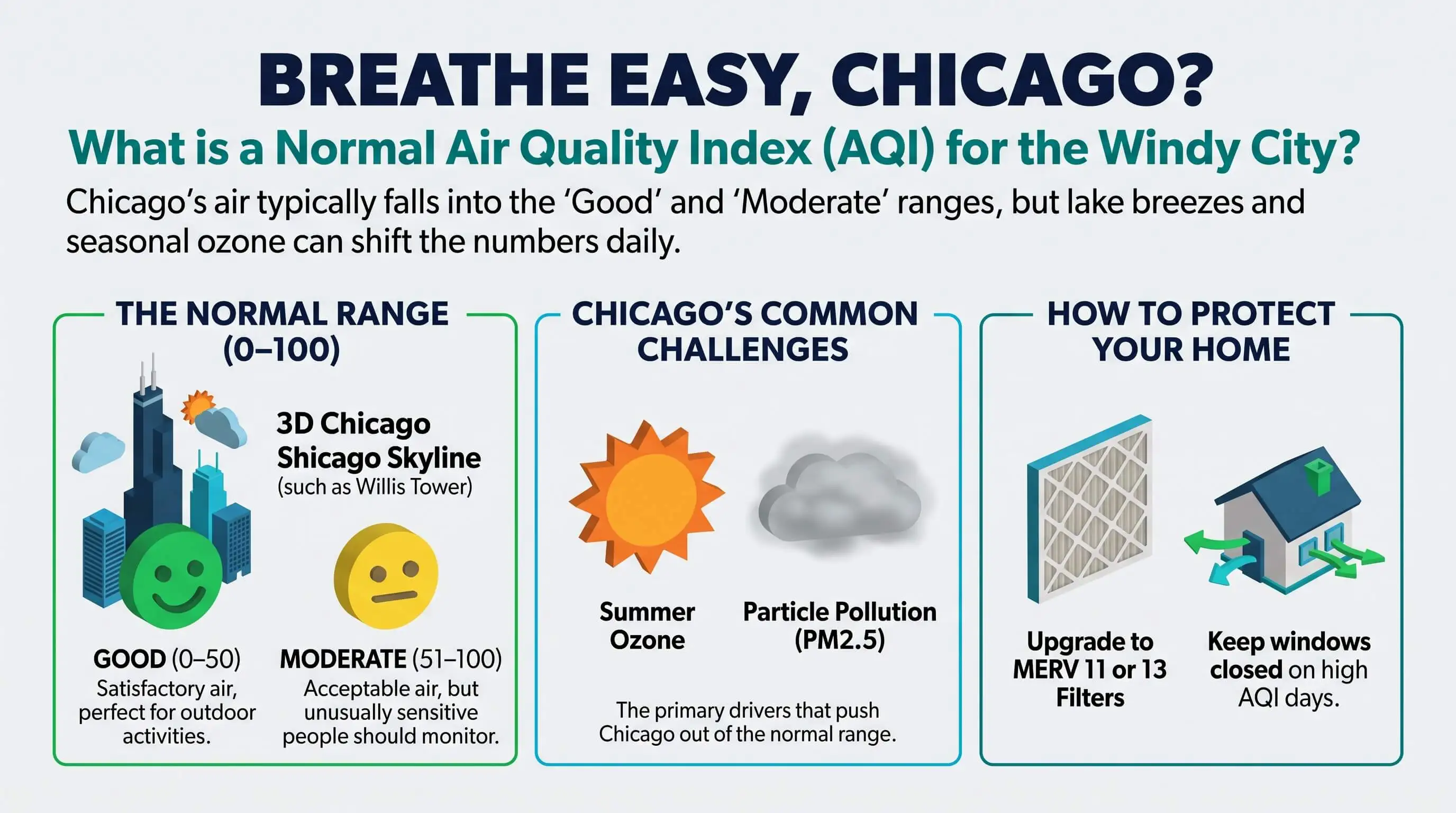
That's the Moderate band, and it's about as normal as our air gets. Good, 0 to 50, is the healthy target. Once the reading crosses 100, I start changing plans.
Most live trackers stop at the number. They hand you today's air quality index Chicago reading and leave the hard part, whether the lakefront run is still on, to you. Let's make the invisible part visible.
TL;DR Quick Answers
air quality index Chicago
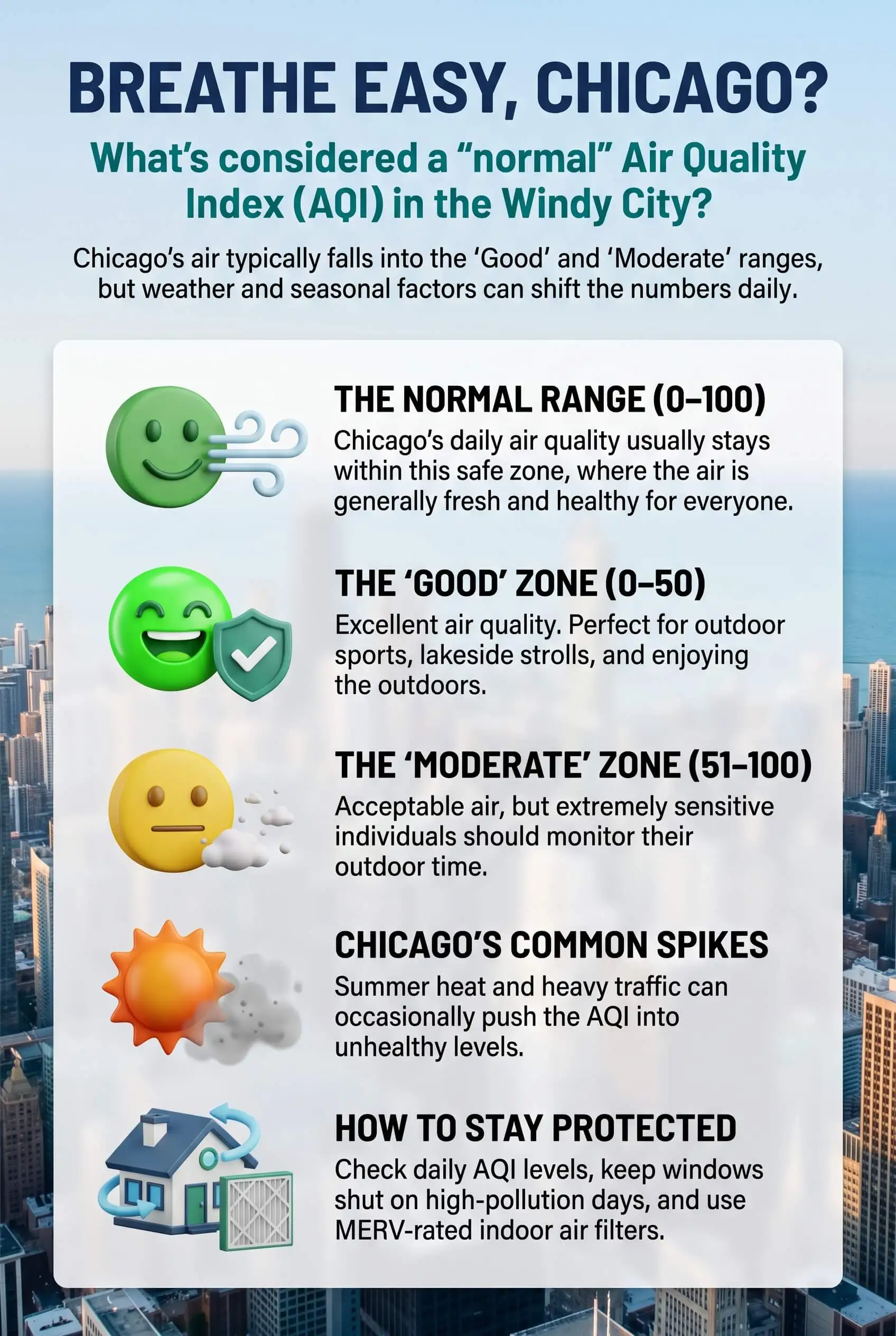
On most days, Chicago's air quality index lands in the Moderate range of 51 to 100, with Good readings of 0 to 50 after wind or rain clears things out. Once readings pass 100, the air turns unhealthy for sensitive groups. Above 150, everyone should cut back outdoors.
Healthy target. 0 to 50, the EPA's Good category.
Normal for Chicago. 51 to 100, especially through summer.
Time to act. Above 100 for sensitive groups, above 150 for everyone.
Where to check. A live Chicago AQI map, once in the morning and again mid-afternoon.
Top Takeaways
Normal in Chicago means Moderate, 51 to 100, while Good, 0 to 50, is the healthy target.
Sensitive groups should act once the AQI tops 100, and everyone should cut back above 150.
Summer ozone, lake inversions, traffic corridors and Canadian smoke are what push the city out of green.
Closed windows handle ozone well, but fine particles need filtration.
The city's worst recorded reading climbed from about 175 in 2023 to 366 in July 2026.
Check the live index twice a day, and trust the worse reading when two sources disagree.
What Counts as a Normal AQI in Chicago
Here's something that might surprise you. In this city, normal and healthy aren't the same reading. The EPA's scale runs from 0 to 500, and only 0 to 50 counts as Good, the range where pollution poses little or no risk. Chicago lives just above that line for much of the year. IQAir's citywide data put the city's 2019 average at an AQI of 52, barely into Moderate.
Healthy adults can get through a Moderate day without changing a thing. Asthma is a different story. Symptoms can stir anywhere from 51 to 100, even with air quality protections under the Clean Air Act, so the city's normal may not feel normal to everyone under your roof.
How to Read Air Quality Index Chicago Readings
0 to 50, Good. Breezy days after a cold front or a cleansing rain. Nothing to adjust.
51 to 100, Moderate. Chicago's everyday range, especially in summer. Unusually sensitive folks may feel it in the long run.
101 to 150, Unhealthy for Sensitive Groups. This is the hot, still ozone afternoon or a light smoke day. Kids, older adults, and anyone with asthma, COPD or heart disease should cut hard outdoor activity short.
151 to 200, Unhealthy. Heavier smoke. Everyone scales back, and sensitive groups head inside.
201 to 300, Very Unhealthy. Rare and almost always smoke-driven. Skip outdoor exertion and keep the windows shut.
301 and higher, Hazardous. Emergency territory, and Chicago crossed into it in July 2026.
Why Chicago's AQI Drifts Above Good
Summer ozone. Sunlight cooks car and factory emissions into ground-level ozone on hot, still afternoons, so the number climbs late in the day.
The lake and the lid. Cool air off Lake Michigan and overnight temperature inversions sit on the city like a lid, holding fine particles near street level through the morning rush.
Traffic and freight corridors. Blocks along the expressways, rail yards and O'Hare flight paths often read higher than lakefront blocks at the same hour.
Canadian wildfire smoke. It used to be rare. Now it turns up most summers, parking over the Great Lakes for days.
When Pollution Becomes a Real Concern
I keep four lines in my head:
Above 100. Sensitive groups shorten outdoor exertion and keep a rescue inhaler close.
Above 150. Everyone cuts back, the windows close, and workouts move inside.
Above 200. Stay in as much as you can and run the best filtration your home has.
Above 300. Treat it like the emergency it is and follow city and state health guidance.
You don't have to wait for the number to climb, either. The Illinois EPA forecasts air quality for 14 sectors and calls a Chicago Air Pollution Action Day when it expects Unhealthy for Sensitive Groups or worse for two or more days in a row.
To put that top tier in perspective, Canadian smoke pushed Chicago's AQI to 366 around noon on July 16, 2026, likely the worst reading the city has ever logged. The previous worst was around 175, back in June 2023. A few northern suburbs topped 600 that day.
Who Should Act Earlier Than the Number Says
Smoke and fine particles hit some people harder than others. That list covers children, pregnant people, first responders, and anyone living with asthma, COPD, heart disease, diabetes or chronic kidney disease. If that describes someone in your home, treat 100 the way everyone else treats 150. And when there's a diagnosed condition, your doctor's plan comes first.
Why the Number on Your Phone Can Look Wrong
Ever smelled smoke while your app still showed yellow? Nothing is broken. The current AQI comes from hourly monitor readings run through a weighted average, so when a plume moves in fast, the number trails what your nose already knows. Networks like Open Air Chicago fill in the block-level detail that a handful of regulatory monitors miss. When the sky and the screen disagree, I check a second source and go with the worse reading until the next update. It's also worth considering top air filters for your home to help reduce indoor exposure to airborne smoke particles.
What I Do When Chicago's Index Starts Climbing
I check twice a day. Once in the morning to plan, then again mid-afternoon, when ozone tends to peak.
I look at which pollutant is leading. Ozone breaks down fast indoors, so shutting the windows handles most of it. Fine particles are stubborn. They slip in around doors and window frames and hang in the air for hours.
I let the filter carry the load. On particle and smoke days, I switch the HVAC fan to On and run the highest-rated filter my system can handle. If you're not sure where yours lands, this guide on what MERV rating you need walks through the tradeoffs.
Homes without ducts get a different plan. Plenty of two-flats and courtyard buildings run on radiators, and there a portable HEPA unit sized for the bedroom is the most useful thing you can add.
I move the workout. Early morning on ozone days, indoors when there's smoke.
"In my experience, the long yellow stretches catch Chicago families off guard more often than the orange days on the evening news. Ozone fades once you're indoors, but fine particles keep drifting in under doors and around window frames, so the pollutant leading the index tells you whether a closed window is enough or your filter has to do the work."
7 Essential Resources
Check Chicago's live air quality index before you plan your day
The Chicago live air quality index map color-codes current readings across the city and names the pollutant driving the number. On a hazy morning, it's the first tab I open.
See how the AQI gets calculated
AirNow's guide to using the Air Quality Index walks through the color categories, next-day forecasts and how hourly readings shift through the day.
Get Illinois forecasts and Action Day alerts
The Illinois EPA's Outdoor Air page covers daily forecasts for 14 sectors, how Air Pollution Action Days work, and free EnviroFlash sign-ups that put the warning in your inbox.
Know who wildfire smoke hits hardest
The CDC explains how wildfire smoke affects your body, including which groups carry higher risk and which symptoms are worth watching.
Watch for official air quality alerts
The National Weather Service Chicago office posts local forecasts and hazard outlooks for northern Illinois and issues air quality alerts when smoke rolls in.
Understand how ozone and particles affect asthma
The Asthma and Allergy Foundation of America breaks down how air pollution triggers asthma, including why symptoms can show up on Moderate days.
See the long-term health picture
For the bigger view, the National Institute of Environmental Health Sciences sums up the research on air pollution and your health, from the haze you can see to the pollution you can't.
3 Statistics
Chicago-Naperville ranks 15th worst of 226 U.S. metros for ozone. The American Lung Association's State of the Air 2026 report for Illinois, built on 2022 to 2024 data, also puts the metro 13th worst of 211 for year-round particle pollution and gives Cook County an F for ozone. The metro averaged 18 unhealthy ozone days a year, down from 20.3 in the prior report.
The federal annual limit for fine particles now sits at 9.0 micrograms per cubic meter. The EPA finalized that tighter PM2.5 standard on February 7, 2024.
Illinois called 13 Air Pollution Action Days in the first half of 2023, against one in all of 2022. Eleven of them landed in June alone, according to Illinois EPA figures reported by Block Club Chicago. The state logged 4 in 2021 and none in 2019, a jump that tracks with smoke turning into a summer regular.
Chicago’s ongoing air quality challenges, including high ozone levels, fine particle pollution, and wildfire smoke, highlight the importance of understanding how an air filter and a furnace filter can help capture airborne particles and protect indoor air quality.
Final Thoughts and Opinion
Here's my honest take. Chicagoans should stop expecting green and start knowing their own threshold, because yellow is normal here and, for most of us, perfectly fine. The ceiling moved. The city's worst-ever reading jumped from near 175 to 366 in three years, and a swing like that rewards the households that prepare before the smoke shows up.
The habit I'd recommend is a small one. Check the live index each morning, notice whether ozone or particles are leading, and have your indoor plan ready before the reading hits 100. You can't control the air outside. The air inside your home is yours to protect.
Frequently Asked Questions
What is a good air quality index for Chicago?
Anything from 0 to 50. That's the EPA's Good category, where pollution poses little or no risk. Chicago often sits a step higher in Moderate, 51 to 100, which suits most people. Using MERV 11 pleated furnace air filters at home can also help capture airborne particles and support better indoor air quality.
Is an AQI of 70 safe in Chicago?
For most healthy adults, yes. A 70 falls in the Moderate range, so normal activity is fine. With asthma, you might notice it on a hard workout, so shorten it or go early.
Why is Chicago's air quality worse in summer?
Heat and sunlight turn vehicle and industrial emissions into ground-level ozone, and it peaks on hot, still afternoons. Summer is also when Canadian wildfire smoke tends to drift south, stacking fine particles on top of the ozone.
What was the worst air quality index ever recorded in Chicago?
On July 16, 2026, Canadian wildfire smoke pushed Chicago's AQI to 366 around noon. That's a Hazardous reading and likely the worst on record. The previous high was about 175 in June 2023, and some northern suburbs climbed past 600 during the 2026 event.
What is an Air Pollution Action Day in Illinois?
The Illinois EPA issues this alert when it expects air quality to reach Unhealthy for Sensitive Groups or worse. A Chicago Action Day covers the metro area when that forecast holds for two or more days in a row.
Where can I check the air quality index in Chicago today?
Start with a live AQI map for Chicago for current readings. AirNow carries the EPA's data and next-day forecasts, and the Illinois EPA posts Action Day alerts.
Know Your Chicago Normal Before the Air Turns
Chicago's normal is Moderate, and 100 is the line worth watching. Make the live reading part of your morning so you know what your family is breathing before the windows open or anyone heads outside. If you're concerned about indoor air quality, you can also explore air ionizer installation services as an additional option for managing airborne particles at home.