I’ve done this job on cars where the manual went home with the last owner, the under-hood sticker had peeled down to glue, and nobody had ever filmed a video for that particular trim. It still took twenty minutes. What follows is how I read the answer off the car itself, using the same kind of basic fit-and-flow logic you’d use with pleated furnace filters, because your vehicle already carries every piece of information you need. You just have to know where it’s written down.
TL;DR Quick Answers
How to Change Cabin Air Filter
You don't need the owner's manual. On most cars the filter hides behind the glove box, and the old filter itself tells you everything else you need to know.
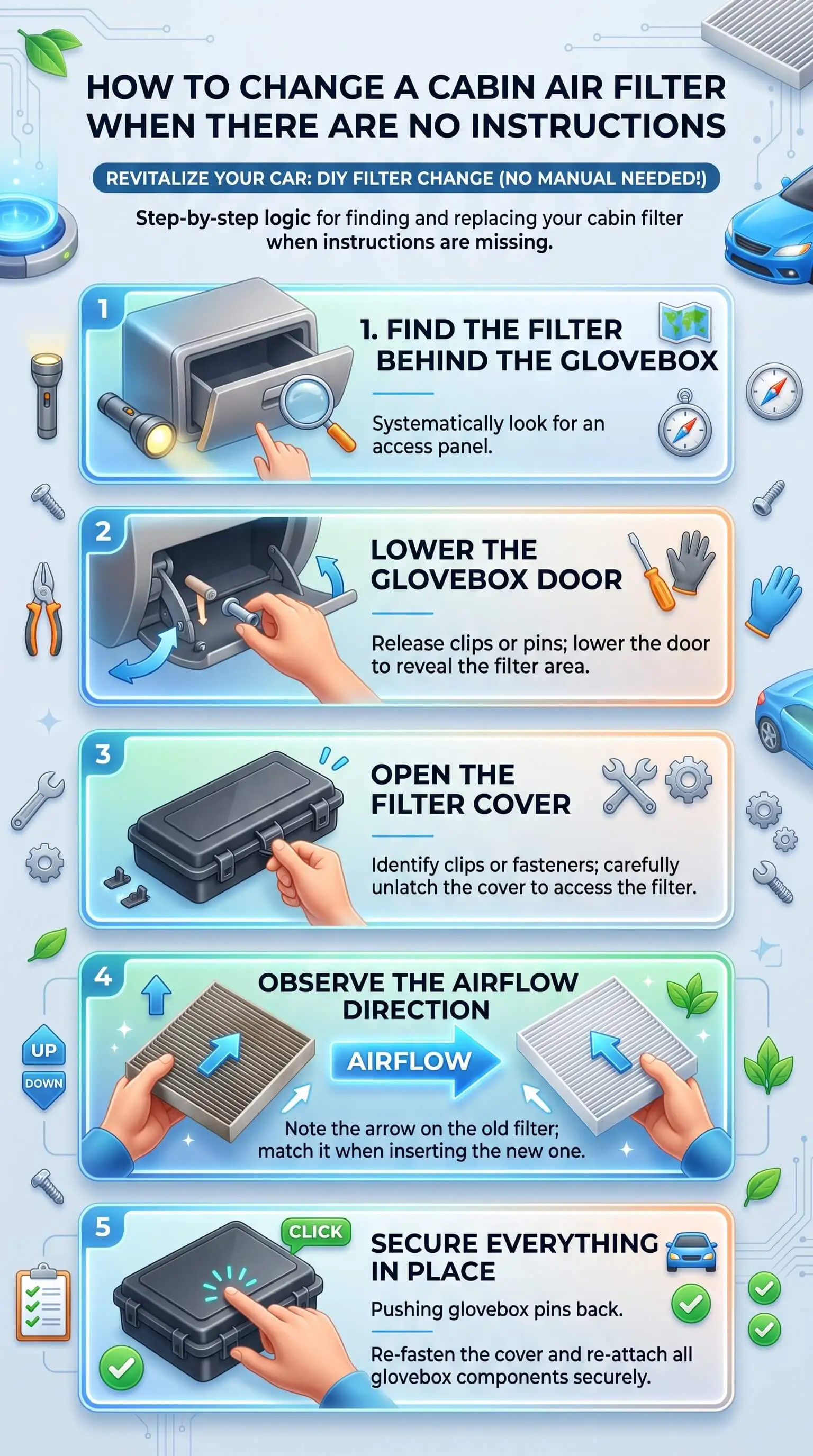
Empty the glove box, squeeze the plastic tabs on both sides, and let the box swing down.
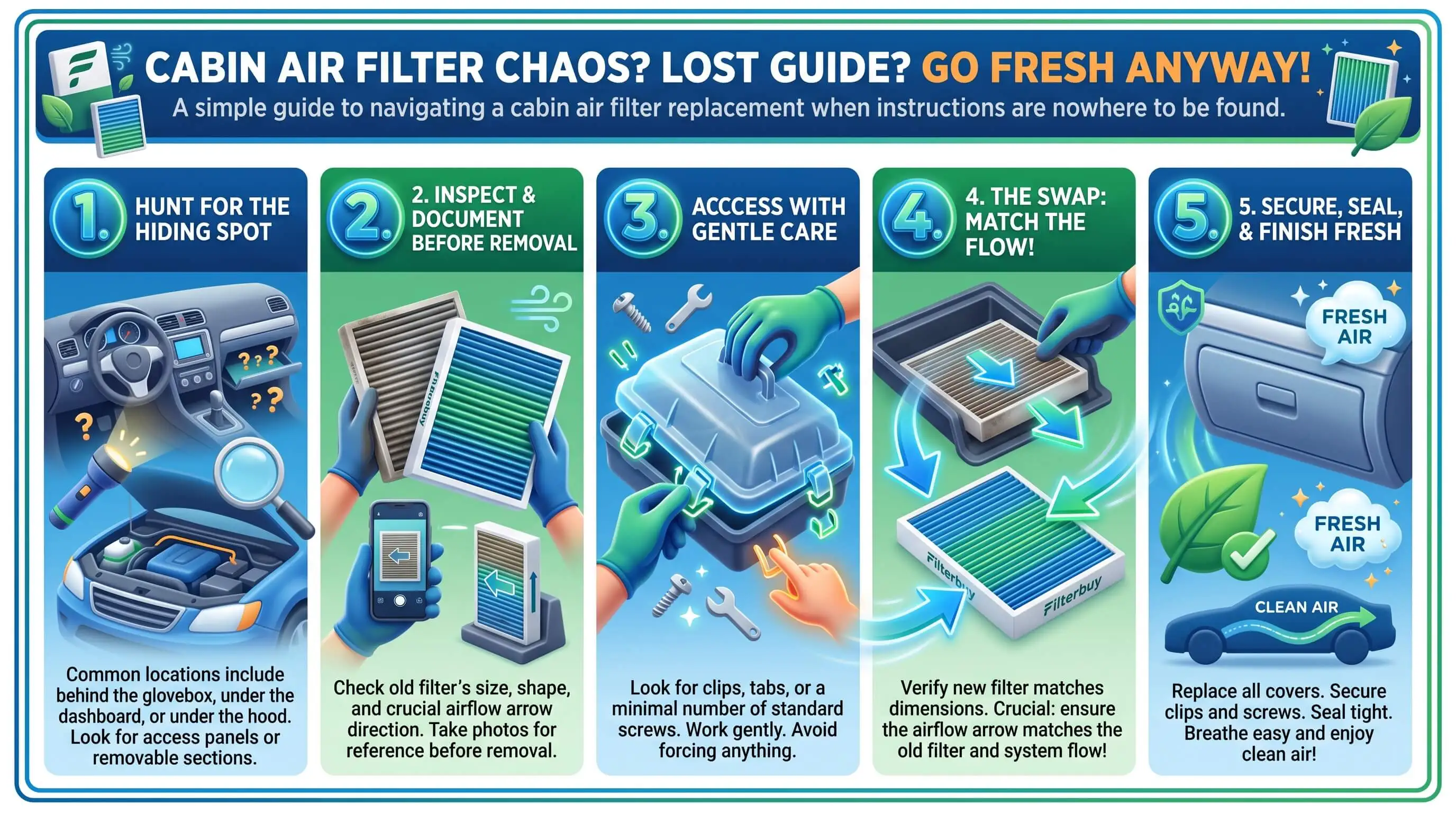
Photograph the filter before you touch it, so you have its orientation on record.
Pull it out and read the frame edge for the airflow arrow, the size, and the part number.
If the arrow has worn off, look at which face is dirty. That side was pointing at the incoming air.
Slide the old filter out with the loaded face upward so debris doesn't drop into the blower.
Seat the new one facing the same direction, then press the access door until it latches.
With no old filter to read, measure the housing opening in all three dimensions and confirm the size through your VIN.
Budget fifteen to twenty minutes. Most cars need no tools at all, which is why how to change cabin air filter is usually a straightforward DIY job. Call a shop if the job requires pulling dashboard panels, or if you find standing water or dark growth inside the housing.
Top Takeaways
Settle location, airflow direction, and frame size. The rest of this job is clips.
Search in order: behind the glove box, then the passenger footwell, then the cowl under the hood, then the console.
Photograph the filter in place before you remove it, and read the frame edge before you throw it out.
If the arrow’s illegible, the dirty face was pointing at incoming air. Match it.
With no old filter to read, measure the opening in all three dimensions and confirm fitment through your VIN.
Standing water, dark growth, or a lingering sour smell points at drainage, not filtration.
When the Old Filter Is Gone or Unreadable
Sometimes a previous owner ran the car with no filter at all. Sometimes somebody wedged in a wrong-sized one and called it finished. Either way, you measure.
Take the housing opening in all three dimensions and write them down before you order a thing. A quarter inch oversized and the frame won’t seat. An eighth inch is undersized and air slips around the edges instead of passing through the media, which quietly defeats the entire point of the filter.
For orientation, reason it out from how the system breathes. Your blower pulls outside air in at the cowl, drags it through the filter, and pushes it out to the vents. The arrow therefore points toward the blower and away from the fresh air intake. On a glove box installation that almost always means downward and toward the middle of the car.
If you want certainty on fitment, run your VIN through the federal decoder listed below. It returns your exact build, and a parts counter can match a filter to that data instead of guessing at your trim level.
Mistakes That Only Happen When You’re Working Blind
I’ve made most of these myself.
Forcing an oversized frame. If it needs pressure, it’s the wrong part. The right one slides.
Snapping the glove box damper arm. That little cord or plastic strut on the side is fragile and annoyingly expensive. Unclip it rather than yanking the box down against it.
Seating the filter backward. Pleated media runs one direction. Reversed, it clogs faster and moves less air, which is the exact problem you set out to fix.
Dropping debris into the blower. As you slide the old filter out, tilt it and keep the loaded face upward. Leaves that fall into the housing end up rattling against the fan for months.
Leaving the access door unseated. A whistle or flutter at high fan speed almost always means the cover never latched.
Once you’ve found the housing, a full step-by-step cabin air filter replacement walkthrough lays out the standard glove box sequence in order, which is a quick way to confirm you didn’t skip anything, just as you would verify the fit and placement of MERV 8 pleated HVAC furnace air filters before closing everything back up.
When Working Blind Is the Wrong Call
I’m firmly in favor of handling this yourself. Not on every car, though.
If reaching the filter means pulling dashboard panels rather than simply dropping the glove box, stop and price the shop labor. A few designs genuinely warrant a technician, and the trim clips you’d snap on the way in cost more than the visit.
If you open the housing and find standing water, dark growth, or a sour smell that outlasts a fresh filter, you’re looking at a clogged evaporator drain rather than a filter problem, not something that calls for an HVAC system replacement. A new filter won’t touch it. Growth inside a ventilation box deserves a professional set of eyes, and that’s the air your kids breathe on the way to school.
Hybrids and electric vehicles sometimes carry a second filter serving the battery pack. Don’t assume the cabin filter is the only one, and stay well clear of anything wrapped in orange.
“The filter is the manual. Every one of them leaves the factory with the airflow arrow, the frame dimensions, and usually a part number printed right on the edge, because the engineers knew somebody would eventually open that box with nothing in hand. The people who get stuck are the ones who drop the old filter in the trash before they read it. Once it’s gone, you’re measuring and guessing. Read it first, then throw it out.”
7 Essential Resources
NHTSA VIN Decoder. Free federal tool that returns your exact build from the vehicle identification number, which is how you confirm fitment with no manual in hand.
Virginia Tire and Auto replacement interval guide. A shop-side view of intervals, access difficulty by model, and why cleaning a used filter never works.
Air filter reference overview. Background on filter media types and how pleated filtration works across both automotive and building systems.
CARFAX guide to cabin filter neglect. A plain explanation of what actually goes wrong when you let the interval slide.
AutoZone symptom checklist. The warning signs are worth checking before you start pulling panels apart.
Health Effects Institute traffic pollution review. Independent research on what road traffic actually puts into the air you drive through every day.
Car Care Council air filter maintenance video. A short visual walkthrough for anyone who’d rather watch than read.
3 Statistics
A cabin filter cuts what you breathe in traffic by roughly a third. Researchers ran 48 commuters through a randomized crossover study and measured a 30 percent drop in fine particulate matter inside the car, 28 percent for ultrafine particles, and 32 percent for black carbon, all against an unfiltered control. National Institutes of Health, Environmental Science and Technology.
Replace it every 12,000 to 15,000 miles, and sooner where the air is bad. The non-profit Car Care Council tells drivers to replace rather than clean the cabin filter at that interval or whatever the owner’s manual specifies, and to shorten it wherever soot, smoke, or wildfire debris runs heavy. Car Care Council.
More than 45 million people in the United States live within 300 feet of a major roadway or transportation facility, according to the EPA. That is exactly the air your cabin filter gets asked to clean. U.S. Environmental Protection Agency.
Using high quality filters and replacing them at the proper interval can help reduce the fine particles, soot, and traffic-related pollution that enter the cabin, especially for drivers who spend a lot of time near busy roads.
Final Thoughts and Opinion
My honest opinion is that the missing manual has turned into an excuse, and an expensive one. Whatever people think they lost was never really in that book. Every fact you need sits stamped on the part or waiting for a tape measure.
I’ll push it further. Working without instructions usually produces a better result, because it forces you to actually look at what you’re doing. Somebody following a diagram slots the new filter in whichever way the picture showed and never registers that the arrow means anything at all. Somebody reading the old filter learns why the arrow is there, notices the dust pattern, and spots the cracked housing seal on the way through. That second person will change this filter correctly for as long as they own the car, and they’ll catch the next problem early because they know what the inside of that box is supposed to look like.
The one place I won’t push self-reliance is contamination. Weak airflow is a filter question. Standing water and dark growth are a drainage question, and no amount of confidence with a tape measure fixes a blocked evaporator drain.
Frequently Asked Questions
How do I find the cabin air filter without an owner’s manual?
Check behind the glove box first, since that covers most cars from the last twenty years. If it isn’t there, work down to the passenger footwell, then under the hood along the base of the windshield. You want a rectangular plastic door with latches and nothing plugged into it.
Which way does the airflow arrow point?
Toward the blower, away from the fresh air intake. In a glove box installation that usually means downward and toward the middle of the car. If you’re still holding the old filter, skip the reasoning and just match its orientation, while remembering that broader air-quality protections such as the Clean Air Act address pollution outside the vehicle, not the direction your cabin filter should face.
What if the old filter is already gone?
Measure the housing opening in all three dimensions and write them down before you order. Then run your VIN through the federal decoder and hand a parts counter to your exact build. That beats guessing at your trim level every time.
How do I confirm the size fits before I buy?
Compare your measured opening against the frame dimensions printed on the listing, and allow no slop at all. A quarter inch oversized won’t seat. Undersized lets unfiltered air bypass the media completely, which means you paid for a filter that isn’t filtering.
Can I clean the old filter instead of replacing it?
No. Pleated media traps particles down inside its structure, so washing it or blowing it out damages the media without restoring airflow. Replacement is the only thing that returns the system to full performance.
Your Next Step
Go out to the car this week, empty the glove box, and squeeze those side tabs. Five minutes of looking tells you whether your filter sits behind that panel or somewhere else entirely, and you can order the right part before you ever commit to the job.
Take the photo, read the frame edge, and write those measurements somewhere you’ll find them again, just as you would keep track of a furnace filter size at home. Do it properly once and you’ll never go hunting for that manual again. Small effort, and you’ll notice the difference the first hot afternoon you turn the fan up.