That's not an accident. When you compare waterless soap vs hand sanitizer, the label is the fastest way to see what each product actually does. Hand sanitizer is an FDA-regulated over-the-counter drug, so it carries a Drug Facts panel that lists its active ingredient and percentage. Waterless soap is usually sold as a cosmetic cleanser, so it lists ingredients instead, and it should talk about removing germs, not killing them.
Know those two facts and you can read either bottle in under a minute. This matters at home more than most people think. Door handles, remote controls, kids' hands after the backyard: the product you grab for those moments should do what its label says, and nothing it isn't allowed to claim.
Here's how to read both labels like someone who's done it a few hundred times.
TL;DR Quick Answers
Waterless soap vs hand sanitizer
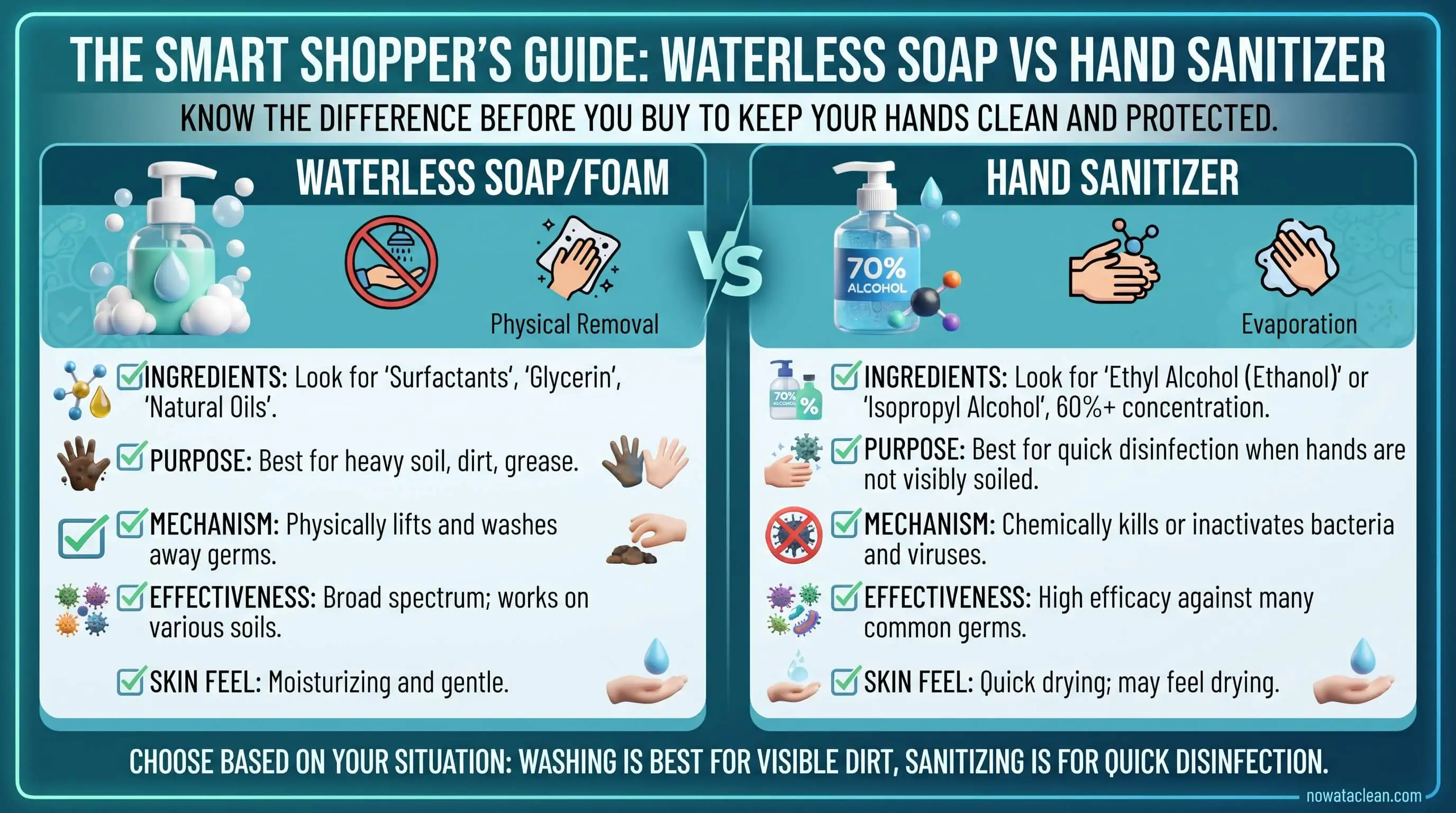
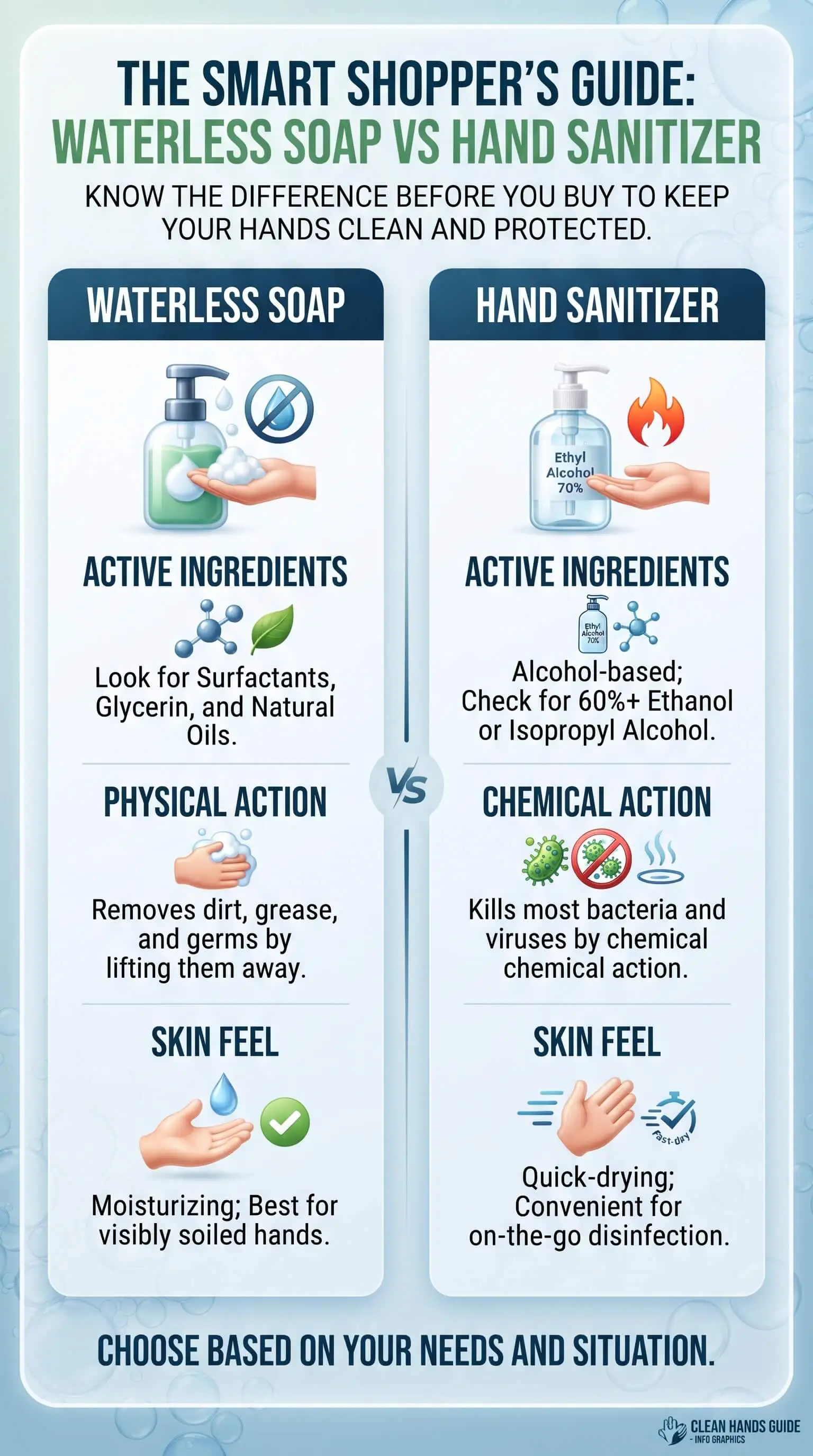
Waterless soap physically removes germs, dirt and oil from your hands without water. Hand sanitizer kills certain germs chemically and leaves the grime, and its own residue, behind. The label tells you which one you're holding.
How it works: Waterless soap lifts germs off the skin the way regular soap does. Sanitizer kills certain germs with alcohol or benzalkonium chloride.
What the label shows: Sanitizer carries a Drug Facts panel and should list at least 60% ethyl alcohol or 70% isopropyl alcohol. Waterless soap lists its ingredients and should say "removes," not "kills."
Dirty hands: Waterless soap handles visible grime, and sanitizer works poorly on it.
Kids and sensitive skin: An alcohol-free waterless soap skips alcohol's drying effect and the risk of a child swallowing it.
Best pick: Soap and running water whenever you can reach a sink. Waterless soap when you can't, with sanitizer as the backup.
Top Takeaways
The Drug Facts panel is the dividing line: sanitizer has one, most waterless soaps don't.
Sanitizer should list at least 60% ethyl alcohol or 70% isopropyl alcohol as its active ingredient.
Methanol or 1-propanol on a label means don't use it, and contaminated products don't always list them.
Waterless soap should say it removes germs. "Kills" on a cosmetic label is a red flag.
A named test method beats a bare percentage every time.
Sanitizer struggles on visibly dirty hands and against some viruses; waterless soap is built for grime.
Soap and running water still come first whenever they're available.
Waterless Soap vs Hand Sanitizer at a Glance
What it does: Kills certain germs on the skin
How it's regulated: OTC drug (FDA)
Where to look: Drug Facts panel
Number to check: At least 60% ethyl alcohol or 70% isopropyl alcohol
Alcohol: Usually yes; alcohol-free versions use benzalkonium chloride
Visibly dirty hands: Works poorly
Wording to expect: "Kills," "decreases bacteria"
Waterless soap
What it does: Lifts dirt, oil and germs off the skin
How it's regulated: Usually a cosmetic (FDA)
Where to look: Ingredient list and directions
Number to check: No single number; check cleansers and any named test method
Alcohol: Often alcohol-free
Visibly dirty hands: Built to remove grime
Wording to expect: "Cleans," "removes"
The sections below walk through each point.
Why the Two Labels Look So Different
The claim decides the label. Under FDA rules, a product meant to kill germs or treat a skin condition is a drug, and drugs must carry a Drug Facts panel. A product that only cleans is a cosmetic, or a true soap regulated by the Consumer Product Safety Commission, and it simply lists its ingredients.
So the panel itself is information. A waterless soap with no Drug Facts panel isn't allowed to say it kills germs. If it does, that's your first red flag.
How to Read a Hand Sanitizer Label
Find the Drug Facts panel first
Ignore the front of the bottle for a moment. Words like "advanced," "refreshing" or "with aloe" tell you nothing about strength. The Drug Facts panel on the back lists the active ingredient, purpose, uses, warnings and directions in the same order on every product.
Check the active ingredient and its percentage
The FDA says ethyl alcohol (often just "alcohol" on the label) should be at least 60%, and isopropyl alcohol at least 70%. Below that, the product may not work as intended.
Alcohol-free sanitizers usually list benzalkonium chloride as the active ingredient. It's a different class of antiseptic, so the panel looks different, but it's still a drug, and it still belongs in this category.
Watch for methanol and 1-propanol
Neither is an acceptable active ingredient. If either appears on the label, stop using the product. The catch: during the 2020 recalls, FDA testing found contaminated sanitizers often didn't list them at all. Buy from brands you recognize and check the FDA's list of hand sanitizers not to use.
Read the warnings like you mean it
Flammable. For external use only. Keep out of reach of children. That last one isn't boilerplate: a few swallowed mouthfuls of alcohol-based sanitizer can poison a small child.
What "Kills 99.9% of Germs" Does and Doesn't Mean
That number comes from lab tests on specific organisms, not on every germ your hands meet. Pathogens vary a lot in how they respond to alcohol. Some non-enveloped viruses, norovirus among them, hold up well against it.
Sanitizer also needs clean-ish skin to work. The Minnesota Department of Health notes it isn't effective when dirt, food or other organic matter is visible on your hands. And the CDC puts it plainly: soap and water remove all types of germs, while sanitizer kills certain germs. That's why a hand sanitizer alternative, such as waterless soap, is worth considering when removing dirt and grime is the priority.
Translation: 99.9% of the tested germs, on hands that weren't dirty to begin with.
How to Read a Waterless Soap Label
Start with the ingredient list
Ingredients appear in descending order by amount. Look for the cleansing agents, the surfactants, near the top, because they do the actual work. Then check the claims on the front against the list. "Alcohol-free" should mean no alcohol in the list. "Plant-based" should be backed up by what you see there.
Look for "removes," not "kills"
A well-made waterless soap works the way regular soap does: it bonds to dirt, oil and germs and lifts them off. Honest labels say exactly that. "Kills germs" on a product with no Drug Facts panel means the maker is claiming more than the label category allows.
Check for a named test method
A bare percentage is easy to print. A named standard is harder to fake. Look for the test protocol (ASTM E1174 is the standard for hand-cleansing products), the organisms tested and who ran the test. For a detailed look at what that testing shows, see this breakdown of how waterless soap compares with hand sanitizer on germ removal.
Read the directions and the fine print
The directions should tell you how much to use and what to do with it: rub, wipe, no rinse. A responsible brand will also say the product is for hand cleansing, not disease prevention. That line isn't a weakness. It's a sign the company knows the rules it's playing by.
Label Claims That Sound Better Than They Are
"Antibacterial": The FDA says there isn't enough evidence that OTC antibacterial soaps prevent illness better than plain soap and water.
"Natural" and "plant-based": Neither has a legal definition on personal care labels. The ingredient list is the proof.
"Hospital grade" and "dermatologist tested": Marketing phrases with no standard test behind them.
"FDA approved": Cosmetics aren't FDA approved, and most OTC sanitizers follow an FDA monograph rather than an individual approval.
Which Label Fits Your Situation
Hands visibly dirty or greasy: Soap and water first. Waterless soap next. Sanitizer last.
Kids and toddlers: An alcohol-free waterless cleanser removes the swallowing worry that comes with alcohol gels, though it still belongs out of reach.
Dry or eczema-prone skin: Alcohol dries skin. Check for fragrance-free, alcohol-free formulas.
Travel, camping and the car: Waterless soap handles grime with no sink; carry a sanitizer that meets the 60% mark as a backup.
Anywhere there's a sink: Use it. The CDC still ranks handwashing with soap and water first.
A 60-Second Label Checklist
Is there a Drug Facts panel? That tells you if it's a drug or a cleanser.
If it's a sanitizer, is the active ingredient at least 60% ethyl alcohol or 70% isopropyl alcohol?
Is methanol or 1-propanol anywhere on the label? Put it down.
Does a waterless soap say "removes" rather than "kills"?
Are the cleansing ingredients near the top of the list?
Is a test method named, not just a percentage?
Do the warnings and directions make sense for who will use it?
Essential Resources
1. CDC: Hand Sanitizer Guidelines and Recommendations
The baseline every other source builds on: when sanitizer is appropriate, why soap and water come first, and how to confirm the 60% alcohol minimum on the label. Read the CDC guidance
2. FDA: Is It a Cosmetic, a Drug, or Both? (Or Is It Soap?)
The clearest explanation of why a germ-killing claim turns a cleanser into a drug. Read this once and every label on the shelf makes more sense. Read the FDA explainer
3. FDA: Frequently Asked Questions on Soap
Defines what legally counts as "soap" and what makes a product a cosmetic or a drug instead. Useful for decoding waterless soap claims. Read the FDA soap FAQ
4. FDA: Skip the Antibacterial Soap; Use Plain Soap and Water
Explains why "antibacterial" on a soap label doesn't mean better protection, and how a Drug Facts panel reveals antibacterial ingredients. Read the FDA consumer update
5. FDA Insight: Hand Hygiene
The FDA's own numbers for effective sanitizer: at least 60% ethyl alcohol or 70% isopropyl alcohol, and why subpotent products fall short. Read the FDA Insight
6. Minnesota Department of Health: Cleaning Hands with Hand Sanitizer
A plain-language walkthrough of correct technique and the big limitation: sanitizer doesn't work on visibly dirty hands. Read the MDH guide
7. CPSC: Soap Business Guidance
Shows how true soaps, cosmetics and drugs split between regulators, and how claims like "moisturizing" or "kills germs" change a product's category. Read the CPSC guidance
Supporting Statistics
1. Handwashing cuts diarrheal illness by 23% to 40%
The CDC reports that handwashing education reduces diarrheal illness by 23% to 40% and respiratory illnesses like colds by 16% to 21% in the general population. That's why soap and water stays at the top of the list, and why a sanitizer label that hints it's "just as good" deserves a second look. See the CDC handwashing facts
2. 29 of 96 imported sanitizers tested contained methanol
In FDA laboratory testing of 96 imported hand sanitizers, 29 contained methanol above the agency's action level, at concentrations from 1.6% to 79.3%. Nearly all of those were also short on the ethanol their labels promised. It's the clearest case for buying known brands and reading the Drug Facts panel. See the FDA lab report
3. The FDA pulled 19 active ingredients from antibacterial washes
In 2016, the FDA gave manufacturers one year to remove 19 active ingredients, including triclosan and triclocarban, from consumer antibacterial washes. Makers hadn't shown the ingredients were safe for long-term daily use or more effective than plain soap and water. The "antibacterial" label promised more than the evidence delivered. See the RAPS report on the final rule
The public health principles behind the Clean Air Act reinforce the importance of making informed choices, including selecting hand hygiene products based on proven effectiveness, ingredient safety, and transparent labeling.
Final Thoughts and Opinion
The waterless soap vs hand sanitizer debate usually gets framed as a contest. We think it's a reading test. Both products have a job, and the label tells you which job each one was built for.
Sanitizer earns its place when your hands look clean and you need a quick germ-kill on the go, as long as the Drug Facts panel shows at least 60% ethyl alcohol and nothing suspicious. Waterless soap earns its place when your hands are actually dirty, when alcohol is a problem for little kids or dry skin, or when you want to remove grime rather than leave it behind with a layer of gel on top.
Our honest take: the brands worth trusting are the ones whose labels stay inside their lane. Clear active ingredients on the sanitizer. "Removes," a named test method and a plain disclaimer on the waterless soap. Products that oversell on the front usually underdeliver on the back.
And when there's a sink nearby, use it.
 Frequently Asked Questions
Is waterless soap better than hand sanitizer?
It depends on the job. Waterless soap removes dirt, oil and germs without alcohol, so it's the better pick for grimy hands, kids and dry skin. Sanitizer kills many germs quickly on hands that already look clean. When a sink is nearby, soap and water beat both.
Does waterless soap kill germs?
It's designed to remove germs, not kill them. That's the same way regular soap works. If a waterless soap claims to kill germs, it should carry a Drug Facts panel, because the FDA treats germ-killing claims as drug claims.
Why doesn't my waterless soap have a Drug Facts label?
Because it's sold as a cleanser, not a drug. Only products that claim to kill germs or treat a condition need a Drug Facts panel. A cosmetic cleanser lists its ingredients instead, and that's normal.
What percentage of alcohol should hand sanitizer have?
At least 60% ethyl alcohol or at least 70% isopropyl alcohol, according to FDA guidance. Read the number from the active ingredient line on the Drug Facts panel, not from the front of the bottle.
Is alcohol-free hand sanitizer the same as waterless soap?
No. Alcohol-free sanitizer still uses a germ-killing active ingredient, usually benzalkonium chloride, and it's regulated as an OTC drug. Waterless soap cleans by lifting dirt and germs off your skin, the way soap does.
Which is safer to keep around young kids?
Check the warnings on both. Alcohol-based sanitizer can poison a child who swallows a few mouthfuls. An alcohol-free waterless cleanser lowers that risk, but any hand-cleaning product belongs out of reach.
Read the Label Before You Reach for the Bottle
The next time you're choosing between waterless soap and hand sanitizer, give the label the 60 seconds it deserves. Turn the bottle over, find the panel or the ingredient list, and check the words the brand chose. Save the checklist above to your phone so it's there in the store aisle.
Want to see how the two compare once they're actually in your hands? Read the full side-by-side on how waterless soap compares with hand sanitizer on germ removal, then choose the product that fits the way your family really lives.